
Rome with kids is genuinely doable – but it requires a different plan than a standard adult trip. A toddler sleeping in a stroller inside a packed restaurant at midnight is a Tuesday in Rome. Nobody will glare at you if your baby cries – the waiter will probably try to make them laugh. At a fundamental level, Rome is one of the most welcoming cities in Europe for families.
The catch when visiting Rome with kids is the terrain. Rome is a 2,800-year-old city paved with sanpietrini – small square blocks of black basalt that are beautiful, historic, and the enemy of modern baby gear. The summer heat bouncing off ancient marble is physically punishing. Crowds around the major monuments are dense. If you try to push a standard stroller through the Vatican Museums at 1 PM on a Tuesday in August, your day will end badly.
Get the logistics right and it is one of the best family destinations on earth. This guide covers what actually works.
The Ground Problem: Strollers and Cobblestones
Before anything else, sort your transport situation. Rome’s sanpietrini will destroy cheap plastic wheels within two days. Many sidewalks in the historic center either do not have curb cuts, end abruptly, or are too narrow for a standard stroller.
A lightweight umbrella stroller with small wheels will not survive. If you need a stroller, you need one with large, air-filled rubber wheels and genuine suspension. The better solution for babies and toddlers is a high-quality ergonomic carrier – it bypasses the cobblestones entirely, fits into narrow restaurant aisles, and lets you climb monument stairs without asking strangers for help.
For older children (5-10), set expectations early. You will clock 15,000-20,000 steps a day. Break the city into small neighborhood blocks. Do not attempt to walk from the Vatican to the Colosseum in one afternoon.
For the full logistics picture – transport, ticketing, and what to pack – our first time in Rome guide covers the essentials.

The Colosseum: The Must-See Rome with Kids Sight
Tell a child they are going to Rome and they immediately want to see the Colosseum. A massive broken arena where gladiators fought wild animals is not a hard pitch. Getting inside is the challenge.
Tickets
The ticketing system for the Parco Archeologico del Colosseo changed significantly post-2020. You cannot walk up and buy on the day. Book timed-entry tickets online – in peak season, aim for at least 3-4 weeks in advance on the official government site. Tickets are nominative: you must enter every family member’s name when booking and bring physical passports to the gate. Mismatched names mean no entry.
Under-18 entry is free for EU citizens at all state-run sites. You still need to “book” a free €0.00 ticket online and show a passport at the gate to prove age.
Skip the Underground Tour with young kids
Every parent thinks they need to book the underground tour to see where the animals were kept. Do not do this with children under 12. These tours involve standing still while a guide discusses architectural foundations for 45 minutes. Kids disengage immediately. Buy standard general admission, let them see the arena floor from the stands, take the photos, and leave while they are still excited.
The Roman Forum – the giant sandbox
Your Colosseum ticket includes the Roman Forum and Palatine Hill next door. For children, the Forum feels like an interactive archaeology site – massive fallen columns to sit on, strange ruins to explore, open space to move around.
The problem: zero shade. In July the Forum is a bright, dusty oven. Do this section at 9:00 AM maximum. Bring hats, sunscreen, and water. By 11 AM it becomes punishing.


The Vatican: Two Options
The Vatican Museums operate like a one-way congested corridor. During normal hours, the Gallery of Maps is a dense shuffle of thousands of people with no air conditioning. A small child’s entire field of vision will be the backs of strangers’ knees.
If you want the Sistine Chapel
Pay for an early access tour through a reputable third-party operator. These get you inside at around 7:30 AM, an hour before general admission. You can walk straight to the Sistine Chapel in relative quiet and leave before the tour buses arrive. This costs significantly more than standard admission but is the only way to do it comfortably with children.
On a tight budget or with unpredictable toddlers – skip the museums. It is not worth the stress.
St. Peter’s Basilica – the better option
Free to enter. The scale of the largest church in the world is enough to genuinely awe any child. Join the security line in the piazza – it moves reasonably fast.
If your kids have energy: pay to climb the Cupola. An elevator takes you halfway, then 320 narrow, sloping stairs to the top. The view over the Vatican gardens and the entire city is the payoff. Children love the physical challenge of the climb. Ticket: €8 by stairs only, €10 with elevator.
Our 3 days in Rome itinerary structures the Vatican into a manageable full day that works for families.


Food: The Rules That Save You
Feeding children in Italy is the easiest parenting task of the trip. The cuisine is carbohydrates, tomatoes, and cheese. The problem is the tourist trap density around major monuments.
How to spot bad gelato
You will buy gelato at least once a day. It is your primary negotiating tool with tired children. Roughly 80% of gelaterias near major monuments sell industrial powder mixed with water.
Two tests your kids can help with:
- Color: Neon green pistachio is fake. Real pistachio is an ugly muddy brownish-green. Bright yellow banana is fake. Real banana is greyish-white.
- Shape: Gelato whipped into towering fluffy mountains is pumped with chemical stabilizers and air. Real gelato artigianale is dense and kept flat in metal tubs, often under lids.
Pizza al Taglio – the ideal family lunch
Do not sit down at a formal restaurant for lunch with children. It takes too long and they will get restless.
Pizza al Taglio (pizza by the slice) is Rome’s best invention for families. Walk into a small shop, point at the rectangular trays of pizza behind the glass, hold up your fingers for how big a slice you want. They cut it with scissors, weigh it, heat it, and wrap it in paper. You eat it on a nearby bench. Fast, cheap, fully customizable for picky eaters. For the best spot near the historic center, Antico Forno Roscioli near Campo de’ Fiori is the standard. For more on eating well in Rome without getting taken, see our foodie’s guide to Rome.
Supplì – order these at the pizza shop
While at the pizza counter, look for small fried cylinders: supplì. These are rice mixed with tomato sauce and meat, stuffed with a core of mozzarella, and deep-fried. Bite into one and the cheese pulls out like a wire – hence the traditional name supplì al telefono. Children are reliably obsessed with the cheese pull. Cost: around €2 each.
The coperto
When the bill arrives, do not panic at a charge of €2-3 per person. This is the coperto – a cover charge for the bread, tablecloth, and tableware. It is legal and standard. Because of the coperto, a 20% tip is not expected. Leaving a few euros on the table is enough.


Water and Bathrooms
The nasoni
Do not buy bottled water from street vendors. Rome has over 2,500 free public water fountains called nasoni (big noses) fed directly from mountain aqueducts. The water is cold, clean, and constantly tested. Bring insulated metal bottles for everyone and refill for free all day.
Show your kids the local trick: plug the main spout at the bottom with your finger and a perfectly arched stream shoots out of a small hole on top, creating a built-in drinking fountain.

Bathrooms
The unwritten rule: you must be a customer to use a business’s bathroom. When your child announces an emergency, walk into the nearest bar or cafe, go directly to the cash register, pay €1.50 for un caffè, drink it in one gulp at the counter, then ask “Dov’è il bagno?” You have bought your child the right to use their toilet. Do not ask for the bathroom before ordering.
Parks: Your Recovery Zones
You cannot look at ancient stones for 12 hours straight. Children will reach a wall. When that happens, deploy the parks.
Villa Borghese
A sprawling park above the Spanish Steps, formerly the private estate of a cardinal. For families, the rental kiosks scattered around the park offer four-wheeled pedal carts with a canopy – you pedal, kids sit in the front basket. You cover the entire park in an hour without anyone complaining about tired legs.
The small artificial lake near the Pincio Terrace has wooden rowboats to rent. The Palacio de Cristal equivalent here is the Tempietto di Aesculapio – a small Neoclassical temple on an island in the lake, reached by a footbridge.
Piazza Navona at 7:30 PM
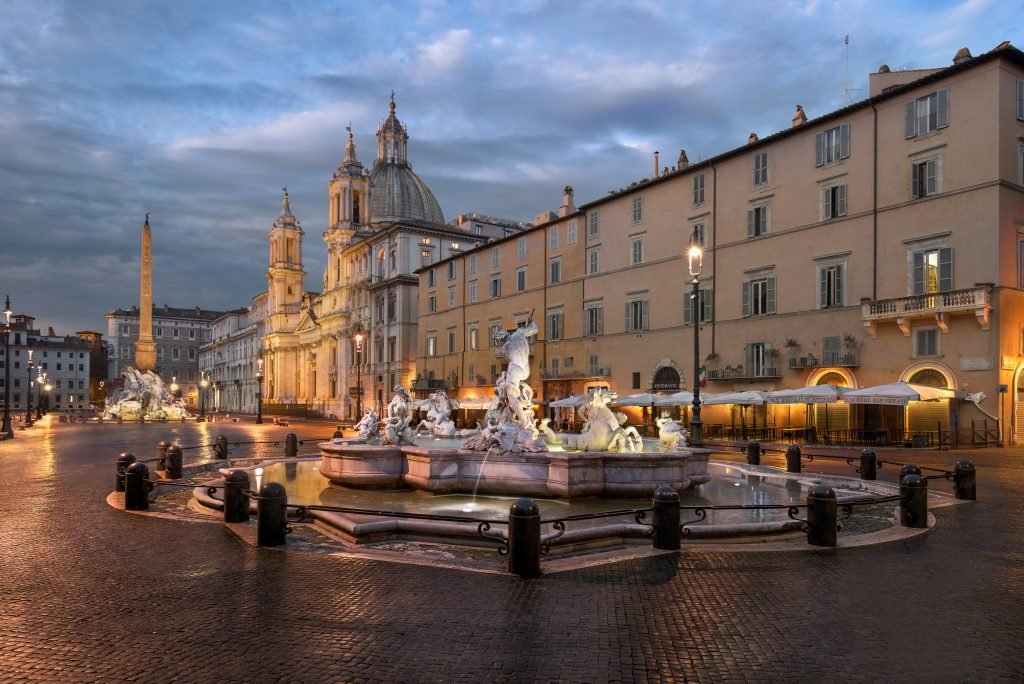
At noon, Piazza Navona is a crowded tourist area. At 7:30 PM in summer, it transforms. The temperature drops, Bernini’s fountains are lit, street musicians and magicians set up across the enormous pedestrian square. Buy gelato, find a spot on the edge of a fountain, and let younger children run freely in a large open space while the city settles into the evening.

Is public transport stroller-friendly?
No. Historic center buses are crowded and boarding with a large stroller during busy hours is difficult. The Metro has elevator problems at many central stations – Line A stops like Spagna and Barberini have unreliable lift access. Use a carrier, walk, or take official white city taxis for longer distances when needed. For transport logistics in detail, our rome on a budget guide covers the cheapest and most practical ways to move around.
Can we take kids to dinner late?
Yes, without any awkwardness. It is completely normal in Italy to see toddlers at restaurant tables at 9:30 PM. Waiters will interact with them, bring food quickly, and nobody will look twice at a slightly loud child.
Do children get free entry to monuments?
At state-run archaeological sites – the Colosseum, Roman Forum, Baths of Caracalla – entry is free for all children under 18 regardless of nationality. You must still book a free €0.00 ticket online and show a passport at the gate.
Are there changing tables?
Rarely. Traditional trattorias and small cafes in the historic center simply do not have the space. Plan to use benches in quieter piazzas, or seek out larger department stores like La Rinascente on Via del Tritone, which have proper facilities.
Best neighborhood to stay in with a family?
Three solid options: Prati (near the Vatican, flat wide sidewalks, quiet residential feel, good Metro access), Centro Storico near the Pantheon (central enough to walk back for afternoon naps, expensive but very convenient), or Trastevere (good food directly downstairs, pedestrian-friendly lanes, but can be loud on weekend nights). Avoid the immediate area around Termini station. For a full breakdown, our 5 days in Rome itinerary includes neighborhood guidance built around how families actually move through the city.