
The 25 best things to do in Granada are not what the travel brochures suggest – they make the city look like a quiet, serene museum dedicated entirely to the Alhambra. This is a massive misrepresentation. The reality of Granada is that it is a loud, fiercely independent, heavily caffeinated university town wrapped in the ancient, crumbling architecture of the last Moorish empire in Europe.
Because of its geographical isolation at the foot of the Sierra Nevada mountains, Granada did not fall to the Catholic Monarchs until 1492. It held onto its Islamic identity centuries longer than the rest of Spain. Today, the city is a jarring, beautiful collision: you can walk out of a heavy, incense-filled Catholic cathedral and immediately step into a narrow medieval alley that smells like Moroccan mint tea and roasted lamb.
Before you attempt to conquer this list, you need to understand that Granada is physically punishing. The historic neighborhoods are built on impossibly steep hills paved with jagged river stones. You cannot just “wing it” here. I highly recommend reading my First Time in Granada: The Ultimate 2026 Survival and Travel Guide to understand how the local minibus system works, and referencing my guide on Where to Stay in Granada: Best Areas & Hotels for First Timers (2026) so you don’t accidentally book a hotel that requires a 30-minute uphill hike with your luggage.
Once your logistics are sorted, here are the 25 absolute best things to do in Granada, brutally filtered to help you avoid the tourist traps. This list includes the 25 Best Things to Do in Granada.
Part 1: Conquering the Alhambra Complex
The Alhambra is not a single building; it is a sprawling hilltop fortress city. Do not attempt to see all of this in one hour. If you are structuring your 3 Days in Granada: The Perfect Itinerary for First Timers (2026 Edition), dedicate an entire, unhurried morning to this hill.
1. The Nasrid Palaces (Palacios Nazaríes) This is the main event, and it is the most heavily restricted monument in Spain. You must book your ticket months in advance, and you must enter at your exact, specific time slot with your physical passport in hand. Once inside, you will walk through the absolute zenith of European Islamic architecture. The rooms are covered floor-to-ceiling in mind-boggling, geometric stucco arabesques, Arabic calligraphy praising God, and intricately carved wooden ceilings. The centerpiece is the legendary Court of the Lions, featuring an alabaster fountain supported by twelve marble lions.

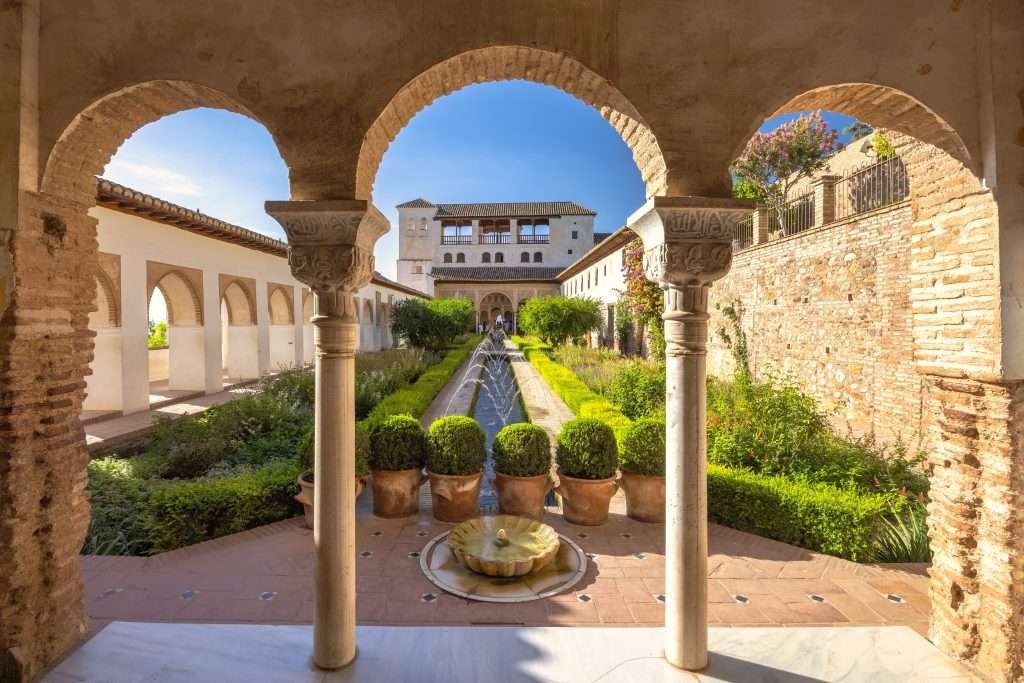
2. The Generalife Gardens Located on a slightly higher hill adjacent to the main fortress, the Generalife was the summer retreat for the Nasrid sultans. It is a masterpiece of landscape architecture designed to provide relief from the brutal Andalusian summers. The long, rectangular Patio de la Acequia features a mesmerizing, constant flow of water arcing over blooming flower beds and perfectly manicured hedges.
3. The Alcazaba This is the oldest and most imposing part of the Alhambra complex. It is the raw, military fortress that sits at the very tip of the Sabika hill, designed to protect the palaces behind it. You will walk through the exposed foundations of the old military barracks and climb the steep steps of the Torre de la Vela (The Watchtower). The panoramic view from the top of this tower gives you an unmatched 360-degree look at the Albaicín neighborhood, the modern city, and the snow-capped Sierra Nevada mountains.

4. The Palace of Charles V (Palacio de Carlos V) After the Catholic reconquest, the Holy Roman Emperor Charles V decided he wanted a home on the Alhambra grounds. He smashed down part of the Moorish architecture and dropped a massive, heavy, blocky Renaissance palace right in the middle of the delicate Islamic city. It looks completely out of place from the outside, but walking into the perfectly circular, colonnaded inner courtyard is an acoustic and architectural marvel. (Bonus: Entry to this specific building is completely free).
