
Most travelers arriving in southern Spain make a fundamental miscalculation: they treat Granada as a quick, passing thought. They book a hotel in Seville or the coastal resorts of Malaga, wake up at 6:00 AM, endure a three-hour bus ride, spend two hours sprinting through the Alhambra in the blistering heat, buy a cheap magnet, and get back on the bus.
This is an absolute tragedy.
Granada is not a day trip; it is an entirely different world. Set against the dramatic, snow-capped peaks of the Sierra Nevada mountains, it was the final stronghold of the Moorish empire in Spain, only falling to the Catholic Monarchs in 1492. Because of this, the city does not feel entirely European. It is a wildly intoxicating collision of Islamic architecture, narrow medieval alleys, heavy Catholic incense, bohemian street art, and the raw, percussive energy of gypsy flamenco.
Furthermore, Granada operates on its own unique economic and cultural frequency. It is a massive university town, which means it boasts a chaotic, youthful energy and fiercely protects the greatest dining tradition left in Europe: the free tapas culture.
If you try to apply standard European travel logic here, you will end up exhausted, lost in a maze of vertical cobblestones, and turned away at the gates of the monuments. This comprehensive guide is designed to teach you how to navigate the hills, hack the ticketing systems, and completely surrender to the rhythm of the city during your first time in Granada.
Chapter 1: The Alhambra Crisis (And How to Secure Tickets)
We must start with the elephant in the room. The Alhambra is not just a palace; it is a sprawling, heavily fortified hilltop city that represents the absolute zenith of Islamic art and architecture in Europe. It is also the most visited monument in Spain, and its ticketing system is a logistical nightmare for first-timers.
The Reality of 2026 Ticketing You cannot walk up to the Alhambra ticket booth and expect to get in. You cannot book a ticket three days before your trip. During the spring and autumn high seasons, general admission tickets sell out months in advance. If you are building a 3 Days in Granada: The Perfect Itinerary for First Timers, securing this ticket dictates the exact dates of your entire vacation.
You must go to the official website (Patronato de la Alhambra y Generalife) the absolute moment your flights are booked.
The Nasrid Palaces Time Slot When you buy your ticket, you will be forced to select a specific time (e.g., 10:30 AM). This time slot is not for entering the main Alhambra grounds; it is strictly for entering the Nasrid Palaces (the spectacularly intricate royal residence featuring the famous Court of the Lions).
The guards are ruthlessly strict. If your ticket says 10:30 AM and you arrive at 10:41 AM, the barcode scanner will flash red, the turnstile will lock, and you will be denied entry. There are no refunds, no arguments, and no exceptions. Because the Alhambra grounds are massive, you must enter the main complex at least 45 minutes before your Nasrid Palace time slot just to walk to the palace entrance line.
The Original Passport Rule Here is a relatively new rule that ruins hundreds of vacations every week: your ticket is strictly nominal. When you purchase it, you must enter your passport number. When you arrive at the gates of the Nasrid Palaces, you must present your original, physical passport. A paper photocopy will not work. A photo on your phone will not work. A driver’s license from your home country will not work. If you leave your passport in your hotel safe, you will not get in.
(If you completely failed to secure a ticket in advance, there are a few emergency loopholes you can exploit, which I break down in detail in my 25 Best Things to Do in Granada: The Ultimate 2026 Guide).
Chapter 2: Arrival Logistics and The Malaga Loophole
Granada is geographically isolated by mountains, which makes getting there slightly more complicated than navigating the flat plains of central Spain.
The Airport Reality Granada has an airport (Federico García Lorca Granada-Jaén Airport – GRX), but it is tiny. It primarily handles a few domestic flights from Madrid and Barcelona. International flights here are incredibly rare and highly expensive.
The Malaga Loophole The smartest logistical move for 90% of international travelers is to fly into Malaga (AGP). Malaga is the massive transit hub of the south. From the Malaga airport, you can walk directly out of the terminal, board an ALSA high-speed bus, and be dropped off at the Granada bus station in exactly 2 hours. If you are executing a larger Andalusian road trip, definitely read my First Time in Malaga: The Only Guide You Need (2026) to understand how to link these two cities perfectly.
Arriving by Train (AVE) If you are coming from the capital, the high-speed AVE train will rocket you from Madrid to Granada in about 3.5 hours. It is comfortable, quiet, and highly efficient.
Getting from the Stations to the Center Both the main train station and the ALSA bus station are located outside of the walkable historic center. Do not attempt to walk to your hotel from the stations, especially if your hotel is in the hills.
When you exit the train or bus station, ignore the aggressive private taxi touts. Walk to the official taxi rank (the white cars with a green stripe) and get in. A ride to the city center uses a metered fare and will typically cost between €8 and €12. Alternatively, you can take the local red city buses (Lines 21 or 33) which drop you right on Gran Vía (the main downtown artery) for under €2.
Chapter 3: The Topography of Exhaustion (Where to Base Yourself)
Granada is not flat. It is a city defined by extreme elevation changes. Choosing the wrong neighborhood for your physical fitness level will result in a miserable vacation.
The Albaicín (The Ancient Arab Quarter) The Albaicín is the most romantic, visually stunning neighborhood in the city. Located on the hill directly across from the Alhambra, it is a labyrinth of blindingly white houses, secret gardens (cármenes), and narrow, winding alleyways. The Warning: Cars cannot enter the vast majority of this neighborhood. The streets are paved with jagged river stones (empedrado). If you book a romantic Airbnb deep in the Albaicín, a taxi will drop you off at the bottom of the hill, and you will be forced to drag your 50-pound rolling suitcase up a 30-degree incline over jagged rocks for twenty minutes. Base yourself here only if you pack light in a backpack and have strong knees.

Centro (The Historic Center) If you value logistics and comfort, stay in the flat, commercial heart of the city around the Cathedral and Plaza Nueva. You are completely immune to the punishing hills, you are surrounded by the city’s best tapas bars, and you have immediate access to the public transit lines that run up to the Alhambra.
Realejo (The Old Jewish Quarter) Located at the foot of the Alhambra hill, Realejo is the hipster, bohemian heart of Granada. It is heavily populated by university students and covered in spectacular, massive street art murals (many painted by the famous local artist “El Niño de las Pinturas”). It is slightly quieter than the Centro but still offers a relatively flat walk to the main sights.
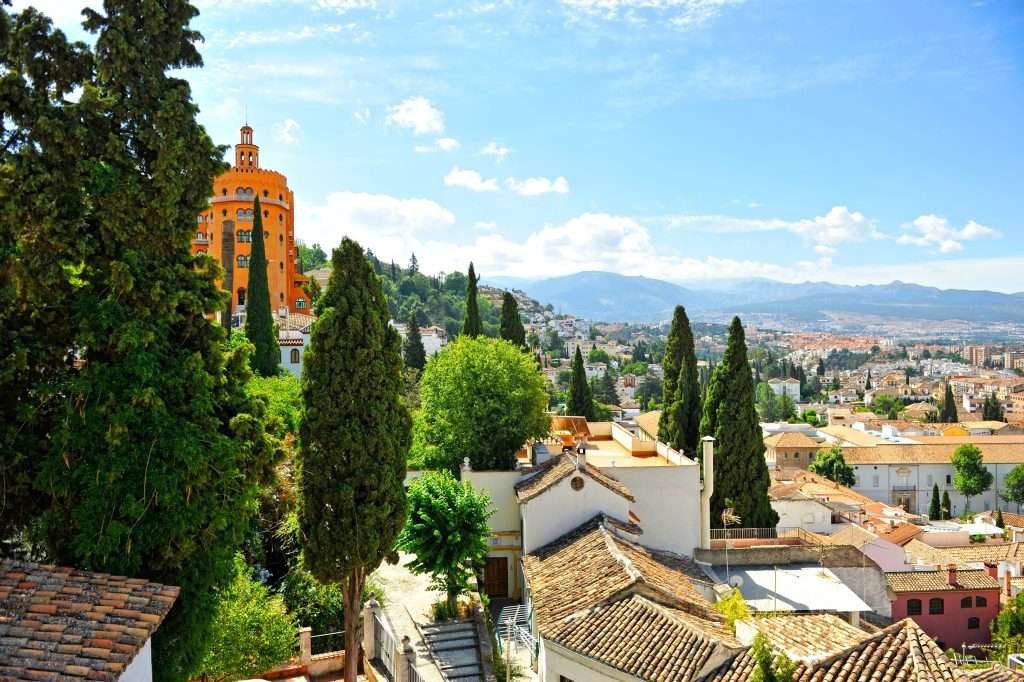
To ensure you don’t book a hotel next to a noisy nightclub or at the top of an impossible hill, pull up my neighborhood-by-neighborhood map in Where to Stay in Granada: Best Areas & Hotels for First Timers (2026).
Chapter 4: The Golden Economy of Free Tapas
In Madrid, you pay for your tapas. In Barcelona, you pay for your tapas. In Granada, tapas are an unalienable human right, and they are completely free.
This centuries-old tradition is the cornerstone of local social life. If you understand the rules, you can eat like a king for the price of a few beers. This makes the city an absolute paradise if you are utilizing the strategies in my Granada on a Budget: The Ultimate Money-Saving Guide (2026).
How the Tapas Economy Works
- You walk into a loud, crowded bar. You do not sit at a table; you stand at the bar or lean against a high barrel.
- You order a drink. This is usually a caña (a small draft beer, almost always the local Alhambra brand), a glass of tinto de verano (red wine mixed with lemon soda), or a standard soda.
- The bartender brings your drink, and along with it, they drop a plate of food in front of you. This is your free tapa.
- You do not get to choose the food. The kitchen makes whatever they are making, and you eat what you are given. (A few modern bars will hand you a menu to pick your free tapa, but traditional spots dictate the terms).
The Escalation Rule The true magic of Granada is the escalation. When you order your first drink, your free tapa will be simple-perhaps a plate of olives, some local cheese, or a slice of Spanish omelet (tortilla).
When you finish and order a second round of drinks, the bartender notes that you are staying. The second free tapa will be an upgrade-maybe a small plate of fried fish, a mini burger, or some meatballs. If you stay for a third round, the food becomes a main course-a plate of paella, a massive sandwich, or fried calamari.
By the time you have consumed three €2.50 beers, you have essentially eaten a massive, multi-course dinner for €7.50.
The Beginner’s Mistake Do not sit down at 8:00 PM and immediately order a ración (a large, paid portion of food from the menu). If you do this, you will ruin the free tapas rhythm, overspend, and be completely stuffed within 20 minutes. Pace yourself. Order a drink. Wait for the food. If you are still hungry after three bars, then order a paid portion.
(For a highly curated list of the absolute best, most generous traditional bars to hit on your evening crawl, bookmark my master guide: What to Eat in Granada: The Ultimate Foodie Guide (2026 Edition)).
Chapter 5: Surviving the Hills (The Minibus Hack)
Because the Alhambra is on one massive hill, and the Albaicín and Sacromonte neighborhoods are on another, your legs will take a brutal beating.
You must learn to use the red Alhambra minibuses.
These tiny, aggressive red buses are the only vehicles capable of navigating the impossibly tight, winding medieval streets of the high neighborhoods. They operate from a main hub at Plaza Nueva.

- C30 & C32: These lines will take you up the steep, wooded hill directly to the main ticket gates of the Alhambra.
- C31 & C34: These lines plunge deep into the Albaicín and Sacromonte.
If you want to watch the sunset from the famous Mirador de San Nicolás (the spectacular viewpoint in the Albaicín that looks directly across the gorge at the Alhambra), do not hike up the hill in the 35°C (95°F) heat. Take the C31 bus up, buy a cold beer from a street vendor, watch the Alhambra turn burning red in the fading light, and then enjoy a leisurely, downhill walk back to the city center.
Chapter 6: Flamenco and the Caves of Sacromonte
To the east of the Albaicín lies the Sacromonte neighborhood. For over 500 years, this area has been home to Granada’s Roma (Gypsy) community. Instead of building houses, the residents carved homes directly into the soft rock of the hillside.
Sacromonte is the birthplace of the Zambra, a highly specific, passionately raw variation of flamenco that is danced barefoot in the caves, originally performed during gypsy wedding celebrations.
The Tourist Trap Warning Because the caves are world-famous, an entire industry of terrible, overpriced tourist traps has sprung up. If a man in the street tries to sell you a €50 ticket for a “cave show with dinner” and promises a massive, air-conditioned bus will pick you up, turn around and walk away. The food at these venues is universally terrible, and the flamenco is a soulless, choreographed routine designed for mass consumption.
Finding the Authentic Experience Authentic flamenco in Sacromonte should be intimate, sweaty, and emotionally intense. You want a venue (tablao) that holds no more than 30 to 40 people. Look for respected, historical caves like Cueva de la Rocío or Zambra María la Canastera. Do not buy the dinner package. Buy the ticket that only includes a drink and the show. Eat your free tapas in the city center beforehand, take a taxi up the dark hill to the cave, and let the acoustic guitar and the stamping heels completely break your heart.

(If you plan to head west after Granada, you will find a totally different, more polished style of flamenco in the Andalusian capital. I explain the differences in my First Time in Seville guide).
Chapter 7: The Moroccan Tea Houses
Because Granada held onto its Moorish identity centuries longer than the rest of Spain, the Islamic influence is still heavily woven into the modern fabric of the city.
Nowhere is this more apparent than on Calle Calderería Nueva.
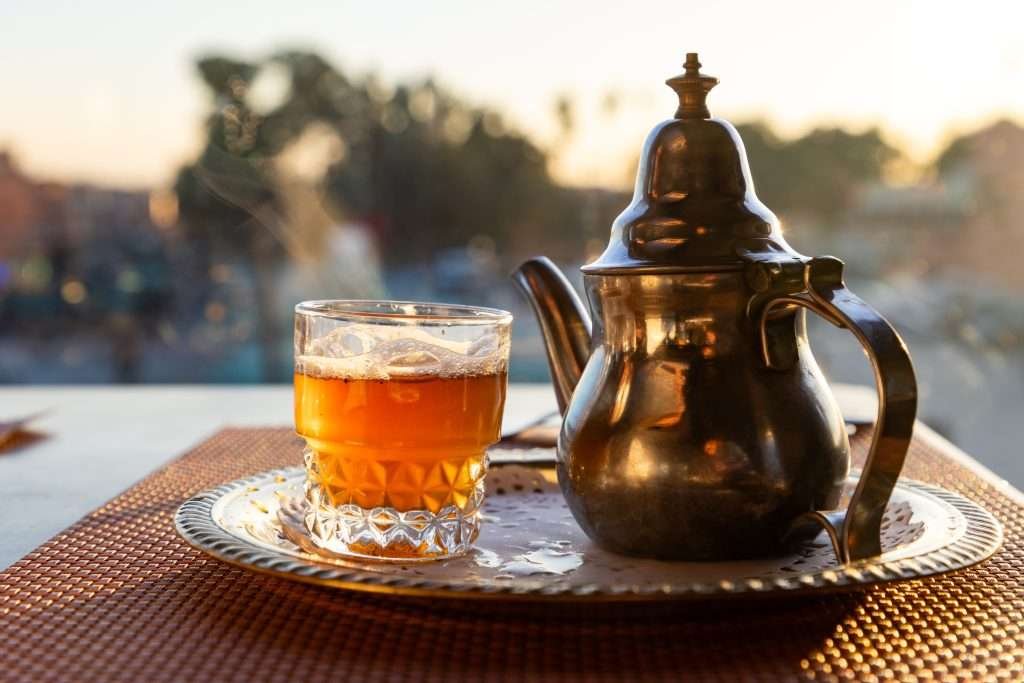
Located in the lower Albaicín, this pedestrian street feels like you have instantly teleported to a souk in Marrakech. The air is thick with the smell of sweet tobacco and spices. The street is lined with teterías (traditional Arab tea houses).
When the afternoon siesta shuts down the retail stores (roughly between 2:00 PM and 5:00 PM), retreat to one of these tea houses. Step out of the sun, sit on a low, velvet-cushioned floor seating area, and order a pot of hot Moroccan mint tea poured from high above into tiny glass cups. Pair it with heavily honeyed, almond-stuffed baklava. It is the ultimate cultural reset button before your evening tapas crawl begins.
Final Thoughts on Your First Time
Granada is a city that demands a bit of friction. You will definitely get lost in the Albaicín. You will probably accidentally order a plate of fried pig intestines because you didn’t understand the Spanish menu. You will definitely have sore calves from the cobblestone hills.
But if you embrace the friction, you will understand why the Moorish kings wept when they were finally forced to surrender the city.
(And if you are finishing your Spanish tour by heading up to the capital, ensure you check out my First Time in Madrid guide so you don’t accidentally order a sangria in the wrong plaza!).
Do I need to bring my actual passport to the Alhambra?
Yes, absolutely. This is the most common mistake tourists make. Your Alhambra ticket is linked to your passport number, and the guards at the Nasrid Palaces will scan your physical, original passport. A paper photocopy or a photo on your phone will result in you being denied entry.
Are tapas really free in Granada?
Yes! Granada is one of the last major cities in Spain that strictly adheres to the free tapas culture. Whenever you order a drink (beer, wine, or a soft drink) at a traditional bar, the bartender will automatically bring you a small plate of food at no extra cost.
Is Granada a walkable city?
The historic center (Centro) and Realejo are relatively flat and highly walkable. However, the Albaicín and Sacromonte neighborhoods are located on steep, jagged cobblestone hills and are largely inaccessible to cars. If you have mobility issues, you must rely heavily on the red Alhambra minibuses to get around the hills.
How many days should I spend in Granada?
For a first-time visitor, you need a minimum of two full days. Day one should be entirely dedicated to the massive Alhambra complex and a tapas crawl. Day two should be spent exploring the Albaicín, watching the sunset at the Mirador de San Nicolás, and watching a flamenco show in the caves of Sacromonte.
What is the best way to get to Granada from the airport?**
While Granada has a tiny airport (GRX), most international travelers fly into the massive Malaga Airport (AGP). From the Malaga airport, you can take a highly efficient, air-conditioned ALSA bus that drives directly to the Granada bus station in exactly two hours.