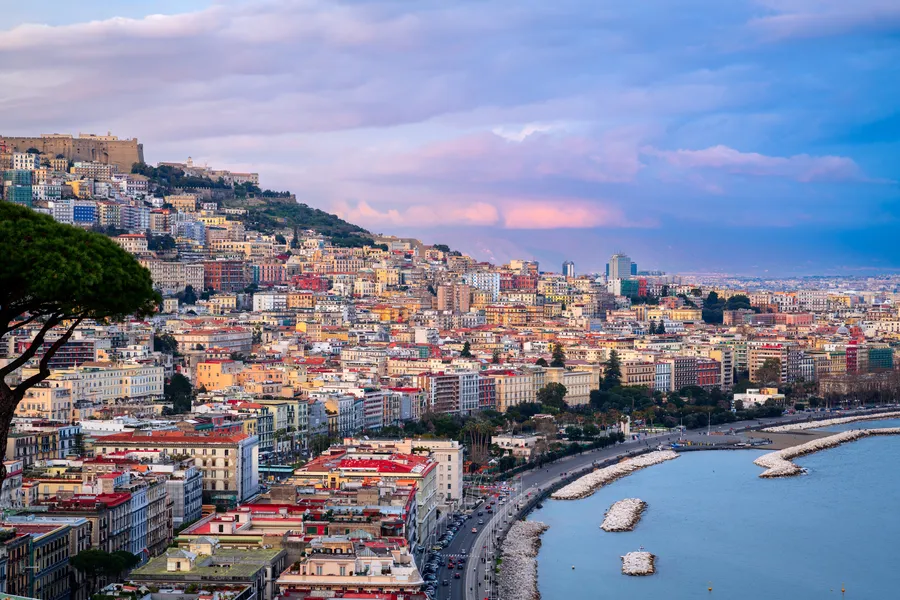
For decades, international tourists have treated Naples as an inconvenience – a chaotic, slightly intimidating transit hub you endure to catch a ferry to Capri or a train to Pompeii. Travel agents would routinely warn visitors to skip the city entirely, citing rumors of mafia violence, uncollected trash, and aggressive traffic.
Here is the truth: skipping Naples is the single biggest mistake you can make on an Italian itinerary.
Rome is an open-air archaeology park. Florence is a Renaissance museum with a city attached. Naples is neither. It is loud, covered in graffiti, and the traffic laws are treated as mild suggestions. It is also home to the best pizza on the planet, underground catacombs that most tourists never find, and a population that lives at a volume and intensity you will not encounter anywhere else in Europe.
Visiting Naples requires a shift in mindset. You cannot apply standard Northern European or American expectations here. Things will be delayed. Scooters will brush past your elbows in narrow alleyways. You will eat dinner at 9:30 PM. Adjust to the rhythm of the city and your first time in Naples will change how you think about travel. This guide shows you exactly how to navigate it.


1. Safety: What’s Real and What’s Myth
The Camorra myth
Many first-time visitors arrive worried about the local mafia. The reality of organized crime in southern Italy has zero crossover with the tourism industry. You will not see it, experience it, or be a target. Violent crime against tourists in Naples is statistically rarer than in many major American cities.
The actual risks: pickpockets and scooters
Your wallet is more at risk than your person. Pickpockets operate in specific locations – the Circumvesuviana commuter train to Pompeii and Sorrento, the platform at Napoli Centrale, and the dense crowds of the Spanish Quarters. Keep your phone out of your back pocket. Wear a cross-body bag and keep your hand resting on it in crowded areas.
The other genuine hazard is traffic. Scooters use narrow, supposedly pedestrian-only alleyways as standard routes. Keep your head up, do not step backward suddenly while taking a photo, and walk purposefully through tight streets.


2. Arrival Logistics
From Naples Airport (Capodichino – NAP)
Capodichino is close to the city center – about 6km north of the historic district. Do not walk straight to the taxi rank.
Take the Alibus – the official airport shuttle. It departs from directly outside arrivals every 15-20 minutes. Tickets cost ~€5, payable at the machine near the bus stop or by tapping a contactless card on the reader when you board. The Alibus makes two stops: Napoli Centrale (the main train station) and Molo Beverello (the ferry port for Capri and Ischia). Journey time is 15-25 minutes depending on traffic. Air-conditioned, reliable, straightforward.
Arriving by high-speed train from Rome
You step out into Napoli Centrale. The station itself is modern and safe. The square immediately outside – Piazza Garibaldi – is chaotic, loud, and packed with street vendors selling counterfeit electronics. It is safe during the day, but do not loiter. Keep your luggage close, ignore anyone trying to hand you something or “help” with your bags, and walk directly to the Metro downstairs or the official taxi rank outside.
Taking a taxi
Only use official white cabs at designated taxi ranks. Never accept a ride from someone whispering “Taxi?” inside the terminal. Naples has fixed rates (tariffe predeterminate) for common tourist routes. Before your luggage goes in the trunk, say: “Tariffa predeterminata per il centro, per favore” (Fixed rate for the center, please). If you do not ask for this before the ride starts, they will use the meter, which costs more in heavy traffic.


3. Getting Around the City
Crossing the street
In London or Munich, you wait for the green man and cars stop. In Naples, pedestrian crossings are decorative. If you wait for traffic to organically stop, you will wait indefinitely.
To cross like a local: step off the curb and walk at a slow, steady, predictable pace into the traffic. Do not run. Do not stop mid-road. Make eye contact with approaching drivers. They will not stop, but they will swerve around you. It takes two attempts to feel normal.
Metro Line 1 (The Yellow Line)
This is the tourist workhorse. It runs through the historic center, up to the hills, and down to the train station. It is also known as the “Art Metro” – every station was designed by a contemporary artist. Get off at Toledo station at least once. It is covered floor to ceiling in blue mosaic tiles and feels like descending into the ocean.
The Funiculars
Naples is built on a steep incline. The Funicolare Centrale takes you from the chaotic downtown up to the Vomero neighborhood in minutes – saving a long, punishing uphill walk. Use it.

4. Where to Stay: Neighbourhood Breakdown
Centro Storico (Historic Center)
The ancient heart of the city, built around Spaccanapoli – a dead-straight street that cuts Naples in half. If you stay here, you are sleeping in buildings that have stood since the Roman Empire, steps from the best pizzerias in the world. The drawback: it is intensely loud. The streets are narrow canyons, church bells ring constantly, and scooters run past your window at 2:00 AM. Right choice if you want maximum history and energy. Wrong choice if you need quiet.
Quartieri Spagnoli (The Spanish Quarters)
A grid of steep, narrow alleyways draped in drying laundry. Once avoided by tourists, now a hub of street food, small trattorias, and some of the best people-watching in the city. It is also the epicenter of the Diego Maradona cult – shrines to the footballer cover nearly every corner (more on that below). The drawback: steep hills and alleys that feel tight if you are prone to claustrophobia.
Chiaia and the Lungomare (Waterfront)
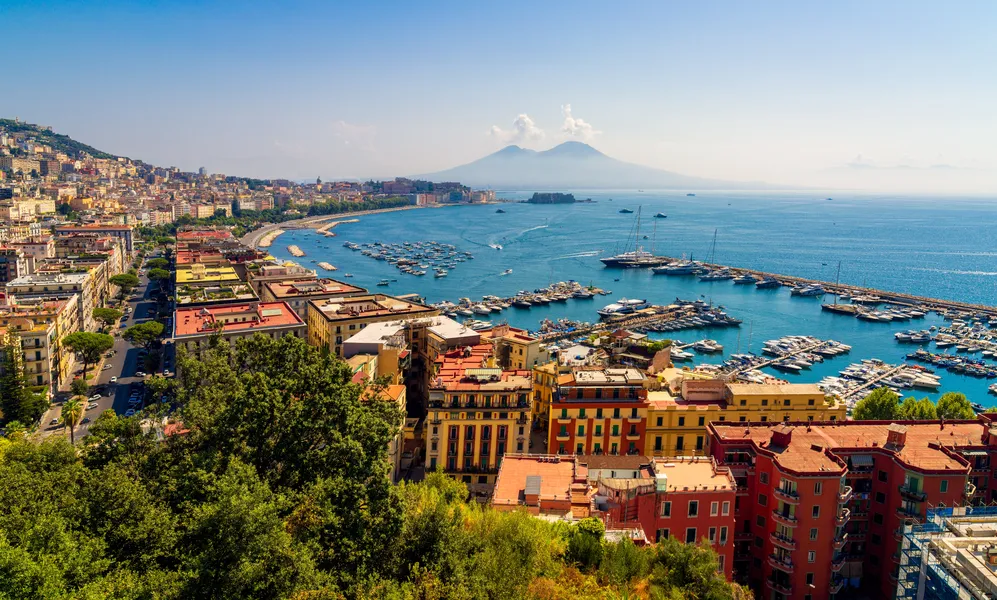
The upscale, quieter side of Naples. Wide pedestrianized shopping streets, good wine bars, and the Lungomare – the waterfront promenade with unobstructed views of Mount Vesuvius across the bay. The drawback: it is more expensive, it lacks the raw energy of the old town, and the main historical sites require a longer walk or a transit ride.
For a complete breakdown of hotels by budget and neighborhood, see our Where to Stay in Naples guide.


5. The Rules of Neapolitan Pizza
Pizza was invented here. They do not treat it as fast food – it has UNESCO heritage status and old-school pizzerias enforce their own rules.
The texture
Forget a stiff New York slice you can fold and walk with. Authentic Neapolitan pizza is cooked for 60-90 seconds in a 480°C (900°F) wood-fired oven. The result is a heavily charred, puffy crust (the cornicione) with a center that is completely soft and wet. You cannot pick it up by the slice. You sit down and eat it with a knife and fork.
The menu at old-school pizzerias
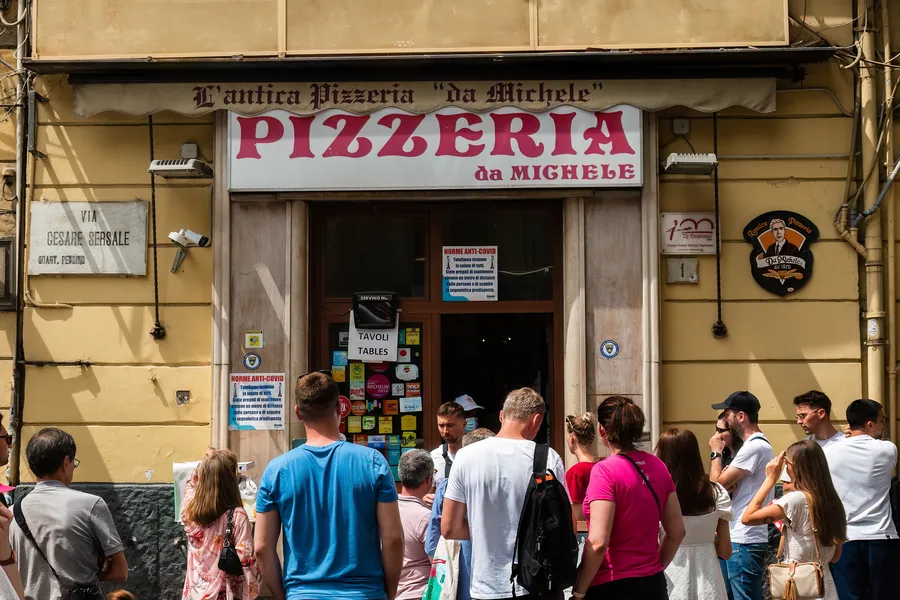
At places like L’Antica Pizzeria da Michele – the one made famous by Eat, Pray, Love – there are two items on the menu:
- Margherita: San Marzano tomato sauce, fresh mozzarella (fior di latte), basil, olive oil.
- Marinara: Tomato sauce, garlic, oregano, olive oil. No cheese.
You order one pizza per person. You do not split one between two people. A world-class pizza in Naples will rarely cost more than €6-€8.
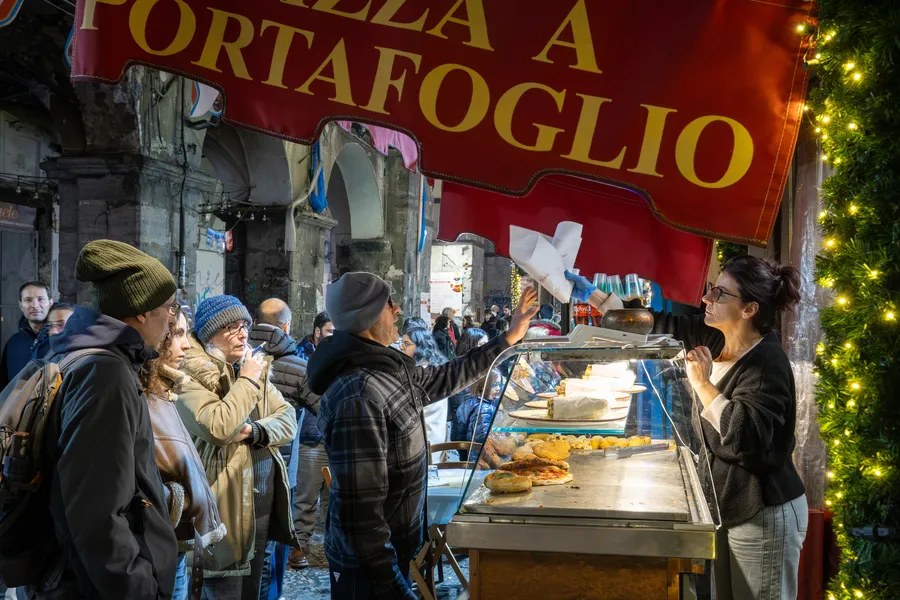
Pizza a Portafoglio (Wallet Pizza)
For eating while walking, look for small storefronts selling pizza a portafoglio – a smaller Margherita folded in half, then in half again, wrapped in wax paper. Costs around €2.50. The molten tomato sauce will burn the roof of your mouth. Order it anyway.
For a full breakdown of where to eat, pastries, and the rules of espresso, see our Naples food guide.


6. Coffee and the Sugar Ritual
Naples runs on a constant cycle of espresso and pastry.
The espresso
Northern Italian coffee (Milan-style) uses lighter Arabica beans. Naples uses a heavy Robusta blend, roasted dark. The result is short, thick, highly caffeinated, and topped with a dense hazelnut-colored crema. When you order un caffè at a bar, it arrives already sweetened unless you say amaro (bitter). Drink a small glass of sparkling water first to cleanse your palate, then drink the espresso in two quick sips at the counter.
Caffè Sospeso
Order a caffè sospeso and you pay for two coffees but drink one. The second is logged by the barista and given free to the next person who cannot afford to pay. The tradition has been part of working-class Neapolitan bar culture for generations.
Sfogliatella
The pastry to order with your espresso. It comes in two versions:
- Riccia: Shaped like a lobster tail, made of hundreds of paper-thin crisp layers of pastry, filled with warm citrus-scented semolina and ricotta cream.
- Frolla: The same filling inside a soft shortcrust shell.
Buy them from a bakery where they are kept in a heated glass case. The filling should be warm.


7. Day Trips: The Beginner’s Mistake
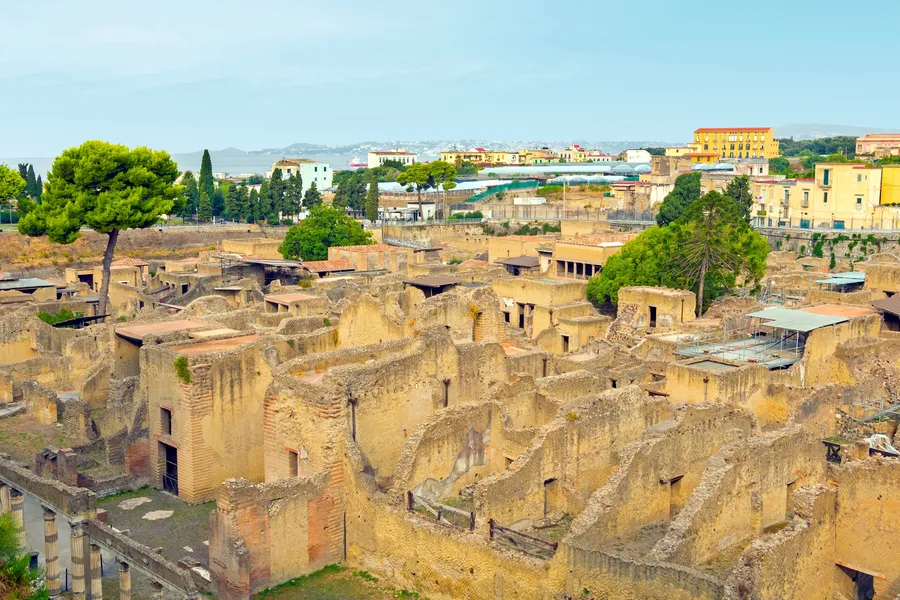
Naples sits within 60 minutes of Pompeii, Herculaneum, Mount Vesuvius, the Amalfi Coast, Capri, and Ischia. On a map, everything looks manageable in a day.
It is not. First-timers try to combine Vesuvius, Pompeii, and a sunset dinner in Positano into a single day. The transit logistics, the crowds, and the scale of these sites make rushing all of them a guarantee of seeing none of them properly.
Use Naples as a base. Sleep here, eat cheap pizza here, and take one focused day trip at a time. For exact train schedules, ferry tickets, and crowd timing, see our day trips from Naples guide.


Is it safe to wear jewelry or carry a camera in Naples?
Yes, with standard urban awareness. A DSLR camera or normal jewelry in the historic center during the day is fine. Keep your phone out of your back pocket and maintain a firm grip on your bag in crowded markets. A flashy watch at a busy train station is a bad idea in any major European city, including this one.
Should I rent a car in Naples?
No. The historic center is mostly pedestrianized or ZTL-restricted (camera-enforced access zones that will generate automatic fines), parking is nearly non-existent, and the traffic is genuinely aggressive by any standard. Use your feet, the Metro, and the funiculars.
Do people speak English in Naples?
In hotels, major restaurants, and tourist areas, yes. In smaller local trattorias and the residential back streets of the Spanish Quarters, less so. Learning three phrases – Buongiorno, Grazie, Il conto per favore – will earn you noticeably more goodwill than arriving and defaulting to English immediately.
How do I get to Pompeii from Naples?
Take the Circumvesuviana commuter train from Napoli Centrale (downstairs in the Garibaldi terminal). Cost is around €3. It is not air-conditioned, it is usually packed, and it is the main pickpocket hunting ground for tourists heading to the ruins. Keep your bag in front of you. Alternatively, the Campania Express tourist train costs more but is air-conditioned with guaranteed seating.
Why are there shrines to a footballer all over the city?
Diego Maradona led Napoli to back-to-back Serie A titles in 1987 and 1990 – victories against the wealthy, dominant clubs of Northern Italy that meant far more than football to a marginalized southern city. He died in November 2020. The shrines in the Spanish Quarters are genuine expressions of grief and loyalty, not a tourist gimmick.
First Time in Naples — Orientation Map
Where things are, how to get around, and what to know before you arrive. Click any pin.