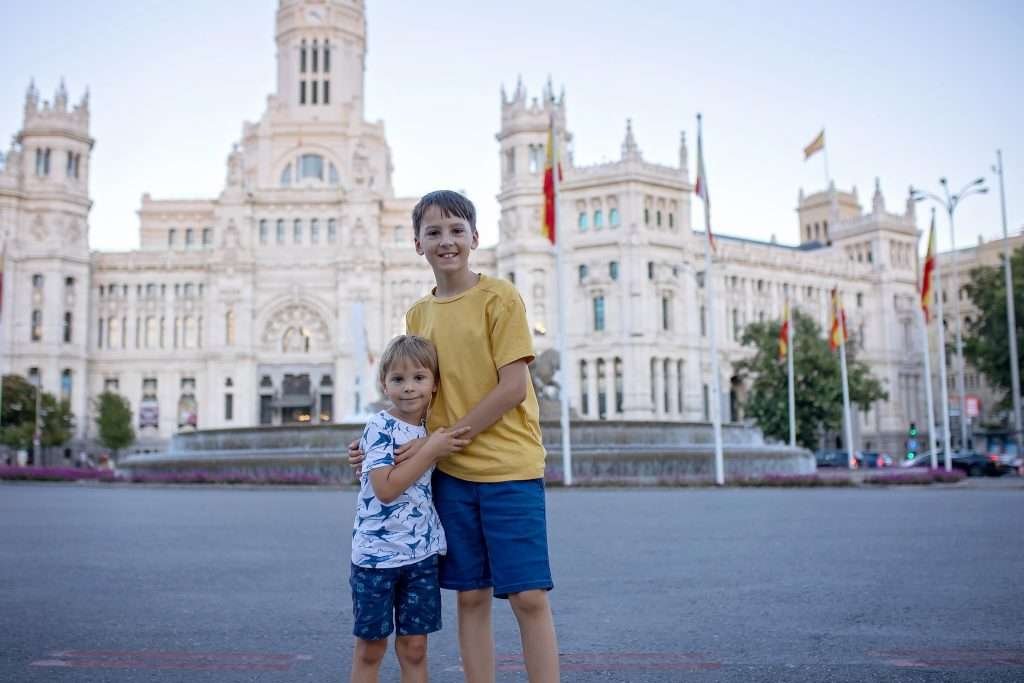
Madrid with kids is easier and more enjoyable than most people expect. Tell people you are taking your children to Madrid and you will likely get blank stares. Families go to the Costa del Sol. They go to the Canary Islands. Madrid has a reputation as a landlocked, concrete capital built for adults who drink vermouth until 3 AM.
That reputation is accurate. It also completely misses the point of Spanish culture.
In Spain, children are not separated into dedicated “family zones.” They are part of public life at every level. A toddler sleeping in a stroller inside a packed tapas bar at midnight is a normal Tuesday. Nobody will glare at your crying baby – they will walk over and try to make the baby laugh. Madrid is one of the most welcoming cities in Europe for families.
The catch is that it requires a significant rethink of your daily schedule. Force a standard northern European or North American routine onto Madrid and your children will have spectacular meltdowns by day two. Hack the local clock, know which museums to use and which to skip, and you will have one of the best family trips you have ever taken.
The Schedule Problem – and How to Fix It
The single biggest challenge in Madrid is the city’s timetable. It clashes directly with how children eat and sleep.
The dinner problem
Children expect dinner around 6 PM. Madrid restaurants pull their security grates down until 8 PM at the absolute earliest. Traditional spots do not open until 8:30 PM.
The fix: the merienda
Around 5 PM, when the siesta ends, cafes open back up. This is when you feed the kids a heavy late-afternoon snack – a thick slice of tortilla de patatas (the Spanish omelet of eggs, olive oil, and potato), a plate of churros with hot chocolate, or a crusty roll (bocadillo). This bridges the gap and gets them to a late dinner without the meltdown.
The siesta is real and you should use it
Between May and September, the afternoon heat turns Madrid’s stone plazas into an oven. Do not drag children to the Royal Palace at 3 PM. Do your heavy sightseeing in the morning, eat a long lunch around 1:30 PM, and retreat to air conditioning. Let the kids rest. Re-emerge once the sun drops and the temperature becomes manageable. This is not a tourism tip – it is how Madrileños have survived the summer for centuries.
For more on the neighborhood logistics – which areas are quieter, which have better apartment options – see our where to stay in Madrid guide.
The Museums: Targeted Strikes Only
Madrid has three world-class art museums. For an adult, this is extraordinary. For a seven-year-old, four hours of 17th-century religious portraits is a hostage situation.
You can absolutely take kids to the Prado. You just need to go in with a specific plan and a firm exit strategy.
The Prado: the scavenger hunt approach
Book tickets online in advance – the standby queue is long and pointless with children in tow. Tell your kids you are going on a treasure hunt, and target exactly three paintings:
- Las Meninas by Velázquez (Room 12): Ask them to find the hidden dog in the bottom right corner. Ask them to spot the painter hiding in the background, and the King and Queen trapped inside the tiny mirror. Kids engage with this immediately.
- The Garden of Earthly Delights by Bosch (Room 56A): A 500-year-old painting that looks like a fever dream – giant birds eating people, figures disappearing into enormous fruits, musical instruments used as torture devices. Children are universally fascinated by it.
- Saturn Devouring His Son by Goya (Black Paintings room): For older kids and teenagers only. This visceral painting of a giant eating a person will produce genuine shock, which is exactly what makes teenagers pay attention in a museum.
Once you have seen these three, walk to the exit. Do not push your luck. Leave while they are still in a good mood.
The Reina Sofía: Guernica only
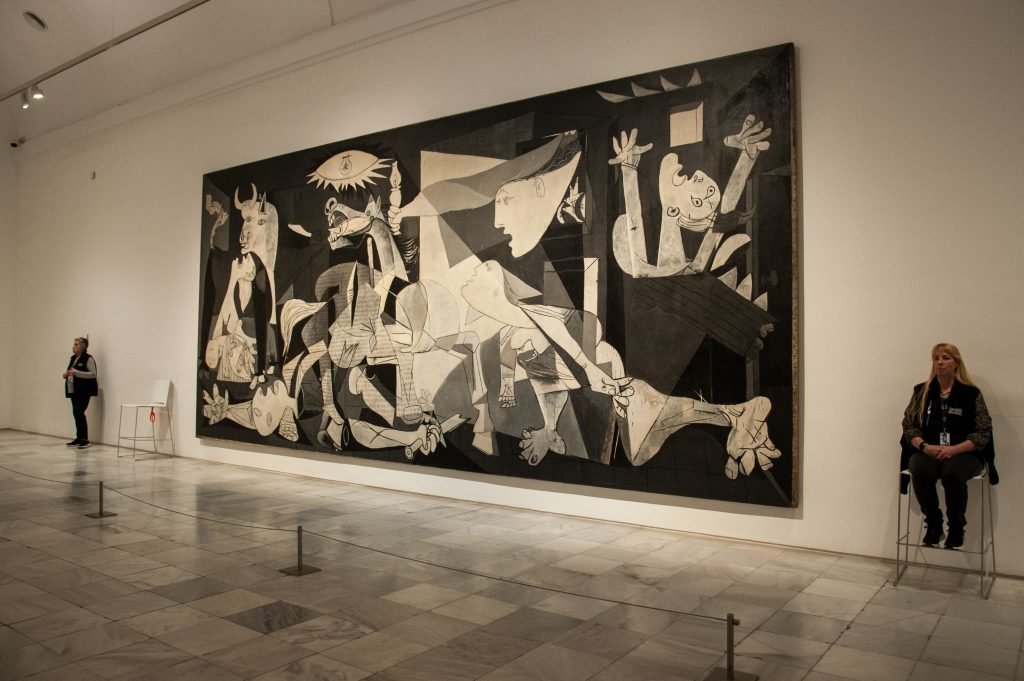
If you visit the Reina Sofía, go directly to Picasso’s Guernica. It is a room-sized black-and-white mural, and the sheer scale of it – the screaming horse, the fragmented figures – holds children’s attention in a way that smaller paintings never do. See it, then leave.
For a full breakdown of what the museums and major sights involve, our 25 best things to do in Madrid has the detail.
The Parks: Your Sanity Savers
Parque del Buen Retiro
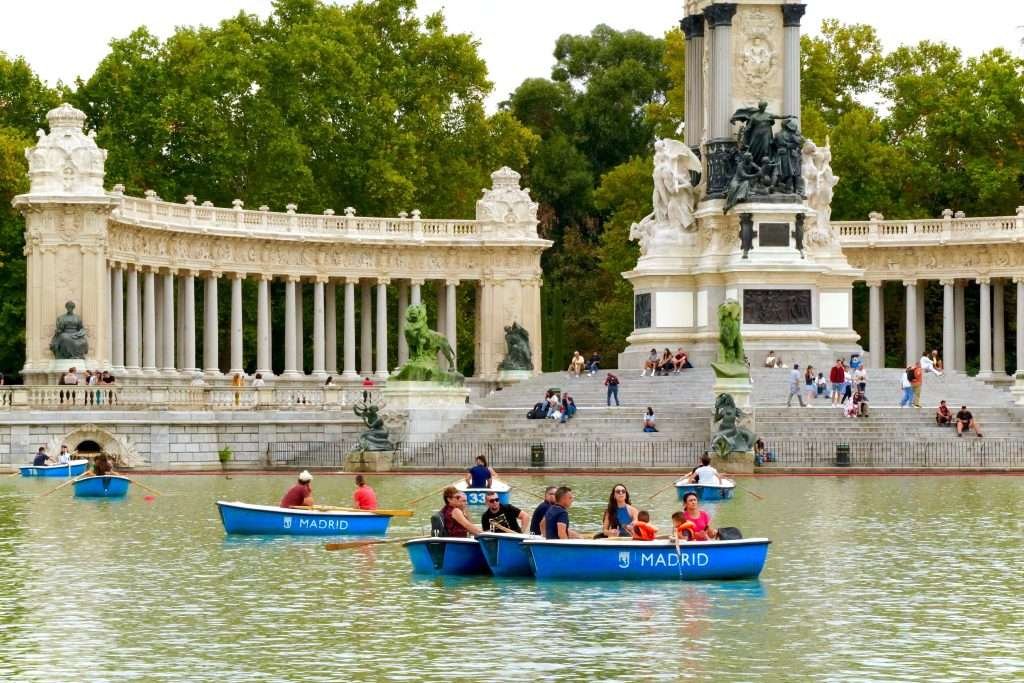

Located directly behind the Prado, El Retiro is the first stop after any museum visit. Two specific things make it worth the detour with kids:
- The rowboats: At the Estanque Grande (the large central lake), you can rent a small wooden rowboat for around €6 for 45 minutes. Let the kids take turns steering. The Alfonso XII monument looms over the water on the far side.
- The Crystal Palace: A glass-and-iron greenhouse from 1887 sitting next to a duck pond. Kids love the echo inside the glass walls, and there are often large art installations hanging from the ceiling. It costs nothing to enter.
On weekend mornings, local puppeteers run shows near the Puerta de Alcalá entrance. No Spanish needed – the physical comedy translates.
Madrid Río

A decade ago the city buried the M-30 motorway underground and turned the freed land into a linear park along the Manzanares River. For families with toddlers and young children, this is the best park in the city.
It has 17 different playgrounds, none of which involve plastic swing sets. There are wooden pirate ships with rope bridges, giant climbing webs, and the “Slide Hill” – eight large metal slides built into the side of a hill. In summer, there is an urban splash pad with jets of cold water. Getting here costs nothing.
Casa de Campo and the Teleférico

For a half-day adventure, head west to Casa de Campo – Madrid’s largest park, roughly five times the size of Central Park. Do not take the Metro. Take the Teleférico (cable car) instead. You board near Argüelles Metro station and it swings you over the Manzanares River and the treetops before dropping you into the park. The ride takes about 10 minutes and provides clear views of the Royal Palace from above. Ticket: roughly €6 one way, €9 return. Once inside, the Zoo Aquarium and Parque de Atracciones (a classic amusement park with roller coasters) are both on-site.
The Royal Palace: Lead with the Armor


Tell a child you are taking them to see neoclassical architecture and they will complain. Tell them you are going to see actual swords, dented battle armor, and a king’s golden throne and they will run to the gate.
Book in advance. The timed-entry queue in the Plaza de la Armería runs long in peak season and there is no shade. Book online weeks ahead. Ticket cost: €14 general admission.
Inside, the Throne Room – red velvet walls, golden lions at the base of the thrones – lands well with kids once you explain that foreign presidents are still received here today.
The Real Armería is the main event. Located in a separate wing across the courtyard, this is one of the great medieval and Renaissance weapons collections in the world. The centerpiece is Emperor Charles V’s actual battle-worn armor – dented, scratched, and very much used. Alongside it: full suits of armor built for royal horses, and tiny, perfectly proportioned suits of armor made for the royal children. History becomes concrete very quickly in here.

What to Feed Them
Traditional Spanish food is inherently friendly to children. You do not need to track down a kids’ menu – they rarely exist here – and you do not need a fast food chain.
Use the chaos of tapas bars to your advantage
In a quiet restaurant, every dropped spoon is a social event. In a loud Spanish tavern with crumpled napkins on the floor and people shouting orders, nobody notices your family’s noise. The chaos is your cover.
The reliable order for picky eaters:
- Croquetas – small, deep-fried cylinders of thick béchamel with cured ham or chicken inside. Kids eat them like popcorn. Cost: roughly €1.50-2 each.
- Tortilla de patatas – eggs, olive oil, and potato. Soft, starchy, and completely inoffensive. Available everywhere.
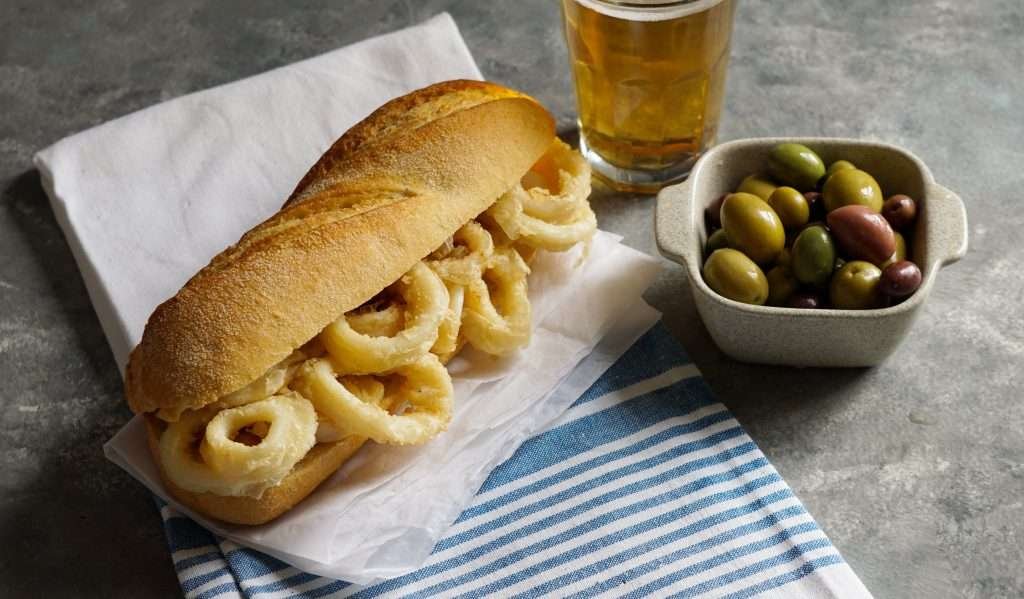
- Bocadillo de Calamares – for lunch near Plaza Mayor, Bar La Campana on Calle Botoneras 6. A baguette stuffed with fried squid rings. If your kids eat fish sticks, they will eat this. Cost: around €4.
- Patatas bravas – fried potato cubes. Ask for the spicy sauce on the side and let them dip in garlic aioli instead.



Skip Mercado de San Miguel. It is next to Plaza Mayor, it is overpriced, and it is too packed to push a stroller through. Go to the Mercado de San Antón in Chueca or the Mercado de Vallehermoso in Chamberí instead. Multiple stalls, communal tables, everyone picks what they want. No argument at the table about the menu.
Our what to eat in Madrid guide covers the full food picture if you want to plan meals in more detail.
Day Trips: Two Options, One Clear Winner for Families
If you have more than three days in Madrid, get out of the concrete for a day. Two options are within an hour by train.
Toledo
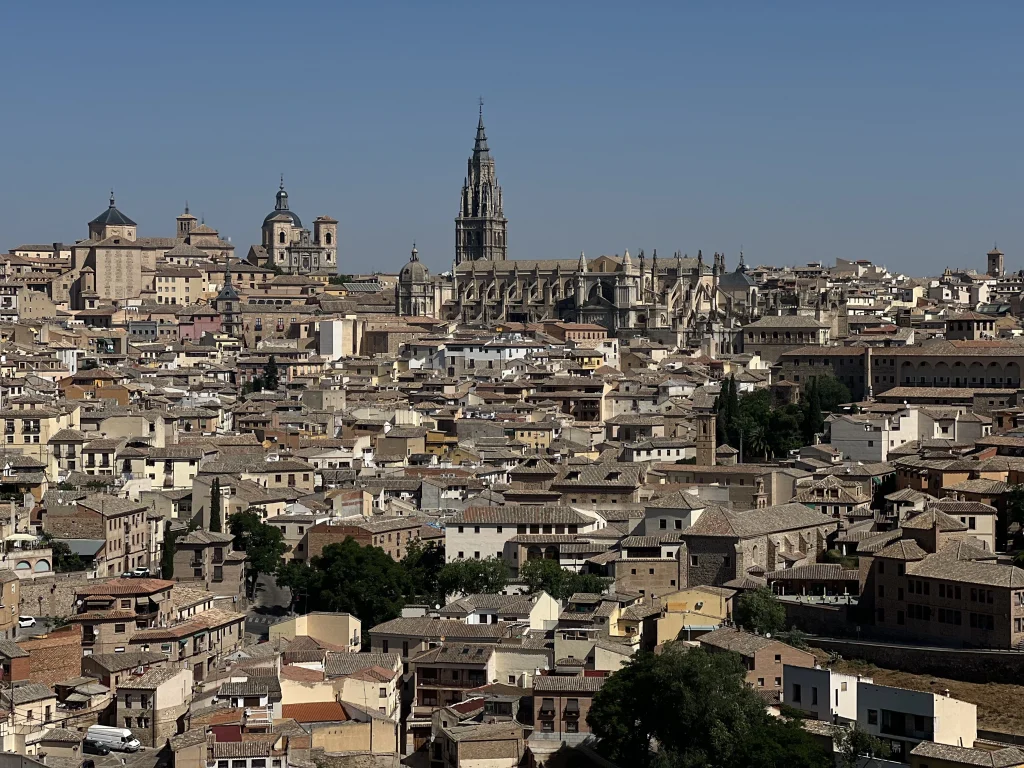
The ancient medieval capital of Spain, perched on a rocky gorge above the Tagus River. The family appeal is real – Toledo has been famous for steelmaking for centuries and the streets are lined with shops selling high-quality swords (many used in the Lord of the Rings films were forged here). Swords are a good hook for kids.
The drawback: Toledo is extraordinarily steep. Pushing a stroller up cobbled hills in July heat is a serious physical workout. Go in spring or autumn if you can.
Segovia – the better option for families

Take the high-speed AVE train from Chamartín station. You arrive in 28 minutes. Train cost: roughly €14 each way.
The moment you step into the city center, a 90-foot Roman aqueduct fills the entire plaza. Built in the 1st century AD without a single drop of mortar. Children can actually understand what that means in a way they cannot grasp abstract history – it is visibly, obviously massive.
Walk to the far edge of the city to find the Alcázar of Segovia – a fortress with blue slate turrets that looks exactly like the castle in Snow White (it genuinely influenced Disney’s designers). Kids can climb the Tower of John II for views of the surrounding countryside and cross the drawbridge. Ticket: €8 adults, €5 children under 14.
At lunch: Segovia is famous for Cochinillo (roast suckling pig). It is so tender that waiters literally cut it with the edge of a ceramic plate to prove a point. Even children who claim not to like pork usually eat it.
Logistics: Strollers, Metro, and Bathrooms
Strollers
Bring a lightweight, foldable travel stroller – a Babyzen YOYO or equivalent. Do not bring a wide-wheel jogging stroller. The sidewalks in La Latina and Barrio de las Letras are narrow enough that you will regularly step into the road to pass a lamppost. A carrier is better than a stroller for the Rastro flea market or any packed tapas bar.
Metro accessibility
The Madrid Metro is excellent but old. Not every station has a lift. Before entering with a stroller, check the Metro map for the wheelchair symbol. Major hubs – Sol, Opera, Callao – have lifts from street level to platform. If you end up at a stairs-only station, locals almost always offer to help carry the stroller. Accept the offer.
The bathroom problem
Madrid does not have a widespread network of free public restrooms. The solution is simple: walk into any bar, order a bottle of water at the counter (una botella de agua, por favor, costs around €1), and immediately ask for the aseos. Alternatively, find an El Corte Inglés department store – there is a large one at Callao. Large, clean, free bathrooms on multiple floors. No purchase required.
If you are still working out how many days you need, our 3 days in Madrid itinerary and 5 days in Madrid guide both work well as family frameworks – the 5-day version builds in the Segovia day trip naturally.
FAQ: Madrid with Kids
Is Madrid safe for children?
Very. You can walk the historic center at midnight with a stroller and be surrounded by local families doing the same. The consistent risk is pickpockets, particularly on crowded Metro trains and around Puerta del Sol. When your attention is split between your children and your surroundings, use a cross-body bag and keep phones out of back pockets.
Do restaurants have high chairs?
Traditional tapas bars and older taverns usually do not. Bring a portable fabric harness that straps onto a standard wooden chair, or hold younger children on your lap. Larger modern restaurants almost always have them if you ask (¿Tiene una trona?).
Are children allowed in tapas bars at night?
Yes, with no restrictions. Seeing children at a high-top table eating croquetas at 10 PM while their parents drink at the bar is standard Spanish practice, not unusual.
Can we drink the tap water?
Yes. Madrid’s tap water comes from the Guadarrama mountains and is considered some of the best in Europe. Bring refillable bottles and ask for agua del grifo at restaurants. You do not need to buy bottled water for children.
Best neighborhood to stay in with a family?
Avoid Puerta del Sol (noisy around the clock) and Malasaña (bars running late). The three best family options: Retiro (immediate park access, quieter streets), Chamberí (residential, good local plazas, low noise), or Salamanca (wide sidewalks, safe, very quiet at night). All three are covered in our where to stay in Madrid guide.