
Madrid sits in the dead center of the Iberian Peninsula. That geographic fact is one of its most underrated assets.
Because the Spanish government has poured money into the AVE high-speed rail network and modern highways, you can wake up in Madrid, take a 30-to-90-minute ride, and step out into a medieval city that looks largely unchanged from the 15th century. You unpack your suitcase once. You eat cheap tapas in the capital every evening. During the day, you move out into the provinces of Castile and León or Castilla-La Mancha for some of the heaviest, most concentrated history in Europe.
The problem is choice. Dozens of towns surround Madrid. Some are worth the trip; others are not. And if you do not understand the transit logistics – specifically which train stations drop you in the middle of a field rather than at the city entrance – you waste half your day getting there. This guide cuts through that.
Day trips from Madrid are possible year-round, but some destinations are better in certain seasons. Toledo, El Escorial, and Cuenca work well year-round. Segovia is colder than Madrid but manageable. Ávila in January requires warm clothing – it sits at altitude and genuinely freezes. The upside: all five destinations have significantly fewer tourists between November and February.
These are the five day trips that actually justify the effort, with the exact transit routes and the one thing to eat at each.
1. Segovia – The Aqueduct and the Castle
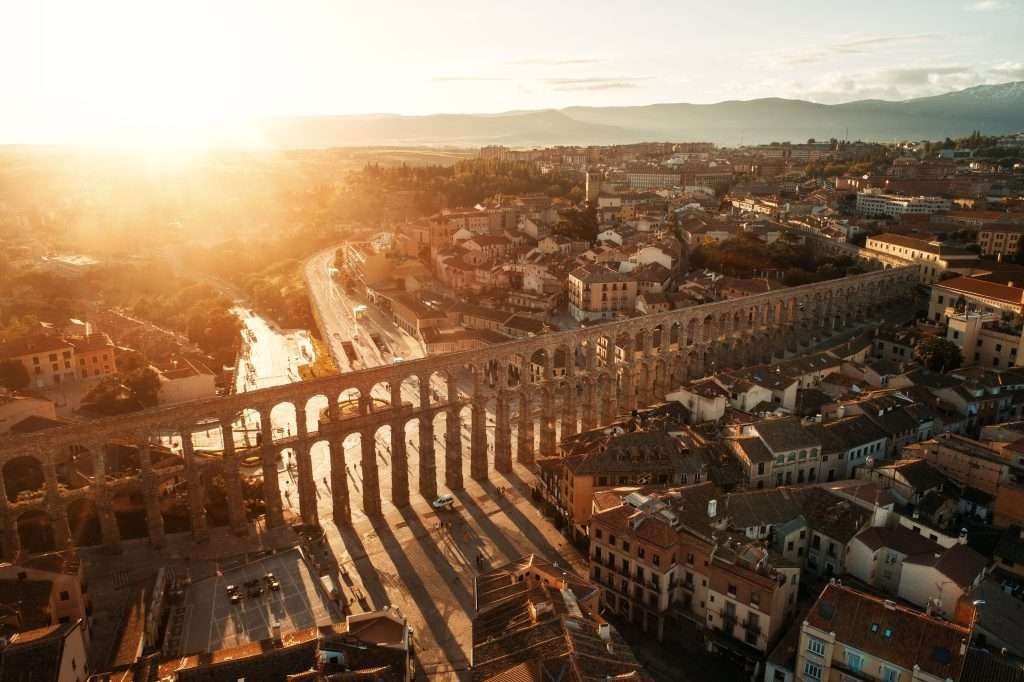

If you only have time for one day trip from Madrid, make it Segovia.
It is the most concentrated single day of Spanish history available within an hour of the capital. Walkable, visually arresting, and easy to navigate without getting lost.
The aqueduct

Walk out of the bus station and turn the corner into the Plaza de Azoguejo. Your brain will take a few seconds to process what it is looking at. A Roman aqueduct – nearly 100 feet tall, 167 arches, spanning the entire plaza – looms over the city. Built in the 1st century AD from massive granite blocks. Zero mortar. Zero cement. Held together entirely by gravity and precise engineering for almost 2,000 years.
The Alcázar

Walk to the far western edge of the city where the rock narrows to a cliff edge. The Alcázar sits here with a deep moat, a drawbridge, and blue slate turrets that look like something from a fairy tale. Climb the Tower of John II – the spiral staircase is tight, but the 360-degree views over the Castilian plains at the top are worth it. Ticket: €8 adults, €5 under 14.
The Cathedral

Sitting in the main Plaza Mayor, this late-Gothic structure is known as the “Lady of Cathedrals.” Worth 30 minutes of your time after the aqueduct and the castle.
What to eat
You come to Segovia to eat Cochinillo Asado – roast suckling pig. The pig goes into a wood-fired oven whole and comes out with skin that shatters like glass and meat that falls off the bone. It is a heavy, caloric, brilliant lunch. Book a table in advance at Mesón de Cándido (directly under the aqueduct) or Restaurante José María. Expect to pay €25-35 per person for a full lunch.

How to get there
Do not take the high-speed AVE train. It is fast (28 minutes) but drops you at Segovia-Guiomar station, which sits in a barren field several kilometers outside the city. You then wait for a local shuttle bus, which eliminates the time saving entirely.
Take the Avanza Bus from the Moncloa transport interchange in Madrid (Metro: Moncloa). Journey time: around 1 hour 15 minutes. Round-trip cost: under €10. Drops you a five-minute walk from the base of the aqueduct. Buy your ticket at the booth or on the Avanza app.
2. Toledo – The City of Three Cultures
Toledo was the capital of the Spanish Empire before Madrid. It sits on a rocky spur of land with the Tagus River curving around it on three sides as a natural moat. The city is dense, steep, and visually overwhelming in the best way.
The history
Toledo is known as the City of Three Cultures because Christians, Muslims, and Jews lived here in relative coexistence for centuries. The architecture reflects that directly – Gothic cathedrals, Moorish horseshoe arches, and ancient synagogues all within a few minutes’ walk of each other. Toledo has also been famous for steelmaking since the Middle Ages; the streets are lined with shops selling high-quality broadswords, and many of the weapons made for the Lord of the Rings films were forged here.
What to see
The Toledo Cathedral is the centerpiece – the primate cathedral of Spain, one of the most opulent Gothic structures in the country. The interior features a golden altarpiece and a skylight cut through the roof specifically to illuminate the tabernacle below it (El Transparente). Ticket: €10.
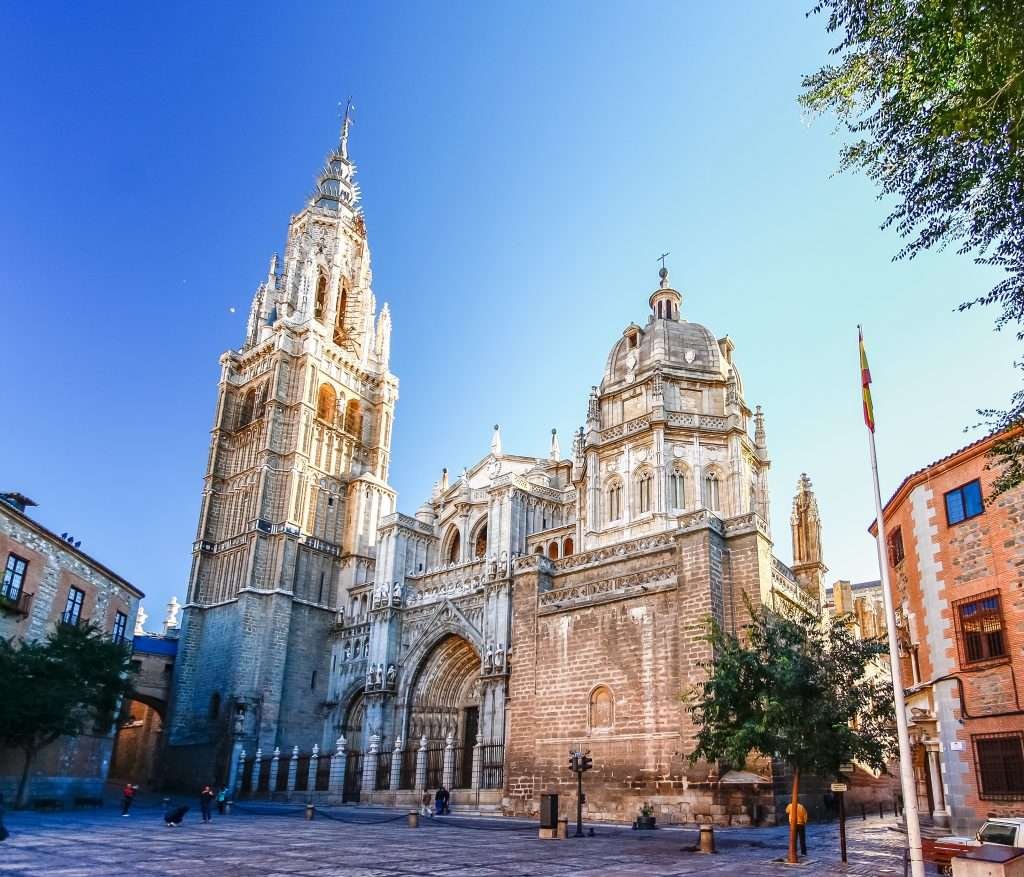
The Alcázar of Toledo dominates the highest point of the city and houses a military museum, but the Cathedral is the architectural star. Visit the Synagogue of Santa María la Blanca in the old Jewish Quarter – it is a 12th-century building with horseshoe arches and whitewashed pillars, and costs only €3.

Before you leave, buy a box of traditional marzipan from the Convento de San Clemente, where cloistered nuns bake it on the premises. Toledo’s marzipan is an almond paste pressed into shapes and baked – nothing like the industrial version sold elsewhere.
The physical warning
Toledo is built on a steep hill. If you are traveling with a stroller or have mobility issues, plan around this. Do not walk up from the bus station under your own steam. Look for the Remonte Mecánico de Safont – a free, covered escalator system carved into the rock that carries you straight up to the historic center.
How to get there
Same rule as Segovia: skip the high-speed train. It takes 33 minutes but costs significantly more and is no faster door-to-door once you factor in getting to Atocha station.
Take the direct ALSA Bus from the Plaza Elíptica station in Madrid (Metro: Plaza Elíptica). Journey time: 45 minutes. Round-trip cost: around €10. Drops you near the base of the escalators.
3. San Lorenzo de El Escorial – The Royal Mausoleum


If the Royal Palace in Madrid is a display of Rococo wealth and theatrical decoration, El Escorial is its opposite: dark, austere, and deliberate. This is where the Spanish Empire came to think.
The history and vibe
King Philip II commissioned this structure in the 16th century in the foothills of the Guadarrama mountains. It functioned simultaneously as a monastery, a royal palace, a museum, and a school. Philip II ran the largest empire the world had ever seen from a tiny, deliberately spartan bedroom inside this massive stone grid. The architecture is intentionally severe – no Baroque excess, no gilded ceilings.
What to see
The Pantheon of Kings is the reason to come. Descend underground, directly beneath the basilica’s high altar, into a circular crypt lined entirely with dark marble and bronze. Every Spanish monarch from Charles I to the present dynasty is buried here in identical, stacked marble urns. The atmosphere is cold, quiet, and genuinely unsettling in the best possible way.
The Library is the visual surprise. A long room with a barrel-vaulted ceiling painted in elaborate allegorical scenes, lined with thousands of ancient manuscripts. The books are shelved with their gilded edges facing outward rather than their spines – a preservation technique that protects the paper from light damage.

The Basilica itself is worth an hour: severe Renaissance architecture with none of the decorative chaos of later Baroque churches, but a heavy, gravitational presence.
Climate note
El Escorial sits in the mountains and runs 5 to 10 degrees cooler than central Madrid year-round. In August this is a genuine relief. In November, bring a proper jacket.
How to get there
Take the Cercanías commuter train (Line C-3) from Atocha or Chamartín station toward El Escorial. Journey time: around 1 hour. From the station, take the local shuttle bus (Line 661) up the hill to the monastery, or walk 15 minutes uphill. Train fare: around €7 round-trip on the Cercanías network.
4. Ávila – The Walled City

Ávila is the highest provincial capital in Spain, sitting on a flat rocky plateau with one specific claim that no other city in Europe can match: its medieval walls are essentially intact.
The walls
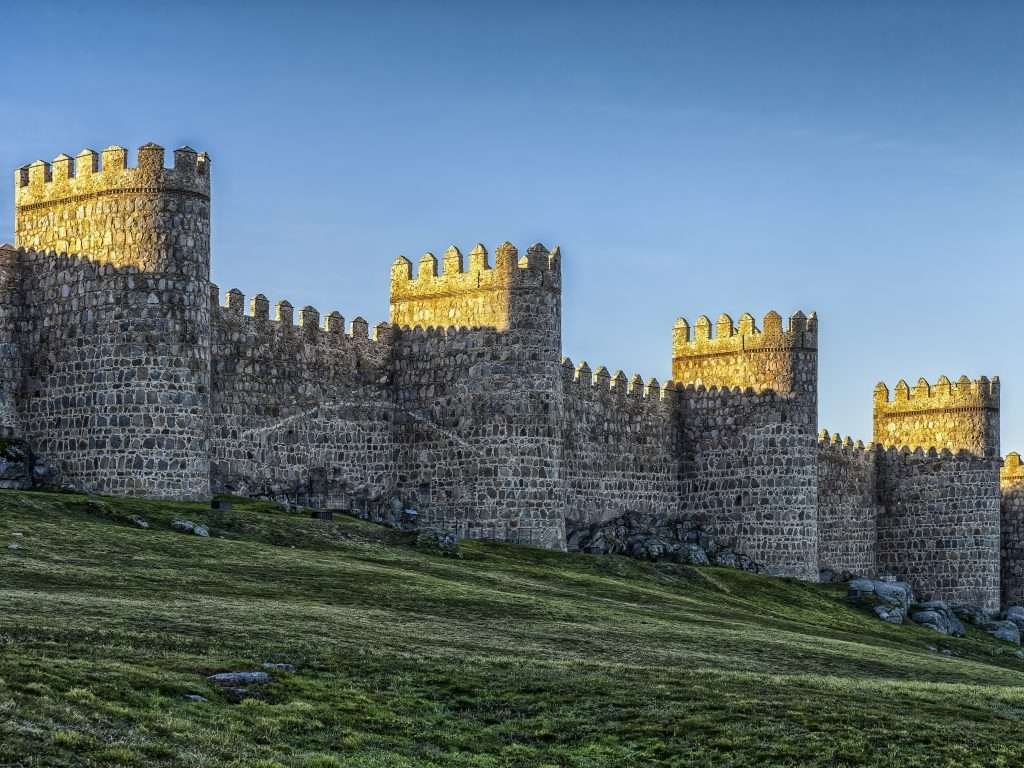
The Murallas de Ávila are 2.5 kilometers of unbroken Romanesque fortification with 88 semi-circular towers and 9 gates. You do not just look at them from below – you buy a ticket and walk along the top, on the stone sentry path between the battlements. The views over the Castilian countryside on one side and the old city rooftops on the other are worth the trip on their own. Ticket: €5.
The Cathedral
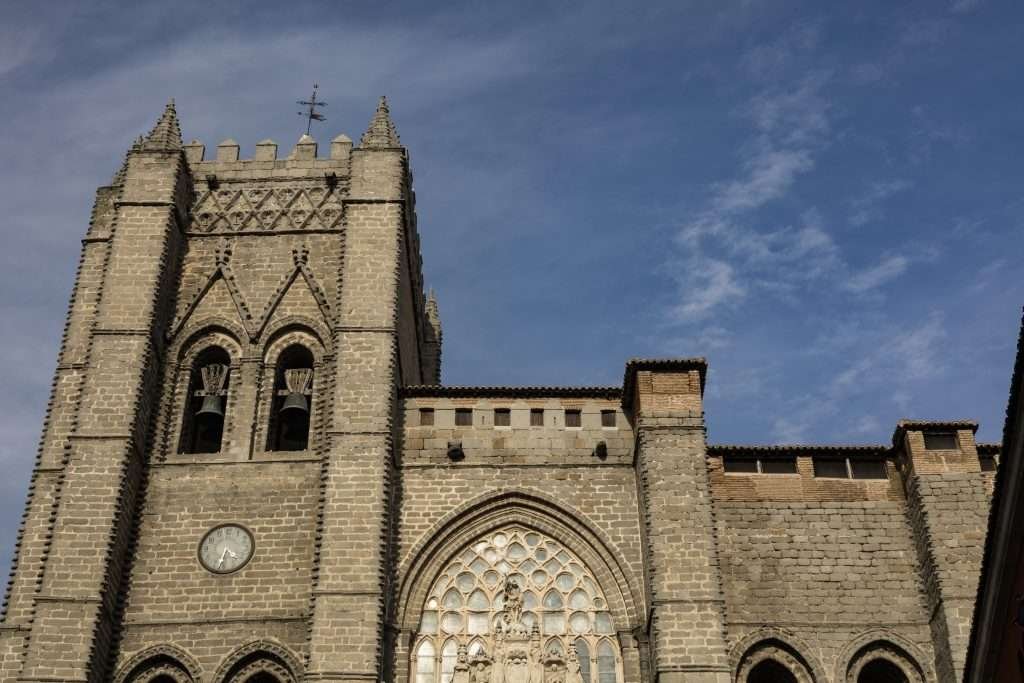
Built directly into the city walls – the apse of the cathedral functions as one of the defensive towers. It is the only cathedral in Spain designed to withstand a military siege. Architecturally, this makes it unlike anything else in the country.
What to eat
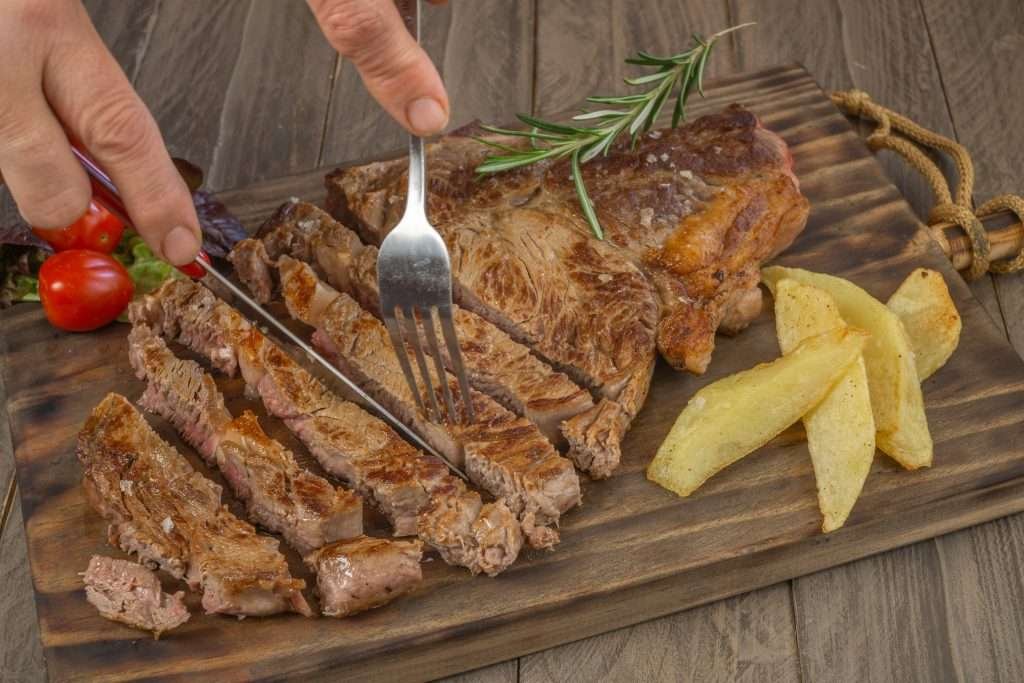
Ávila is cattle country. If Segovia is the city of pork, this is the city of beef. Order a Chuletón de Ávila – a bone-in veal T-bone, usually close to a kilogram, salted and seared rare over a wood fire, served on a wooden board. It is meant to be split between two people. Do not attempt it alone unless you are very hungry.
How to get there
Take the regional train (Media Distancia) from Príncipe Pío station in Madrid. Journey time: around 1 hour 30 minutes. The station drops you a short walk from the main city gates. No shuttle needed. Train fare: roughly €11-14 round-trip depending on timing.
Winter warning: Ávila is at high altitude and genuinely cold from November through March. Snow is common. Dress accordingly.
5. Cuenca – The Hanging Houses

Cuenca is the furthest trip on this list and requires the high-speed rail to make sense as a day trip. The visual payoff is unlike anything else in central Spain.
The city
Cuenca was built on a narrow spur of rock flanked by two deep river gorges. As the medieval city ran out of buildable space, residents simply cantilevered their houses over the cliff edge. The result is the Casas Colgadas – 15th-century buildings with wooden balconies jutting out over a sheer drop above the Huécar River gorge. They should not exist. They have existed for 600 years.
The Puente de San Pablo
To get the best view of the hanging houses, cross this iron footbridge spanning the gorge. Fair warning: it is very high, the floor is wooden planks with visible gaps, and it moves slightly in the wind. If you have a significant fear of heights, this section requires some commitment.
The Museum of Spanish Abstract Art
One of the hanging houses was converted in the 1960s into a museum for mid-century abstract art. Walking through a 500-year-old medieval building to look at Cuenca’s abstract painters is a strange and good experience. Free on Fridays.

How to get there
Do not take the bus – it is nearly three hours each way and makes Cuenca impossible as a day trip. Book the AVE or Avlo high-speed train from Madrid’s Atocha or Chamartín station. Journey time: 54 minutes. Book on the Renfe website 3-4 weeks in advance – high-speed rail uses dynamic pricing and last-minute tickets can triple in cost.
The Cuenca high-speed station (Fernando Zóbel) is a few kilometers from the old town. Take the local Line 1 bus or a taxi (around €10) to the historic center.
Practical Notes for All Five Trips
Do not rent a car
Traffic into Madrid is bad enough that leaving by car loses you an hour. More importantly, the historic centers of Toledo, Segovia, and Ávila are medieval labyrinths of one-way streets where unauthorized vehicles are heavily fined and parking is close to impossible. The public transit options for all five destinations are cheap, reliable, and drop you closer to the sights than a car park would.
Bus vs. train for Toledo and Segovia
For both cities, the bus wins on value. The ALSA and Avanza buses are cheaper, no advance booking required, and drop you at the edge of the historic center. The high-speed trains are faster in theory but leave you at out-of-town stations requiring an additional local connection. The time saving disappears.
Can you do Toledo and Segovia in one day?
No. Tour operators sell this as a package. It means 45 minutes of free time in each city after accounting for transit and a rushed lunch. Dedicate a full day to one, not a half-day to both.
Best trip for families with children
Segovia. The aqueduct is an engineering concept children can actually grasp. The Alcázar looks like a Disney castle. The city is relatively flat compared to the punishing hills of Toledo. For more on managing logistics with kids, our Madrid with Kids guide has the full picture.
Best trip on a tight budget
El Escorial or Ávila. Both are reachable on the Cercanías commuter network or regional bus for under €15 round-trip, and neither has the heavy restaurant pricing of Toledo’s tourist center. Combined with the free entry windows covered in our Madrid on a Budget guide, either works for a very lean day out.
How far in advance to book?
For Cuenca by high-speed train: 3-4 weeks minimum on Renfe. For El Escorial by Cercanías: buy at the station on the day. For Toledo and Segovia by bus: same-day purchase at the terminal is fine outside of public holidays.
FAQ: Day Trips from Madrid
Which day trip is best for a first visit?
Segovia. It delivers the most concentrated visual impact in the shortest time. If you are planning your first trip to the capital, our first time in Madrid guide and 5 days in Madrid itinerary both build in a Toledo or Segovia day naturally.
Should I book a guided tour or go independently?
For Toledo and Segovia, go independently. The bus drops you at the city entrance, the sights are clearly signed, and a self-guided half-day costs under €20 including transport and entry fees. Guided tours add cost without adding access. For El Escorial, an audio guide hired at the entrance is enough context.
What about Salamanca?
Salamanca is an excellent city – beautiful Plaza Mayor, one of Europe’s oldest universities, golden sandstone architecture – but at 1.5-2.5 hours each way by train, it is better as an overnight than a day trip. It did not make this list for that reason.
Can I do these trips in winter?
Toledo, El Escorial, and Cuenca work well year-round. Segovia is colder than Madrid but manageable. Ávila in January requires warm clothing – it sits at altitude and genuinely freezes. The upside: all five destinations have significantly fewer tourists between November and February.