
You have 24 hours in Spain’s capital. Reset your expectations now.
Most travelers arrive expecting a slow Mediterranean city – cobblestone alleys, sangria at 5 PM, a guitar somewhere in the background. Madrid is none of that. It sits in the dead center of the Iberian Peninsula, landlocked and unapologetic about it. It is a working capital of colossal neoclassical architecture, aggressive traffic, and a local population that treats late-night socialization as a competitive sport.
One day here is a logistical challenge. The Prado is the size of an airport terminal. The Royal Palace swallows three hours if you arrive without a ticket. Sit down at the wrong cafe in Plaza Mayor and you’ll pay €15 for a frozen tortilla. Attack it with precision, though, and it is one of the most rewarding cities in Europe.
This is the step-by-step plan for doing it right.
Pre-Trip: Three Rules You Cannot Ignore
1. Book tickets in advance – weeks, not days. The Prado and Royal Palace do not have functional walk-up queues anymore. Post-2020 tourism volumes broke the old system permanently. A timed-entry ticket booked three to four weeks out gets you in at your slot. No ticket means standing in direct sun for two hours, which kills this itinerary.
2. Use the Metro. Surface traffic in Madrid’s historic center is a maze of restricted zones and one-way streets. The Metro is fast, clean, air-conditioned, and costs €0.61 per ride if you load a Tarjeta Multi card with a 10-journey Metrobús ticket (€6.10 for the card refill, €2.50 for the plastic card itself). Tap once, pass the card back, your travel partner taps – it’s shareable. For more on getting around and picking a base, see our where to stay in Madrid guide.
3. Adjust to the local clock immediately. If you try to eat dinner at 7 PM you will eat alone in a tourist trap. Tapas bars do not get going until 9:30 PM. Locals sit down for dinner at 10 PM. This is not an exaggeration – it is how Madrid runs.
Morning: Churros, Royal Power, and One Rule for Plaza Mayor
08:00 – Chocolatería San Ginés

Skip the hotel breakfast. Walk directly to Chocolatería San Ginés, tucked into Pasadizo de San Ginés, a narrow alleyway just off Puerta del Sol.
Founded in 1894, this is the most famous churro institution in Spain. At 11 AM the queue stretches down the block. At 8 AM you walk straight in. Order a ración de churros and a cup of dark hot chocolate. These are not the cinnamon-sugar version you find elsewhere – they are lightly salted, properly crisp, and built to be submerged completely in the thick, pudding-like chocolate. Eat standing at the marble counter if needed. Cost: roughly €5-7 for the pair.
09:00 – Puerta del Sol and Plaza Mayor


Two minutes on foot from San Ginés. The Puerta del Sol is the geographic center of Spain – find the “Kilometer Zero” plaque embedded in the pavement on the south side of the square. Take a photo of the Bear and the Strawberry Tree statue, then walk immediately west to Plaza Mayor.

The Plaza Mayor is a rectangular enclosed square of red brick with 237 balconies facing inward. It hosted bullfights, public executions during the Inquisition, and royal coronations. The frescoes on the Casa de la Panadería on the north facade are worth five minutes of your attention.
The one rule: Walk through it. Take your photos. Do not sit down at any cafe in this square. They are the most notorious tourist traps in Madrid, serving overpriced, microwaved food to people who don’t know better. (The good calamari places are 90 seconds away through the arches – more on that at lunch.)
09:45 – Palacio Real
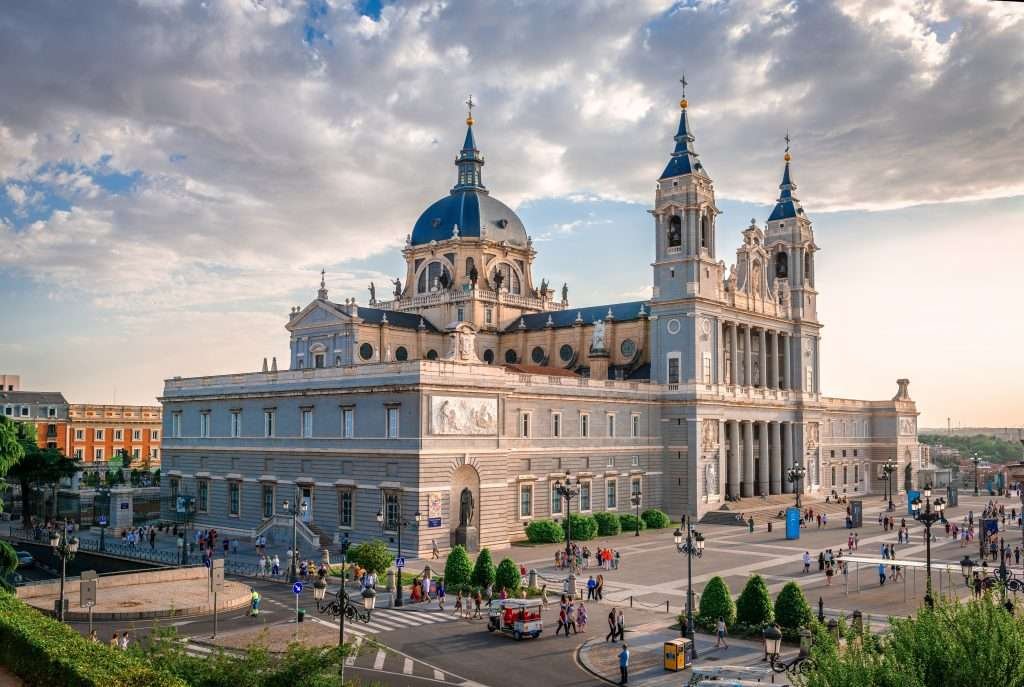


Walk west from Plaza Mayor down Calle Mayor. The narrow streets open suddenly to reveal the Catedral de la Almudena and then the Palacio Real behind it. The scale shift is jarring in the best possible way.
You pre-booked your 10:00 AM timed-entry slot, so you bypass the standby queue entirely. This is the largest functioning royal palace in Western Europe – 3,418 rooms of accumulated Habsburg and Bourbon wealth.
Do not try to see every room. Three rooms justify the ticket on their own:
- The Royal Armory – one of the finest collections of medieval armor in existence, including Emperor Charles V’s actual battlefield armor
- The Throne Room – ceiling frescoes by Tiepolo, silk walls, and a floor that feels slightly too good to walk on
- The Gasparini Room – Rococo stucco and embroidered silk so dense it feels physically oppressive
Spend 90 minutes maximum and get out. Ticket cost: €14 for general admission; €7 on Monday and Wednesday afternoons for EU citizens.
For everything else the city has to offer beyond this single day, our 25 best things to do in Madrid covers the full list.
Afternoon: The Greatest Sandwich, Then the Prado
13:00 – Bocadillo de Calamares at Bar La Campana
Exit the Palace and walk back east toward Plaza Mayor – but you are eating outside the square, not inside it. Head to Calle Botoneras 6 (a 2-minute walk through the Arco de Cuchilleros on the southwest corner of Plaza Mayor). This is Bar La Campana.


Order a Bocadillo de Calamares. This is Madrid’s signature landlocked-city seafood paradox: a crusty baguette stuffed with thick rings of flash-fried squid. No lettuce, no tomato. Squeeze a lemon wedge over it, add a smear of alioli if you want, and eat it standing on the cobblestones with a caña (small draft beer). Cost: roughly €4 for the sandwich, €2-3 for the beer. You will not eat a better €6 lunch anywhere in Europe.
14:30 – The Prado: A Surgical Strike

Take Metro Line 2 from Sol to Banco de España, then walk south down the Paseo del Prado. You have a pre-booked ticket for the Museo Nacional del Prado.
Do not browse. Hunt down three specific paintings, in this order:
- Las Meninas by Velázquez (Room 12) – This is the Mona Lisa of Spain. A massive, psychologically complex painting where the painter appears to be painting you, the viewer, while the royal family reflects in a mirror behind him. Spend 20 minutes here minimum.
- The Third of May 1808 by Goya (Room 64) – A firing squad executing Spanish rebels, painted with such raw directness that it is considered one of the first truly modern works of art.
- The Garden of Earthly Delights by Hieronymus Bosch (Room 56A, ground floor) – A 500-year-old triptych depicting heaven, earth, and hell with imagery that looks like it was hallucinated: giant birds eating humans, musical instruments used as torture devices, figures disappearing into enormous fruits. You cannot look away.
Pick one more wing – El Greco or Rubens – then leave before museum fatigue sets in. Ticket cost: €15; free on Monday evenings (18:00-20:00) and Sunday evenings (18:00-20:00), but the queues for free entry are long.
17:00 – Recovery in El Retiro


Walk up the hill from the Prado’s north entrance directly into Parque del Buen Retiro. After the dark corridors of the museum, the wide avenues of this 350-acre park feel like physical relief.
Walk to the Estanque Grande (the large artificial lake at the park’s center) where locals rent rowboats by the hour. Your real target is the Palacio de Cristal, a glass-and-iron greenhouse from 1887 sitting on the edge of a small pond surrounded by cypress trees. Find a bench in the shade nearby, sit down, and give your feet a mandatory 45 minutes of recovery.
Evening: One Rooftop, Then the Tapas Crawl
19:30 – Círculo de Bellas Artes Rooftop
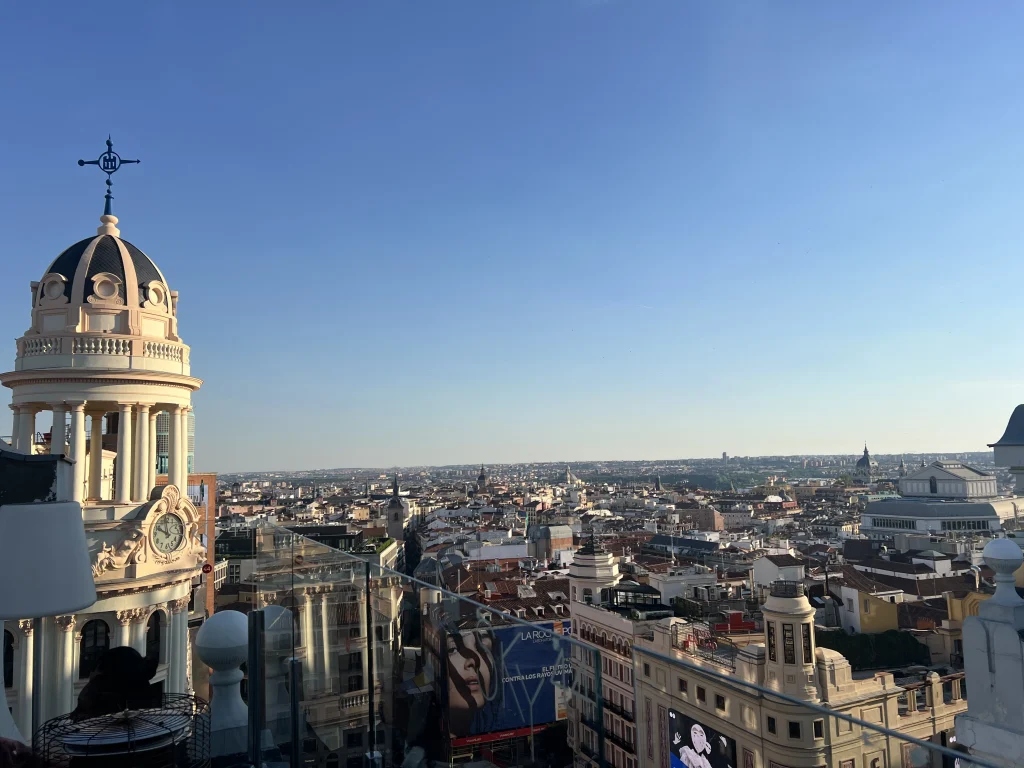
Walk northwest out of Retiro through the Puerta de Alcalá gate, then west down Calle de Alcalá until it hits Gran Vía. This is Madrid’s main boulevard – a kilometre of early 20th-century architecture that looks like a Batman film set.
At the junction of Calle de Alcalá and Gran Vía, find the Círculo de Bellas Artes building. Pay €5 for the dedicated elevator to the rooftop terrace (La Azotea). Buy a gin and tonic (€12-14, yes it’s overpriced, it’s worth it once), stand at the glass railing, and watch the sunset light up the Metropolis Building. This is the best 360-degree view of central Madrid. Tour buses cannot get you here.
21:30 – Cava Baja Tapas Crawl, La Latina
Take the Metro to La Latina station. Walk 3 minutes to Cava Baja – a curved, narrow street that is the epicenter of traditional Madrid bar culture. The rules are the same as in any Spanish tapas crawl: you do not sit down for a full meal in one place, you move between bars.
Three-stop structure:
- Stop 1: Vermouth. Walk into any tiled tavern on the street and order a Vermut de Grifo (vermouth on tap). Spanish vermouth is dark, sweet, herbaceous, and served over ice with an orange slice. Pair it with a plate of boquerones en vinagre (pickled white anchovies in olive oil). Cost: €3-4 per glass.
- Stop 2: Casa Lucio (or the nearby Los Huevos de Lucio). Order Huevos Rotos – broken eggs. A mountain of fried potatoes, two eggs fried in olive oil, and thick cuts of Jamón Ibérico. The waiter slices the eggs at the table so the yolks coat everything. It is heavy, salty, and exactly what you need at this point in the day. Cost: around €14-16 per plate. (Locals do not share these.)
- Stop 3: A Basque-style bar for pintxos. Order a glass of Txakoli (the bartender pours it from a great height to aerate it) and take two or three pintxos from the counter – small tapas pinned onto bread with a toothpick. Cost: €2-3 per pintxo.
After Midnight: Optional Final Act
The plazas in La Latina stay packed with locals drinking standing on the cobblestones well past 1 AM. Grab a final Mahou beer (Madrid’s local lager, €2-3 anywhere in the neighborhood), lean against a 16th-century wall, and let the city happen around you.
What You Are Missing (And That’s Fine)
One day in Madrid means you skip the Reina Sofía and Picasso’s Guernica, the Bernabéu, the Malasaña neighborhood, and the Sunday El Rastro flea market. That is not a failure – it is the correct trade-off for a 24-hour visit.
If you can add two more days, our 3 days in Madrid itinerary covers those gaps properly. If you have five days, the 5 days in Madrid guide adds a Toledo day trip and the Bernabéu.
Frequently Asked Questions: 1 Day in Madrid
Is one day actually enough time for Madrid?
No. Madrid is a massive capital and 24 hours forces hard choices – you will see the Palace, the Prado, and experience a proper tapas crawl, but nothing else. Three full days is the minimum for a first-time visitor who wants to leave without feeling cheated. See our first time in Madrid guide for the full survival briefing.
Do I need to book the Royal Palace and Prado in advance?
Yes, and this is not negotiable. Standby queues at both can run two hours in peak season. Book timed-entry tickets online a minimum of three to four weeks ahead.
Is Madrid safe at night?
Very. Streets in La Latina, Sol, and Malasaña are full of families and locals well past midnight. The one consistent risk is pickpockets on the Metro and around Puerta del Sol – use a cross-body bag and keep your phone out of your back pocket.
What are the most traditional foods to try in a single day?
In order of this itinerary: Churros con Chocolate for breakfast, Bocadillo de Calamares for lunch, and Huevos Rotos with Jamón Ibérico for dinner. For a deeper dive into Madrid’s food scene, our what to eat in Madrid guide covers the full picture.
How do I get from Madrid Airport (MAD) to the city center?
Two reliable options: Metro Line 8 from any terminal to Nuevos Ministerios, then transfer toward Sol (total cost around €5 including the airport supplement). Or the bright yellow Exprés Aeropuerto bus (Line 203), which costs €5, runs 24 hours, and drops you at Atocha station in around 40 minutes depending on traffic.