
One day in Barcelona is not enough. That is the honest answer. The city has enough to fill a week comfortably, and anyone who tells you otherwise is either lying or has very low standards for what “seeing” a city means.
But here is the thing – one day done right is significantly better than one day done wrong. Cruise passengers, people on layovers, travelers who only have a 24-hour window before moving on to Madrid or the coast: this itinerary is built for you. It will get you through Park Güell, the Sagrada Família, the Gothic Quarter, and El Born without a single wasted hour.
The entire route runs roughly north to south, ending at the sea. You start at the top of the city and walk downhill all day. This is not an accident – it saves your legs, eliminates unnecessary backtracking, and means you finish at the waterfront at sunset with a cold drink in your hand.
Expect 15,000-18,000 steps. Wear proper walking shoes.
Before You Leave Your Hotel: The Two Non-Negotiables
Two things will ruin this itinerary if you have not sorted them before you step outside.
Park Güell tickets. The Monumental Zone – the terraced area with the mosaic dragon staircase and the famous curved bench overlooking the city – requires a timed entry ticket. There is no buying them at the gate. Book the 9:30 AM slot at parkguell.barcelona. The free sections of the park are genuinely worth seeing, but without a Monumental Zone ticket you are standing outside the fence looking in.
Sagrada Família tickets. Book the 12:00 PM slot directly at sagradafamilia.org. Third-party sites sell the same tickets with a markup. The 12:00 PM slot gives you roughly two hours at Park Güell before you need to move. If you book towers (the Nativity Tower is the better one – better views, better light), factor in an extra 45 minutes inside.
Both of these sell out days or weeks in advance depending on the season. If you are reading this the night before and both are sold out, the itinerary below still works – you walk the exterior of the Sagrada Família (genuinely impressive) and the free sections of Park Güell. It is not the same, but it is not a wasted day either.
09:00 AM: Getting to Park Güell
Park Güell sits in the Gràcia neighborhood on a steep hill in the north of the city. Do not attempt to walk up from the city center – it is a 40-minute uphill slog and you will arrive sweating before the day has started.
From Plaça de Catalunya, take Metro Line 3 (green) to Lesseps or Vallcarca. From Lesseps, it is a 10-minute uphill walk to the main entrance. From Vallcarca, there are escalators that cut the hill climb significantly – most people miss this.
Alternatively, take a taxi or FreeNow from your hotel directly to the park entrance. At this time of morning it will cost €8-€12 depending on where you are staying. For one day in the city, the time saving is worth it.
09:30 AM: Park Güell
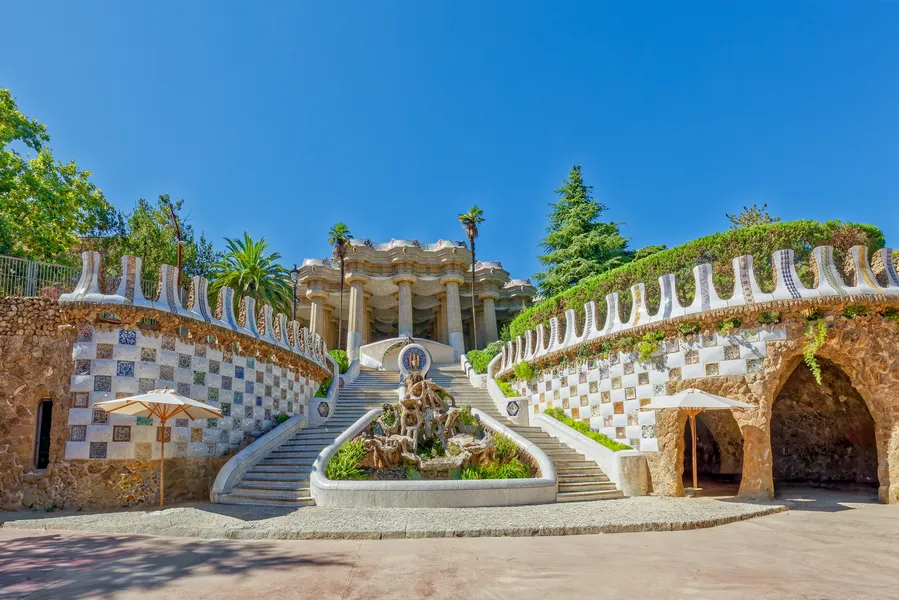
Gaudí designed Park Güell between 1900 and 1914 as a private residential development for wealthy Barcelonans. Only two houses were ever built – the project was a commercial failure. The city of Barcelona eventually bought it in 1926 and turned it into a public park.
Enter through the main gate on Carrer d’Olot. The first thing you see is the double staircase with the famous ceramic dragon (actually a salamander, but everyone calls it the dragon). At the top of the staircase is the Sala Hipòstila – a forest of 86 Doric columns that was designed to be a covered market. Above that is the main terrace, the Plaça de la Natura, with the long mosaic bench that snakes around the perimeter.
The bench is the reason people come here. It is covered in broken ceramic tile (trencadís) arranged in abstract patterns – some geometric, some organic. Sit on it. The view from the terrace looks out over the entire city, with the Sagrada Família towers visible in the middle distance and the sea at the horizon.
Crowd reality: By 11:00 AM the terrace is packed. By noon it is extremely crowded. The 9:30 AM slot is the right call – you will have the bench mostly to yourself for the first 20 minutes.
What to skip: The Gaudí House Museum inside the park is interesting but takes 45 minutes and eats into your schedule. Skip it on a one-day visit.
What most people miss: Walk up past the terrace into the free, upper section of the park. The viaducts (stone colonnaded walkways built into the hillside) are some of the most atmospheric structures in the park and almost nobody walks up to see them. Takes 10 minutes and the crowds disappear.
11:30 AM: Moving to the Sagrada Família
From Park Güell to the Sagrada Família, you have two options:
Taxi/FreeNow: 10 minutes, ~€10. Right answer for a one-day itinerary. Get in, get there, use the time you save.
Walk: 25 minutes downhill through the Gràcia neighborhood. If you have energy and time, Gràcia is worth a slow wander – it is the most residential, least touristy neighborhood in central Barcelona. Plaça del Sol and Plaça de la Vila de Gràcia are both good spots to stop for a quick coffee before the main event.
12:00 PM: Sagrada Família
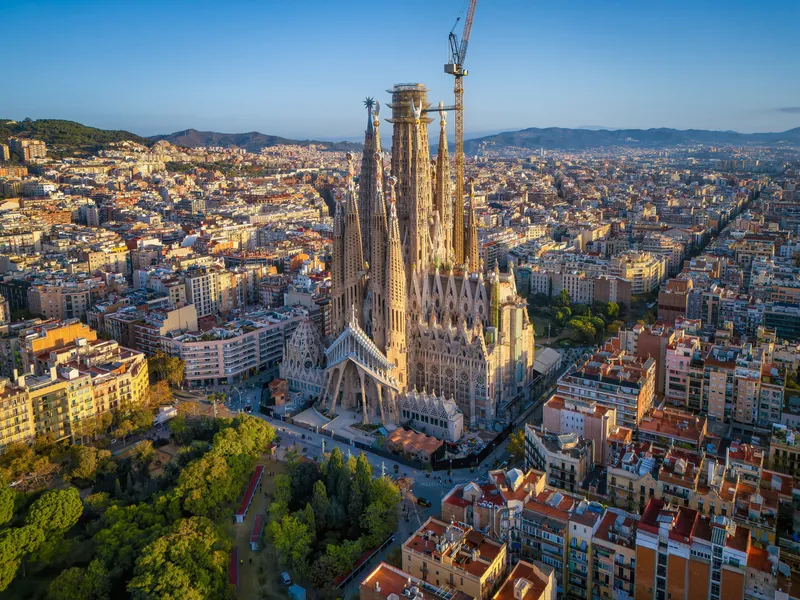

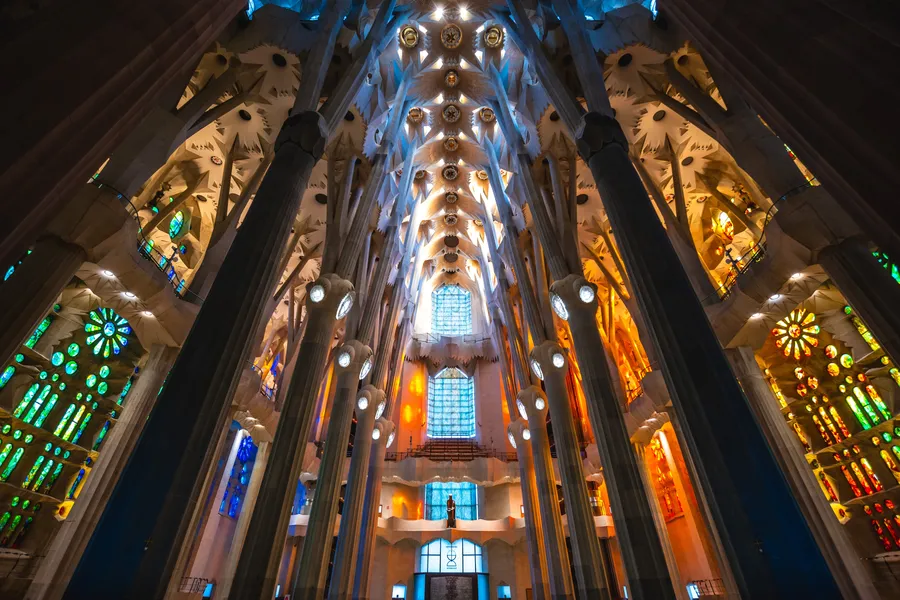
Stand across the street on Avinguda de Gaudí before you go in. Look at the Nativity Facade (east side, facing you as you approach from Gràcia). Construction began on this facade in 1882. The figures are layered three or four deep in places – animals, angels, plants, the nativity scene itself – all carved in stone that has been darkening with age for over a century.
Then go inside.
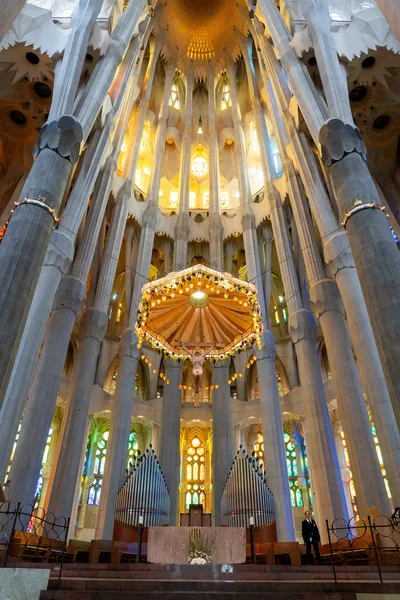
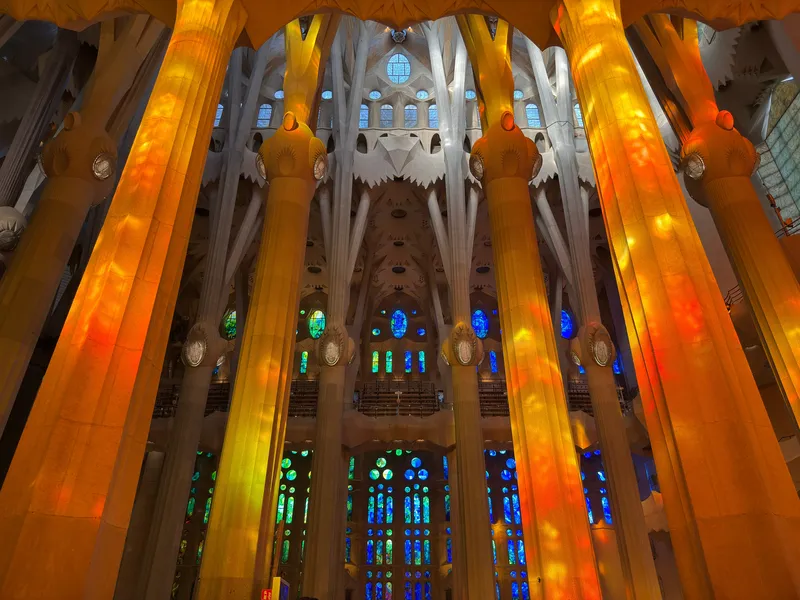
The interior is not what most people expect. Gaudí designed it as a stone forest – the columns branch as they rise toward the ceiling, mimicking trees. The stained glass runs the full length of both sides, warm amber and red on the west, cool blue and green on the east. At noon, the eastern light comes through the blue and green glass and turns the floor of the nave into something that looks like the bottom of a swimming pool.
Practical notes:
- Audio guide: Yes, worth it. The symbolism embedded in every surface is not obvious and the audio guide explains it without requiring a guided tour.
- Towers: The Nativity Tower gives better views than the Passion Tower – you can see the city grid of Eixample laid out below you. Takes an extra 45 minutes including the lift queue. Only do this if you booked it in advance.
- Time needed: 1.5 hours without towers. 2.5 hours with.
- The crypt: Gaudí is buried here. It is in the basement, accessible with your ticket. Takes 5 minutes and most people skip it.
Before you leave, walk around to the Passion Facade on the west side. Where the Nativity Facade is ornate and layered, the Passion Facade is angular, skeletal, and deliberately harsh. The sculptor Josep Maria Subirachs completed it in the 1980s and 1990s in a style that caused enormous controversy. The scene of Christ carrying the cross, carved in sharp geometric planes, is one of the more unsettling pieces of religious art you will find anywhere in Europe.
01:45 PM: Lunch in Eixample
You are now in the middle of Eixample – the grid district with the distinctive chamfered corners on every block. Do not eat within two blocks of the Sagrada Família. The restaurants immediately surrounding it exist entirely to catch tired tourists.
Walk three blocks in any direction toward Passeig de Gràcia. The restaurant density and quality improves immediately.
Cervecería Catalana (Carrer de Mallorca, 236) is the reliable choice – small tapas plates, good patatas bravas, and the pan con tomate here is worth ordering even though it sounds boring. Arrive before 1:30 PM or expect a 20-minute wait. They do not take reservations for lunch.
What to order: Huevos Cabreados if it is on the menu (fried eggs over broken fried potatoes with jamón), the croquetas, and whatever fish special they have that day. Budget €18-€25 per person including a drink.

The Menú del Día – starter, main, dessert, and a drink for €14-€18 – is available at most restaurants in Eixample until 3:30 PM. If Cervecería Catalana has a queue, walk another block and look for a handwritten Menú del Día sign in any window.
For a wider breakdown of where to eat across the city, see our Barcelona food guide.
03:00 PM: Passeig de Gràcia and the Block of Discord
Walk south on Passeig de Gràcia. This is Barcelona’s main upscale boulevard – Zara next to Hermès next to Rolex next to a pharmacy. The street itself is worth looking at: the hexagonal pavement tiles were designed by Gaudí (the same pattern was later reused all over the city).
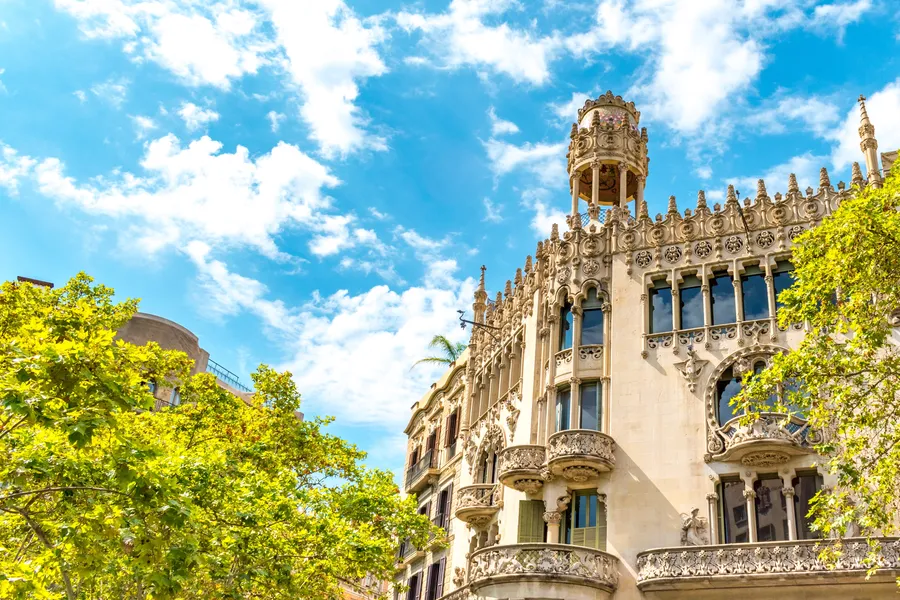
Between Carrer d’Aragó and Carrer del Consell de Cent, you hit what is known as the Block of Discord (Manzana de la Discordia) – three major Modernista buildings on the same block by three different architects, all competing for attention.
- Casa Lleó Morera (No. 35): Lluís Domènech i Montaner. The least famous of the three. Floral stone carvings on the facade, most of the ground floor was stripped out decades ago by a leather goods shop.
- Casa Amatller (No. 41): Josep Puig i Cadafalch. The Dutch-gabled roofline looks completely out of place on a Barcelona street, which was the point. There is a café inside where you can try the original Amatller hot chocolate.
- Casa Batlló (No. 43): Antoni Gaudí. The facade is covered in broken blue and green ceramic tiles that shift color as you move. The balconies look like skulls and bones. The roof is a dragon’s back covered in arched ceramic scales. The inside costs €35+ and takes 90 minutes – skip it on a one-day itinerary. Stand on the pavement and look at it properly for five minutes instead.
Two blocks further south is Casa Milà (La Pedrera, No. 92) – the building that looks like eroded limestone, with the famous chimneys on the roof that look like helmeted warriors. Same logic applies: the exterior is free, the interior is €28+. On a single day, your ticket money was better spent at the Sagrada Família.


04:30 PM: The Gothic Quarter
Cross Plaça de Catalunya and enter the Barri Gòtic. The transition is abrupt – you go from a wide, sunlit boulevard to narrow medieval streets where the buildings are close enough that neighbors could shake hands from their windows.
Walk down Portal de l’Àngel (pedestrian shopping street) until you reach the Barcelona Cathedral. This is the older cathedral – not the Sagrada Família, which is a basilica. The Barcelona Cathedral was built between 1298 and 1450. The cloister at the back contains thirteen white geese, one for each year of the life of Santa Eulàlia (the co-patron saint of Barcelona), who was martyred at age 13. They have been kept here continuously since the 14th century. Entrance to the cathedral is free during worship hours (check current times before visiting, typically mornings and late afternoons).

From the Cathedral, head south through the maze of streets. The goal here is not to follow a route – it is to get moderately lost. The streets are mostly from the medieval period and several follow the lines of the original Roman city wall. If you find Plaça de Sant Jaume, you are standing at the political center of Catalonia – the Catalan government building and Barcelona’s City Hall face each other across the square. Further south, Plaça Reial is a wide, palm-lined square with restaurants around the perimeter. It is one of the few places in the Gothic Quarter where you can sit in sunlight.
Pickpocket note: This is the highest-risk area in the city. Bag on your front. Phone in your pocket. Be aware of anyone who bumps into you or creates a distraction.

06:00 PM: El Born and Santa Maria del Mar
Cross Via Laietana (the wide road that cuts through the old city) east into El Born. The neighborhood immediately feels different – slightly wider streets, better bars, younger crowd.
Walk to Santa Maria del Mar. It was built between 1329 and 1383 by the merchants and sailors of the Ribera neighborhood, who physically carried the stone from a quarry outside the city on their backs – a detail recorded in the church’s construction documents. The Gothic interior is unusually light for a medieval church because the columns are spaced further apart than normal, giving it an open, airy quality that the larger Barcelona Cathedral does not have. Entry is free in the evening. Sit inside for ten minutes. It is quiet in a way that nothing else on this itinerary is.
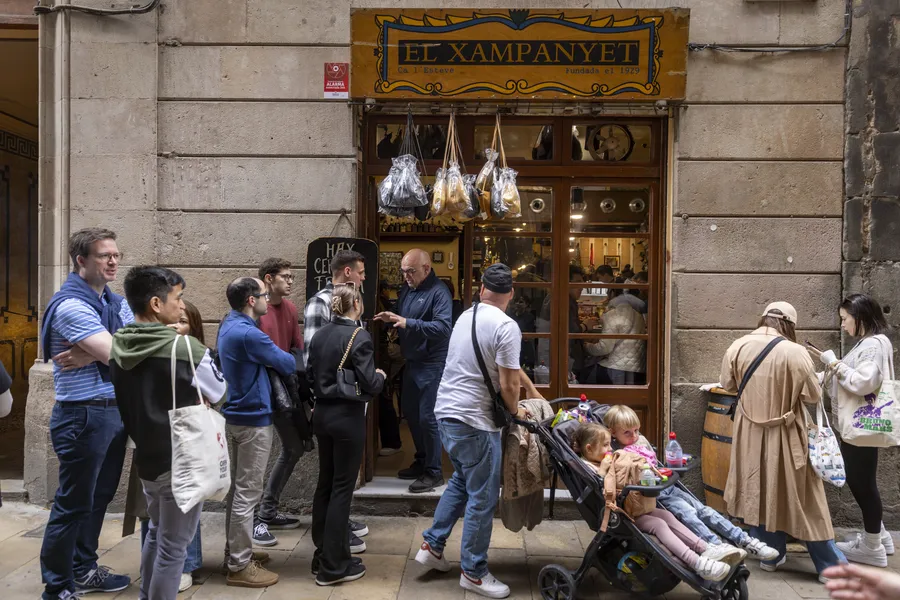
From Santa Maria del Mar, the streets of El Born fan out in every direction. This is the best neighborhood in the city for a drink: El Xampanyet on Carrer de Montcada serves house cava by the glass at around €3 and has been doing so since the 1950s. The bar is narrow, always crowded after 6:00 PM, and covered in antique tiles. Get there before 6:30 PM or expect to wait outside.


07:30 PM: The Final Decision – Beach or Bar
At this point you have covered roughly 15,000 steps and seen the main sights. You have two options for the end of the day.
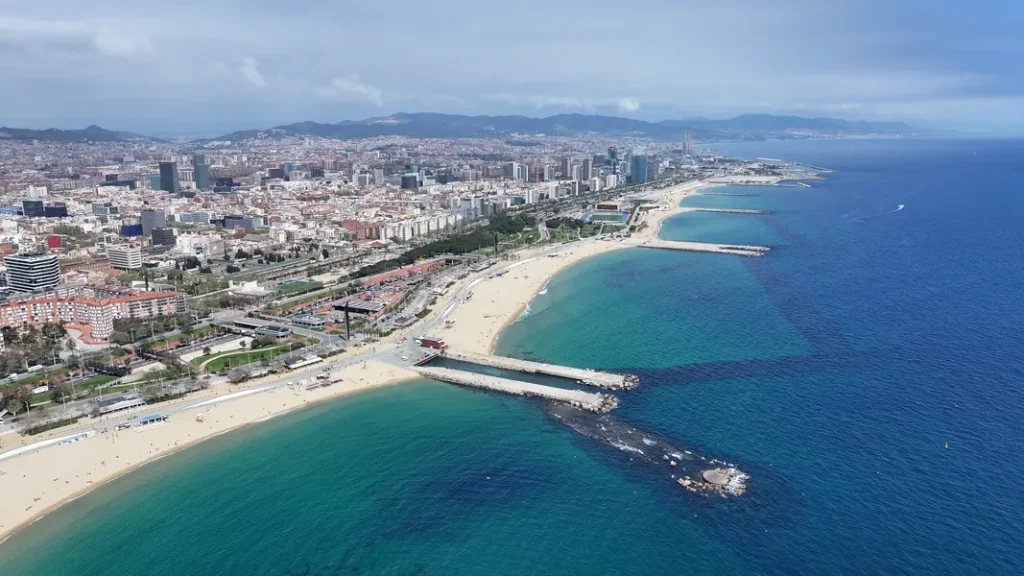
The beach option: Walk 15 minutes south and east from El Born to Barceloneta. The beach itself is fine – it is clean, Mediterranean, and the water is swimmable from May through October. The chiringuitos (beach bars) along the promenade serve cold beer and frozen drinks. Sitting on the sand watching the light go off the water is a reasonable way to end a long day. The Barceloneta restaurant strip on Passeig Marítim is heavily tourist-facing – if you eat here, stick to the beachside bars rather than the sit-down restaurants.

The city option: Stay in El Born. The neighborhood has the best bar density in the city for this time of evening. Order a Vermut over ice with an olive, find a stool outside, and watch the street.
On dinner timing: Locals eat dinner at 9:00 PM at the earliest, more typically 9:30 PM to 10:30 PM. If you are hungry at 7:30 PM you are on tourist time. Order a small tapa or some olives to hold you over, or accept that you are eating early at a restaurant that is primarily serving other tourists.
The Honest Summary
This itinerary covers five distinct stops: Park Güell, Sagrada Família, a proper Eixample lunch, the Gothic Quarter, and El Born. That is a full day by any standard. What it does not cover – Casa Batlló interior, Picasso Museum, Montjuïc, Camp Nou, the Boqueria market – are all legitimate things to do, but none of them fit into a single day without cutting something better.
If this day makes you want to come back with more time, our 3 days in Barcelona itinerary builds on exactly this route. And if you are trying to do all of this without spending more than you have to, our Barcelona on a budget guide covers where the tourist price premium is worth paying and where it is not.
New to Barcelona entirely? Read our first time in Barcelona guide before you land – it covers the transport card, meal times, safety, and the Sagrada booking process in detail.
Can you do Park Güell and Sagrada Família in one day?
Yes, if you book the 9:30 AM slot at Park Güell and the 12:00 PM slot at the Sagrada Família. A taxi between the two takes 10 minutes. Walking takes 25 minutes. Do not try to do it the other way around – Sagrada first, Park Güell second – the afternoon crowds at the park are significantly worse.
Is one day in Barcelona enough?
For a first visit, one focused day covers the architecture highlights and gives you a sense of the city’s neighborhoods. You will not see everything. The Picasso Museum, Montjuïc, a proper beach afternoon, and any serious eating require more time. If you have flexibility, two days is the right minimum.
What is the best way to get around Barcelona in one day?
Start with the Metro (buy the T-Casual card – 10 rides for ~€12 at any station). Use a taxi or FreeNow for the jump from Park Güell to Sagrada Família. Walk everything else. The city center is compact and flat enough that walking between the Gothic Quarter, El Born, and Barceloneta is faster than waiting for transit.
Do I need cash in Barcelona?
Most places accept card, including small bars and tapas spots. Carry €20-€30 in cash as backup for markets, very small cafes, and splitting bills. ATMs are everywhere but use your bank’s network to avoid fees.
What time do Barcelona restaurants open for dinner?
Most restaurants open for dinner at 8:30 PM to 9:00 PM. The locals arrive at 9:30 PM or later. If you show up at 7:00 PM, you will either find the restaurant closed or be eating alongside other tourists. Order a drink and a small snack at a bar to bridge the gap.
One Day in Barcelona — The Route
North to south, downhill all day. Click any pin for timing, prices, and what to skip.