
Madrid on a budget is completely doable if you know where to look. Madrid has a reputation as an expensive capital. The rooftop cocktail bars, the Michelin-starred restaurants, the designer boutiques on the Salamanca district’s wide avenues – all of that exists and all of it will drain your account quickly if you let it.
But underneath the imperial architecture, Madrid is a working-class city. It was built by and for the people who navigate its streets every day. Step off the main tourist corridors, use the ticketing system correctly, and eat on the local clock, and Madrid becomes one of the cheapest capital cities in Western Europe. This guide shows you exactly how.
The Menú del Día: The Most Important Thing to Know
You cannot talk about saving money in Spain without covering the Menú del Día – the single greatest lunchtime deal on the continent.
During the 1960s, the Spanish government required restaurants to offer affordable multi-course meals for working-class laborers. The law is long gone. The tradition is not.
How it works
Between 1:30 PM and 4:00 PM, almost every traditional restaurant in Madrid puts a chalk board on the sidewalk. Fixed price, three courses. In 2026, a standard Menú del Día in a local neighborhood runs €11 to €15. Here is what you get:
- El Primer Plato: A heavy starter – a bowl of lentil stew, a plate of paella, a salad, or cold gazpacho
- El Segundo Plato: A main – grilled pork loin with fries, roasted chicken, or a filet of sea bream
- Pan y Bebida: A basket of bread plus a drink – and the drink includes draft beer or, in many local spots, an entire bottle of house red wine left on the table
- Postre o Café: Flan, a piece of fruit, or an espresso
How to spot the tourist trap version
The menu boards in tourist areas have weaponized this tradition. Two red flags:
- If the board is printed on laminated card with photos and four languages, keep walking. A real local menu is handwritten in chalk, entirely in Spanish.
- If a restaurant on Gran Vía advertises a “Menú del Día” at 6 PM featuring paella and sangria, it is not the real thing. The genuine menu runs Monday through Friday during the afternoon lunch rush only. Weekend versions exist but cost €5-8 more.
The Museums: Free Entry Hours
Madrid’s three major art museums – the Prado, the Reina Sofía, and the Thyssen-Bornemisza – cost nearly €50 combined at full price. The Spanish government legally requires all three to offer free entry windows.
The Prado
The Prado holds the former Spanish royal collection: Velázquez, Goya, El Greco, Bosch.
- Free window: Monday-Saturday from 6:00 PM to 8:00 PM. Sundays and holidays from 5:00 PM to 7:00 PM.
- The reality: You cannot walk up at 6:05 PM. The line forms at the Puerta de Goya entrance by 5:00 PM. By 5:45 PM it wraps around the building.
- The move: Get in line at 5:15 PM. Wait 45 minutes, enter in the first wave. You have two hours – run straight to Las Meninas (Room 12), Goya’s Third of May (Room 64), and Bosch’s Garden of Earthly Delights (Room 56A). Then leave. For the full targeted museum strategy, see our 1 day in Madrid itinerary.
The Reina Sofía
Home to Picasso’s Guernica – a room-sized anti-war mural that is alone worth the visit.
- Free window: Monday, Wednesday-Saturday from 7:00 PM to 9:00 PM. Sundays from 1:30 PM to 2:15 PM. Closed Tuesdays.
- The move: Arrive at 6:45 PM. The queue here moves faster than the Prado. Walk directly to Room 206 on the second floor before the crowds flood the corridor.
The honest trade-off
If you only have 48 hours in Madrid, is it worth two hours of your evening standing in a queue to save €15? If your budget is genuinely tight, yes. If you value time over money, book online in advance and go in the morning. There is no shame in either choice.
Cheap Eats Beyond the Menú del Día
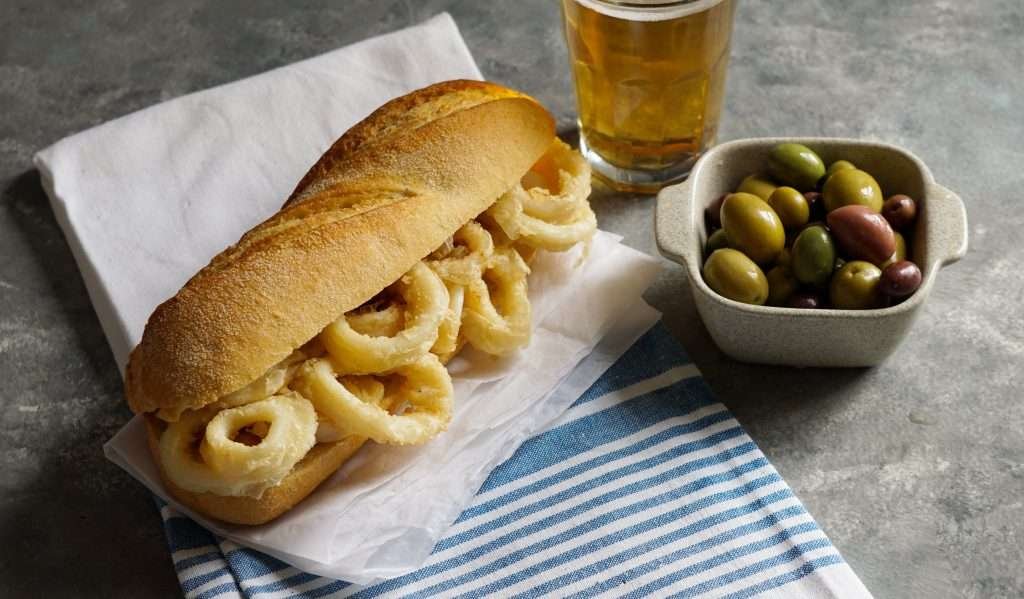
The Bocadillo de Calamares – €4
Madrid is landlocked, yet its most famous street food is fried seafood. A Bocadillo de Calamares is a fresh crusty baguette stuffed with thick rings of flash-fried squid. No lettuce, no tomato – just squid, a squeeze of lemon, and optionally some alioli.
Do not order this at a sit-down restaurant. Go to Bar La Campana on Calle Botoneras 6, just outside the southwest arches of Plaza Mayor. Fight to the counter, hand over roughly €4, and eat standing up on the cobblestones. Add a draft beer (caña) for €2-3. This is the best €6 lunch in the city.

One important note: in Granada, tapas are free when you order a drink – a cultural tradition that makes the south dramatically cheaper for drinking. Madrid does not work this way. You pay for tapas here. For a full breakdown of how the free tapas economy works and why it matters, our what to eat in Granada guide explains the difference. The Menú del Día is the foundation of how to save money in Madrid when it comes to food.
100 Montaditos – Wednesdays and Sundays only
This is a Spanish chain and not the kind of place that appears in high-end travel writing. It works on a simple premise: 100 types of montaditos (small slider-sized sandwiches on bread). On Wednesdays and Sundays, almost everything on the menu drops to €1 per piece. Pints of beer: €1.50.
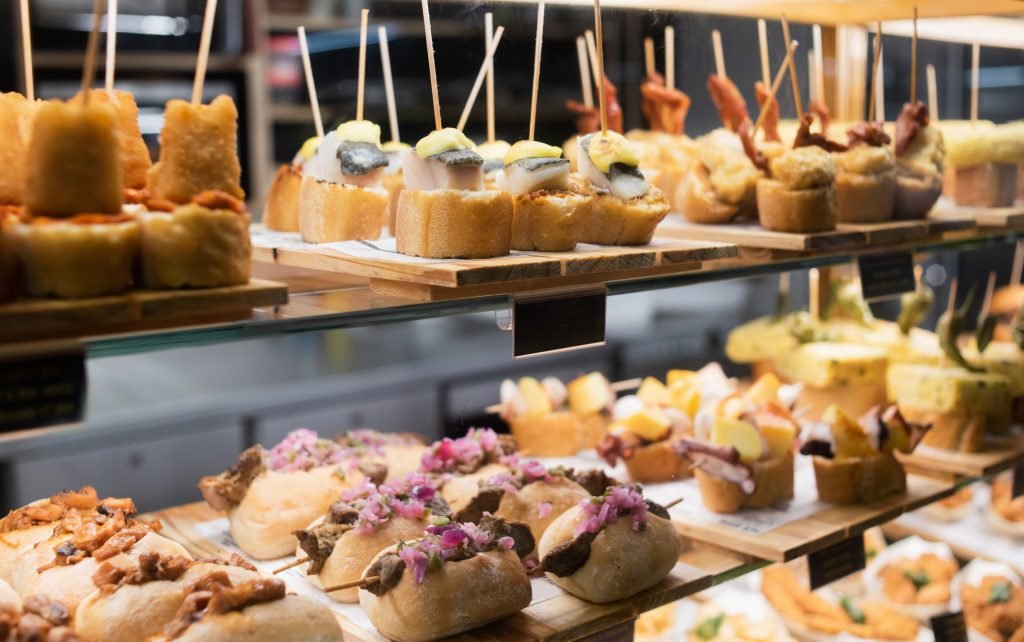
Is it Michelin-quality food? No. If you are on a tight budget, you can eat five sandwiches and drink two beers for under €8. You order by writing numbers on a paper slip at the counter – no waiter interaction required.
Sidrería El Tigre – Chueca neighborhood
El Tigre operates like a scaled-up version of the Granada free tapas model. Order a large beer or cider (around €5-6) and the bartender brings mountains of free food with it – patatas bravas, Spanish omelet, bread with ham. The floor is covered in napkins. The noise is considerable. It is a rite of passage for every budget traveler in Madrid.
Getting Around Without Wasting Money
Skip taxis and Ubers
The historic center is compact enough to walk almost everywhere. When you cannot, use the Metro. An Uber through Madrid’s center in traffic costs €15 and takes longer than walking.
The Tarjeta Multi

Madrid no longer sells paper Metro tickets. At any ticket machine, buy a red plastic Tarjeta Multi card (€2.50 for the card itself), then load it with a 10-journey Metrobús ticket (€6.10). That brings each ride down to roughly €0.61.
The card is fully shareable. If you are traveling with someone, buy one card between you. Tap it, hand it back, they tap it.
Airport to city center
Do not pay €33 for a taxi from Madrid-Barajas (MAD).
- Option A – Exprés Aeropuerto bus (Line 203): €5, runs 24 hours, drops you at Plaza de Cibeles or Atocha in around 40 minutes. Tap your contactless card on the bus.
- Option B – Metro Line 8: Also around €5 total (standard fare plus the mandatory €3 airport supplement), but involves stairs with luggage and a transfer at Nuevos Ministerios.
Skip the hop-on-hop-off buses
They charge €25 and get stuck in outer ring road traffic. The historic center is largely pedestrianized. They cannot take you down the narrow streets where the actual city lives. Walk instead.
Free Parks and Views

The 350-acre park behind the Prado is free to enter and worth hours of your time. The Palacio de Cristal – a glass-and-iron greenhouse from 1887 on the edge of a duck pond – costs nothing to enter and houses rotating modern art exhibitions. Rowboat hire on the main lake runs a few euros if you want it, but watching from the bank is free.
Templo de Debod

A 2,200-year-old Egyptian temple dismantled in Egypt and rebuilt in the Parque del Oeste, given to Spain in 1968 to save it from rising floodwaters. Arrive an hour before sunset. You will find hundreds of locals sitting on the grass with cheap supermarket wine, waiting for the sun to drop through the ancient stone arches. Free, entirely. The best evening activity in the city.
The free rooftop view on Gran Vía

The rooftop terrace at the Círculo de Bellas Artes costs €5 to access plus €12 for a cocktail. Skip it.
Instead: walk to Plaza del Callao on Gran Vía and enter the El Corte Inglés department store. Take the elevator to the top floor – the Gourmet Experience food court. Floor-to-ceiling glass windows, outdoor terrace, unobstructed views of the Gran Vía skyline and the Metropolis building. Buy a €2 coffee from the bakery stand. Free to go up, no minimum spend.
Where to Base Yourself
Where you sleep in Madrid directly affects your daily food spend. Hotels within a five-block radius of Plaza Mayor charge tourist prices at every surrounding restaurant.
Lavapiés
South of the historic center, built on steep hills, and genuinely multicultural. Because it is historically a working-class immigrant neighborhood, food here is cheap and diverse – Senegalese, Indian, Moroccan alongside Spanish. Hostels and pensiones (guesthouses) are affordable, and you are a 15-minute walk from the Prado. The trade-off: it is hilly and the streets are narrow.
Malasaña
North of Gran Vía, this was the center of the Movida Madrileña – Madrid’s post-Franco cultural explosion of the late 1970s. Today: vintage shops, dive bars, specialty coffee. Some of the best-value modern hostels in the city are here (Bastardo Hostel is a reliable option). Loud at night, which you either want or you do not.
Avoid Salamanca entirely if budget is the priority
Dior, Chanel, Michelin stars, wide tree-lined avenues. Beautiful neighborhood. Wrong place to sleep if you are watching your spending.
For the full neighborhood breakdown with specific hotel picks at every price point, our where to stay in Madrid guide covers it in detail.
Day Trips: Bus Over Train
Madrid sits in the center of Spain, surrounded by medieval cities worth a day of your time. Toledo and Segovia are the two mandatory ones. The high-speed train is the tourist default. It is also the expensive option.
Toledo

The ancient walled capital of Spain, 45 minutes from Madrid by bus.
- The tourist trap: Travel agents push the AVE high-speed train from Atocha. Round-trip: over €30.
- The local option: ALSA bus from the Plaza Elíptica terminal (Metro: Plaza Elíptica). Journey time: 45 minutes. Round-trip cost: around €10. The bus drops you directly at the edge of the historic walls. You save €20 per person for 15 extra minutes of travel time.
Segovia

Famous for a 90-foot Roman aqueduct built without mortar and the Alcázar castle that influenced Disney’s designers.
- The tourist trap: High-speed train from Chamartín – expensive and drops you at a station miles from the aqueduct, requiring an additional city bus.
- The local option: Avanza bus from the Moncloa transport interchange (Metro: Moncloa). Journey time: around 1 hour 15 minutes. Round-trip cost: around €9. Drops you five minutes’ walk from the aqueduct.
Budget FAQ
Do I need to tip?
No – not in the way North American visitors expect. Service workers in Spain are paid a living wage. At a sit-down restaurant, rounding up the bill or leaving a euro or two is a polite gesture, not an obligation. At a tapas bar where you are ordering at the counter, nothing is expected.
Can I drink the tap water?
Yes. Madrid’s tap water comes from the Guadarrama mountains and is considered some of the cleanest in Europe. Ask for una jarra de agua del grifo at any restaurant. Do not waste money on plastic bottles.
Cash or card?
Post-2020 Madrid is very card-friendly – contactless works for a single coffee, a Metro tap, or a market stall. Carry around €20 in small bills for old-school bakeries, church entry boxes, and buskers.
Cheapest month to visit?
January and February. After Three Kings Day on January 6th, tourism drops sharply. Flights and hostels drop with it. The weather is cold but usually clear blue skies.
Are the Royal Palace gardens free?
Yes. The interior costs €14. The Sabatini Gardens on the north side of the palace and the Campo del Moro gardens directly below it are both free to enter and offer some of the best exterior views and photography angles in the city.