
For decades, the culinary reputation of the Costa del Sol was unfairly overshadowed by its status as a cheap beach destination. Tourists would fly in, eat a subpar plate of imported frozen paella on a plastic chair, drink a watered-down sangria, and assume that was the pinnacle of local gastronomy. In this guide to What to Eat in Malaga, we will uncover the true essence of the region’s cuisine.
Those days are entirely over.
Today, Malaga is recognized as one of the most dynamic, fiercely traditional, and spectacular food cities in all of Spain. The cuisine here is a beautiful, edible history lesson. It reflects the Phoenicians who first salted the fish, the Romans who built the local garum (fish sauce) factories, the Moors who introduced almonds, citrus, and sugar cane, and the local fishermen who still pull their nets onto the beaches of Pedregalejo.
If you are planning your First Time in Malaga: The Only Guide You Need (2026), understanding how, when, and what to eat is the single most important part of your trip. The Mediterranean diet is not a fad here; it is the absolute foundation of daily life. This comprehensive guide will walk you through every meal, every strange local tradition, and every absolute must-order dish in the capital of the Costa del Sol.
This is your complete resource for understanding What to Eat in Malaga, ensuring you experience the best culinary delights the city has to offer.
Chapter 1: The Malaga Breakfast (El Desayuno)
Do not attempt to find a heavy, American-style breakfast of eggs and bacon in a traditional Malaga cafe. You will only find disappointment. Breakfast in Andalusia is a fast, carbohydrate-heavy, and incredibly specific ritual designed to be consumed at a metal counter before heading to work.
The Pitufo If you order a sandwich in Madrid, you get a bocadillo. If you order one in Malaga, you must ask for a pitufo. The word literally translates to “Smurf,” and it refers to a small, oval-shaped bread roll that is toasted and filled.

While you can get a pitufo with modern fillings like avocado or turkey, to eat like a true Malagueño, you must order a Pitufo con Zurrapa. Zurrapa is not for the faint of heart or the diet-conscious. It is a traditional spread made from pork lard (manteca) infused with paprika, garlic, and tiny, slow-cooked shreds of pork loin. It is salty, incredibly rich, and melts instantly into the hot, toasted bread. If that is too heavy, the classic Pitufo con Tomate (crushed tomatoes, local olive oil, and sea salt) is a lighter, refreshing masterpiece.
Tejeringos: The Local Churro If you are following my 3 Days in Malaga: The Perfect Itinerary for First Timers (2026 Edition), you already know that churros are a mandatory morning event. However, Malaga has its own highly specific variation called the tejeringo.

Unlike standard churros that are often extruded by a machine in massive loops, true tejeringos are drawn by hand using a syringe-like tool. The dough has a slightly different yeast content, resulting in a pastry that is exceptionally crispy on the outside but incredibly airy and fluffy on the inside. You dip them into molten, dark hot chocolate, and you eat them immediately.
The Unique Coffee Lexicon Ordering coffee in Malaga is unlike ordering coffee anywhere else on the planet. In the 1950s, the owner of the famous Café Central invented a specific measurement system based exactly on the ratio of espresso to milk, ensuring customers got exactly what they wanted without wasting beans.
You must learn these terms:
- Un Solo: 100% coffee, no milk.
- Un Largo: 90% coffee, 10% milk.
- Un Mitad: 50% coffee, 50% milk. (This is the standard order).
- Un Corto: 30% coffee, 70% milk.
- Una Sombra: 20% coffee, 80% milk. (Literally a “shadow” of coffee).
- Una Nube: 10% coffee, 90% milk. (Literally a “cloud”).
Chapter 2: The Art of the Espeto (The Ultimate Malaga Dish)
If there is one culinary experience that defines Malaga, it is the Espeto de Sardinas. You cannot leave the city without eating this. In fact, eating an espeto is so deeply ingrained in the culture that it features prominently as a top activity in my 25 Best Things to Do in Malaga: The Ultimate 2026 Guide.
What is an Espeto? An espeto is a skewer of fresh sardines roasted over an open wood fire. But the magic lies entirely in the hyper-specific technique.
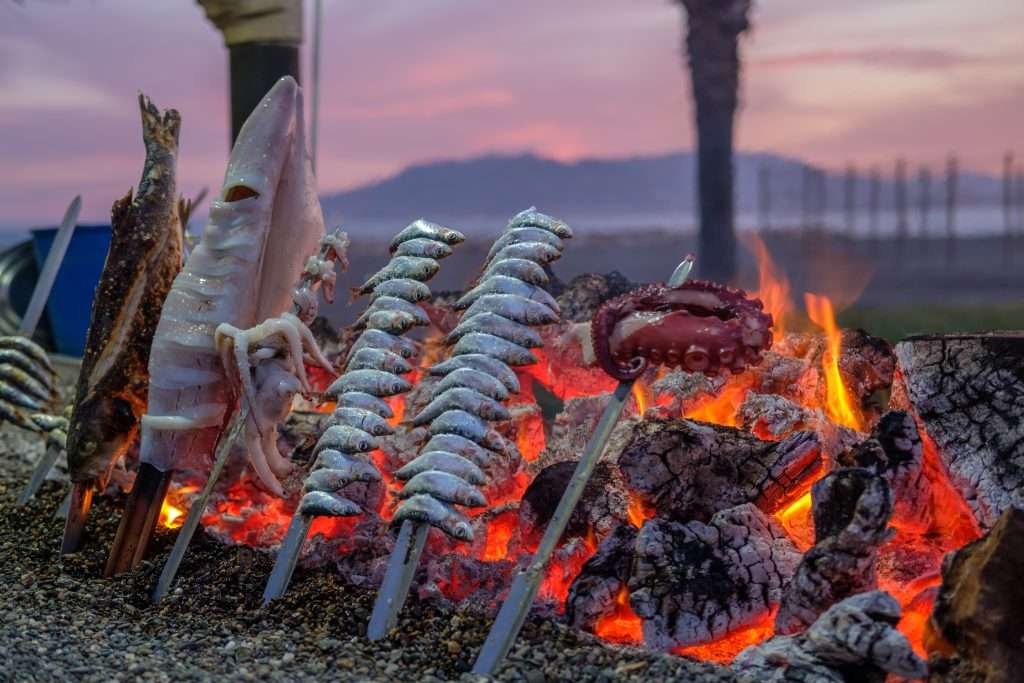
Local espeteros (the grill masters) take six plump sardines and skewer them on a sharpened piece of wild olive wood. They do not use charcoal grills. Instead, they build roaring fires inside old, sand-filled wooden fishing boats (called jabegas) right on the beach. The olive wood imparts a distinct, slightly sweet smoke. The skewers are stabbed into the sand next to the fire, allowing the fish to slowly roast in the ambient heat and smoke without ever touching a metal grate.
The skin blisters and chars, the sea salt crystallizes, and the fatty meat inside remains incredibly juicy.
How and When to Eat Them
- The Location: You do not eat espetos in the historic city center. You must walk or bike east to the old fishing neighborhoods of Pedregalejo or El Palo. Here, the beachfront promenade is lined with dozens of chiringuitos (beach bars) with boats burning wood out front.
- The Rule of the ‘R’: Local tradition dictates that you should only eat sardines during months that do NOT contain the letter “R” in their Spanish name (Mayo, Junio, Julio, Agosto). During these summer months, the water is warmer, and the sardines are fattier and more flavorful.
- The Technique: Put your fork and knife away. You eat an espeto with your hands. Grab the sardine by the head and tail, bite the meat off the spine like corn on the cob, and wash it down with an ice-cold Victoria beer (the official beer of Malaga).
Chapter 3: Fritura Malagueña (The Fried Fish Platter)

Andalusia is famous for frying fish, but Malaga has perfected it into an absolute art form. A Fritura Malagueña is a mixed platter of deep-fried seafood, and it serves as the ultimate sharing plate for a long, lazy weekend lunch.
The Golden Rules of Fritura A bad fried fish platter is heavy, greasy, and tastes mostly of old oil. A proper Malaga fritura is a revelation. The secret lies in using exceptionally clean, high-quality extra virgin olive oil and a very light dusting of coarse chickpea or wheat flour. There is no heavy, beer-battered crust here. The frying is done at an incredibly high temperature so the seafood flash-cooks, sealing in the moisture while leaving the exterior practically greaseless.
What is on the Platter?
- Boquerones (Anchovies): These are the stars of the show. In fact, the people of Malaga eat so many anchovies that their official nickname in Spain is Los Boquerones. They are usually fried whole, joined at the tail. You eat the entire thing-bones, tail, and all. They are salty, crunchy, and taste purely of the sea.
- Puntillitas: Tiny, bite-sized baby squid.
- Cazón en Adobo: Dogfish (a small type of shark) that has been heavily marinated in vinegar, garlic, oregano, and cumin before being dusted in flour and fried. The vinegar cuts through the fat beautifully.
- Calamares and Chopos: Standard squid rings and small cuttlefish.
Squeeze a massive wedge of local lemon over the entire mountain of seafood and enjoy it while taking a break from checking off the sights in your First Time in Malaga: The Only Guide You Need (2026) itinerary.
Chapter 4: Tapas and Traditional Dishes
While seafood dominates the coastline, the interior of the Malaga province is highly agricultural, producing spectacular vegetables, almonds, and pork. This heavily influences the traditional tapas you will find in the historic center.


Porra Antequerana If you have been to other parts of Spain, you have likely had Gazpacho or Salmorejo. Porra Antequerana is Malaga’s local version of cold tomato soup, originating from the nearby town of Antequera (which makes for a fantastic excursion if you are researching the 5 Best Day Trips from Malaga (Worth the Effort)).
Porra is incredibly thick-so thick that a spoon should be able to stand straight up in it. It is made by blending tomatoes, green peppers, garlic, massive amounts of high-quality olive oil, and stale bread. It is served ice cold and traditionally garnished with chopped hard-boiled eggs and chunks of savory Serrano ham. On a 40°C (104°F) August afternoon, this dish is an absolute lifesaver.
Ajoblanco This is the ancient, Moorish predecessor to gazpacho, invented long before tomatoes were brought over from the Americas. Ajoblanco is a chilled, milky-white soup made from crushed raw almonds, garlic, olive oil, bread, and a splash of vinegar. It is rich, nutty, and pungent. It is almost always served with fresh green Moscatel grapes or chunks of sweet melon floating in the bowl, creating a perfect balance between savory, garlicky depth and sharp, fruity sweetness.
Ensalada Malagueña If you read the ingredients on a menu, you will likely think this dish is a mistake. Ensalada Malagueña is a traditional salad made of boiled potatoes, chunks of salt cod (bacalao), green olives, finely diced white onions, and wedges of sweet, fresh oranges.
It sounds like a chaotic flavor clash, but it is an absolute masterpiece. The starchy potatoes absorb the pungent olive oil, the salt cod provides a savory anchor, and the burst of acidic, sweet orange juice ties the entire dish together. It is a brilliant representation of the region’s Moorish agricultural history.
Albóndigas en Salsa de Almendras Meatballs (albóndigas) are standard tapas fare across Spain, usually served in a rich tomato sauce. In Malaga, they pay homage to their local nut production by serving them in an almond sauce. The sauce is made by frying raw almonds, garlic, and a slice of bread, then blending it all with chicken broth and a splash of white wine. The result is a velvety, savory gravy that demands a thick piece of bread for dipping.
Chapter 5: The Market Culture
If you want to understand the soul of a city’s food culture, you must visit its central market. In Malaga, that means dedicating an entire morning to the Mercado Central de Atarazanas.


If you are currently mapping out your daily schedule based on my 3 Days in Malaga: The Perfect Itinerary for First Timers (2026 Edition), you absolutely must block out a two-hour window for this building.
The History The building itself is a spectacular piece of architecture. Atarazanas translates to “shipyard” in Arabic. During the Moorish occupation of the city, the sea level was much higher, and this exact spot was where the Nasrid dynasty built and repaired their naval fleets. The stunning, massive white marble horseshoe arch at the main entrance is the original 14th-century gate to the shipyard. Today, the building is a soaring iron-and-glass structure containing the best produce in the province.
What to Buy and Eat The market is divided into three distinct zones: Meat, Fish, and Produce.
- The Olive Stalls: You will find dozens of varieties of olives here, the most famous being the Aceituna Aloreña, a bitter, cracked green olive heavily seasoned with fennel, thyme, and garlic.
- The Almonds: Buy a paper cone of freshly roasted Marcona almonds. They are roasted in olive oil and hit with sea salt, making them the ultimate walking snack while you navigate the crowds.
- The Tapas Bars: The absolute best part of Atarazanas is that you can eat right there. Along the edges of the market are tiny, standing-room-only bars. They buy their seafood directly from the stalls 20 feet away and flash-fry it for you. Ordering a plate of grilled razor clams (navajas) or a skewer of grilled shrimp with an ice-cold Victoria beer at 12:30 PM among the shouting vendors is a peak Malaga experience.
Chapter 6: Sweets, Pastries, and Local Wines
After recovering from your morning walking tours or perhaps returning from one of your 5 Best Day Trips from Malaga (Worth the Effort), you will need a late afternoon sugar and caffeine boost to make it to a 10:00 PM dinner.
La Torta Loca Walk into any traditional pastelería (pastry shop) in the city center, and your eyes will immediately be drawn to a violently pink pastry. This is the Torta Loca (The Crazy Cake).
Invented during the lean, difficult years after the Spanish Civil War, bakers wanted to create something that looked extravagant and joyful but was made with cheap, readily available ingredients. The Torta Loca consists of two discs of puff pastry filled with a thick layer of vanilla custard (pastry cream), topped with a vibrant, bright pink frosting, and garnished with a single maraschino cherry. It is excessively sweet, slightly tacky, and universally beloved by locals.
The Sweet Wines of Malaga You cannot discuss the gastronomy of this region without dedicating serious time to its wine. Malaga is historically famous for its sweet, fortified wines, made primarily from Moscatel and Pedro Ximénez grapes. These grapes are often left out on mats to dry in the fierce Andalusian sun, turning them into raisins before they are pressed. This concentrates the sugars, resulting in a dark, syrupy, deeply complex wine with notes of figs, caramel, and roasted nuts.
Antigua Casa de Guardia To drink this wine properly, you must visit the Antigua Casa de Guardia. Founded in 1840, it is the oldest tavern in Malaga and an absolute must-visit spot on my 25 Best Things to Do in Malaga: The Ultimate 2026 Guide.
There are no chairs here. There is no music. The walls are lined with massive, ancient Russian oak barrels. You stand at a long, sticky wooden bar, point to a barrel, and the bartender pours your wine straight from the spigot into a small glass. The best part? They keep your tab by writing your total in white chalk directly on the wooden bar in front of you. When you pay, they wipe it away with a damp cloth. Order a glass of Pajarete or Cartojal and a small plate of cold mussels to balance the sweetness.
Final Thoughts on Dining in Malaga
The culinary scene in Malaga requires you to abandon your standard dining habits. You must be willing to eat lunch at 3:00 PM. You must be willing to stand up at crowded bars, shouting your order to a busy waiter over the din of hundreds of conversations. You must be willing to eat fish with your hands on the beach.
If you are willing to adopt the local rhythm, you will be rewarded with some of the freshest, most vibrant, and historically rich food in all of Europe.
(And if you are planning an extended European tour after Spain, don’t forget to check out my guide on Where to Stay in Florence: Best Areas & Hotels for First Timers (2026) to ensure your Italian food coma is just as comfortable as your Spanish one!)
What is a traditional breakfast in Malaga?
Skip the eggs and bacon. A traditional Malaga breakfast is fast and carb-heavy, consisting of a pitufo (a small, toasted oval sandwich often filled with crushed tomatoes or zurrapa, a rich pork spread). Alternatively, locals order tejeringos, which is a fluffier, hand-piped local variation of the classic Spanish churro.
How do you order coffee in Malaga?
Malaga has a highly specific, unique coffee language invented in the 1950s based entirely on the ratio of espresso to milk. If you want a standard half-coffee, half-milk, order un mitad. If you want mostly milk with just a splash of coffee, ask for una nube (a cloud), and if you want it strong, order un largo.
What is an espeto and where is the best place to eat it?
An espeto is a skewer of fresh sardines roasted over an open olive-wood fire built inside a sand-filled wooden boat right on the beach. You won’t find the best ones in the historic center; you need to head east to the traditional fishing neighborhoods of Pedregalejo or El Palo and eat them with your hands at a local beach bar (chiringuito).
What ingredients are in an Ensalada Malagueña?
Ensalada Malagueña is a traditional local salad made with a surprising but brilliant combination of flavors: boiled potatoes, chunks of savory salt cod (bacalao), green olives, diced white onions, and wedges of sweet, fresh oranges.
Where is the best place to drink sweet wine in Malaga?
You must visit Antigua Casa de Guardia, the oldest tavern in the city (founded in 1840). There are no chairs-you stand at a long wooden bar while bartenders pour local, syrupy sweet wines directly from ancient Russian oak barrels and keep your tab written in white chalk directly on the bar top.