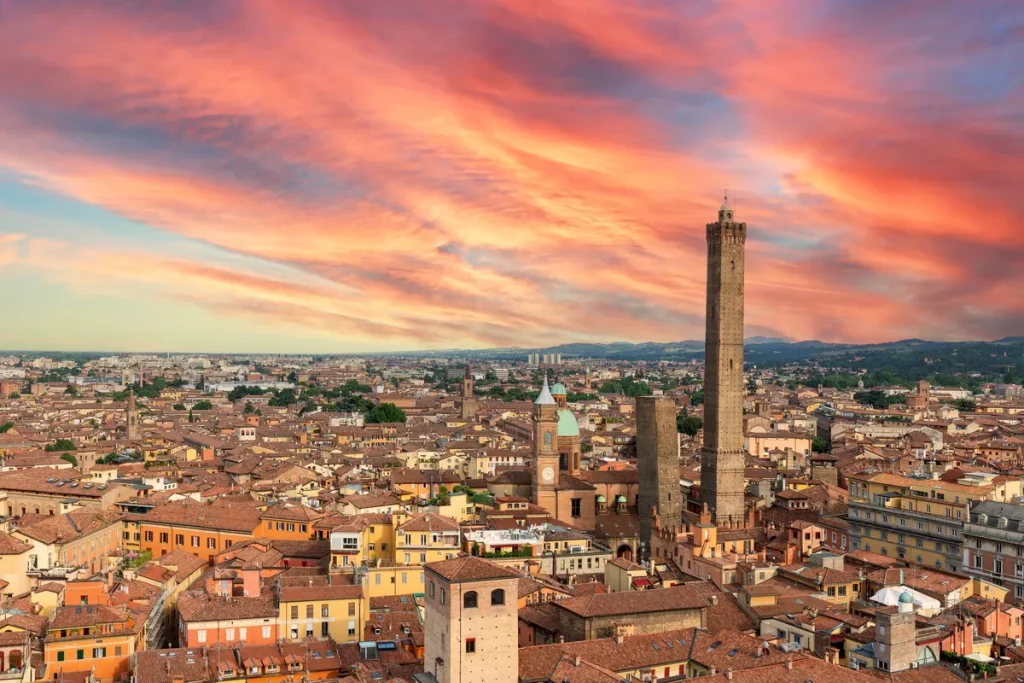
First time in Bologna, most visitors don’t know what to expect – it doesn’t appear on the standard Rome, Florence, Venice itinerary, and that’s exactly why it’s worth adding. That is a mistake, and Bologna is the reason.
It is not a tourist city in the way those three are. No gondolas, no Colosseum, no polished piazza built for photos. Bologna is a working city – gritty, politically opinionated, covered in graffiti, and run largely by 80,000 university students. The architecture is dark red brick from end to end. The streets are covered by 40 kilometres of medieval porticoed arcades.
What it has that nowhere else in Italy does: the most serious food culture on the peninsula, a train station that puts Florence, Milan and Venice within 90 minutes, and almost no competition for your attention from other tourists.
The Three Nicknames (How the City Sees Itself)
Locals refer to Bologna by three historic nicknames. Understanding them frames everything else.
La Dotta (The Learned): The University of Bologna was founded in 1088 – the oldest continuously operating university in the Western world. It is not a separate campus; it runs directly through the historic centre. The student population gives the city a loud, chaotic energy that sits in constant tension with the medieval architecture around it.
La Rossa (The Red): Two meanings. First, the physical city – terracotta brick everywhere, giving the skyline a deep burnt-orange hue. Second, the politics – Bologna has been a stronghold of the Italian left for decades, visible in protest banners and layers of political graffiti throughout the university quarter.
La Grassa (The Fat): The most relevant nickname for your trip. The cuisine here runs on pork fat, butter, egg yolks, and aged cheese. It was built for the freezing winters of the Po Valley. If you are hoping for light meals, plan your trip differently.
The Food Rules
Tourist restaurants in Rome and Florence will serve you whatever you ask for. Bologna will not. The culinary traditions here are enforced with genuine stubbornness.
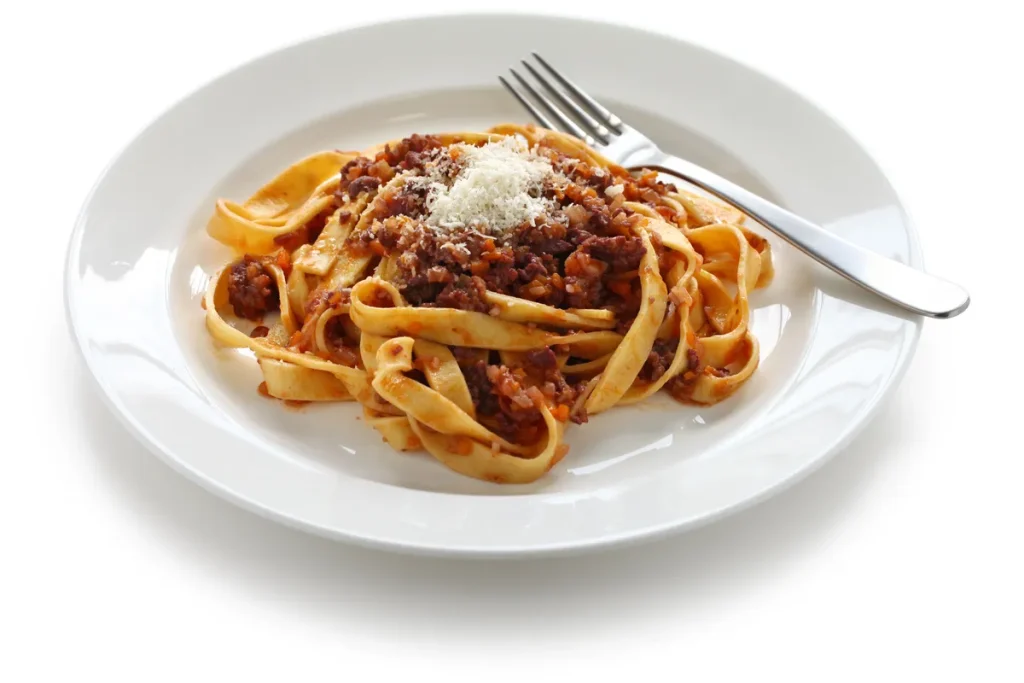
Spaghetti Bolognese does not exist here. Walk into a real trattoria and order it and the waiter will not be amused. The local meat sauce is called Ragù – slow-cooked minced beef, pork pancetta, onion, carrot, celery, wine, and a small amount of tomato paste. It is served exclusively over Tagliatelle: wide, flat ribbons of fresh egg pasta that hold the heavy sauce. Spaghetti is a southern pasta and cannot do the job. Order Tagliatelle al Ragù.
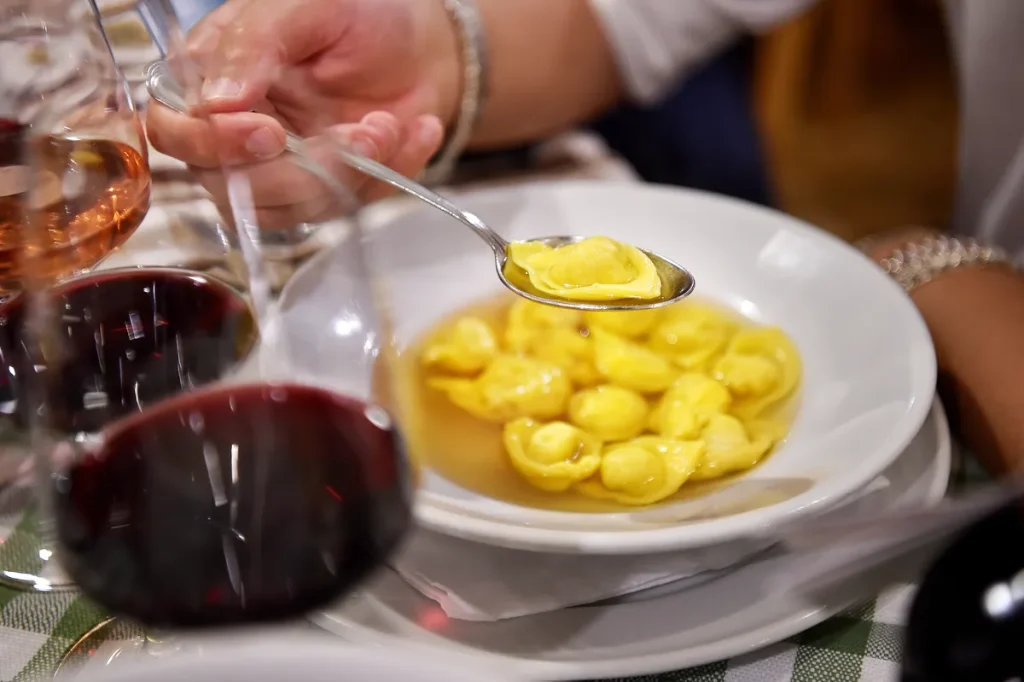
Tortellini in Brodo: The dish most locals would call the city’s signature. Tiny navel-shaped pasta rings stuffed with pork loin, prosciutto, mortadella, and Parmigiano Reggiano, served floating in a clear, deeply rich capon and beef broth. Not in cream sauce – that is a concession to tourists. In brodo is the correct order.
Mortadella: Erase whatever image the word “bologna” conjures. Authentic Mortadella di Bologna is a large, slow-cooked pork sausage studded with cubes of white pork fat and pistachios, sliced paper-thin. It has nothing in common with the supermarket product.

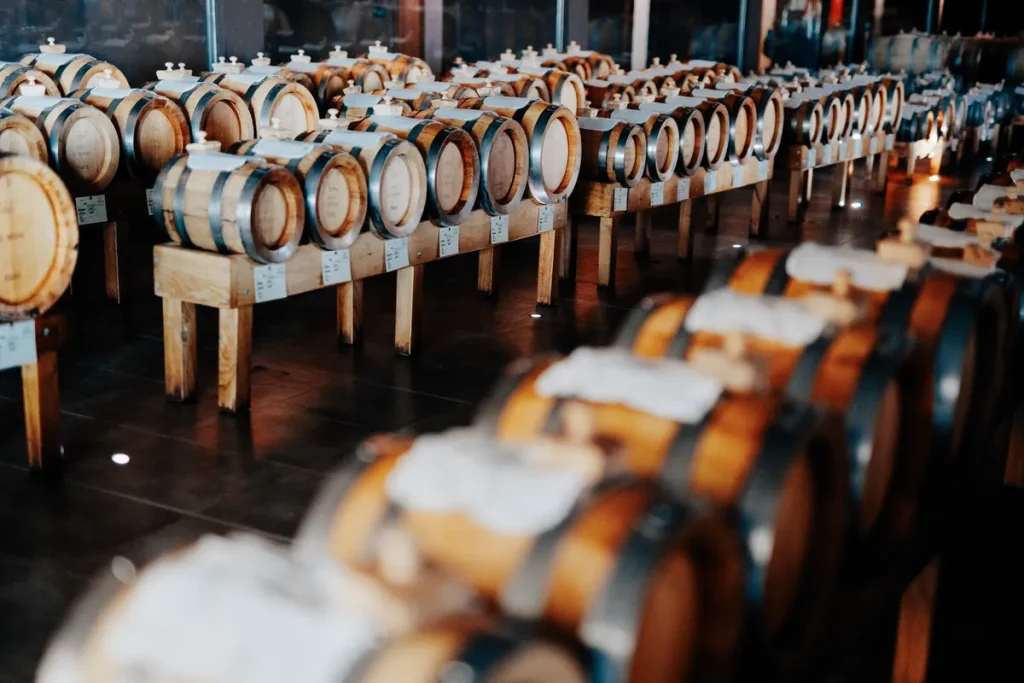
Real balsamic vinegar: Aceto Balsamico Tradizionale di Modena is aged in wooden barrels for 12-25 years, costs €60-€100 for 100ml, and has the consistency of syrup. You use three drops of it over aged Parmigiano or vanilla gelato. The thin black liquid on supermarket shelves is a different product entirely.
Where to Eat and Drink
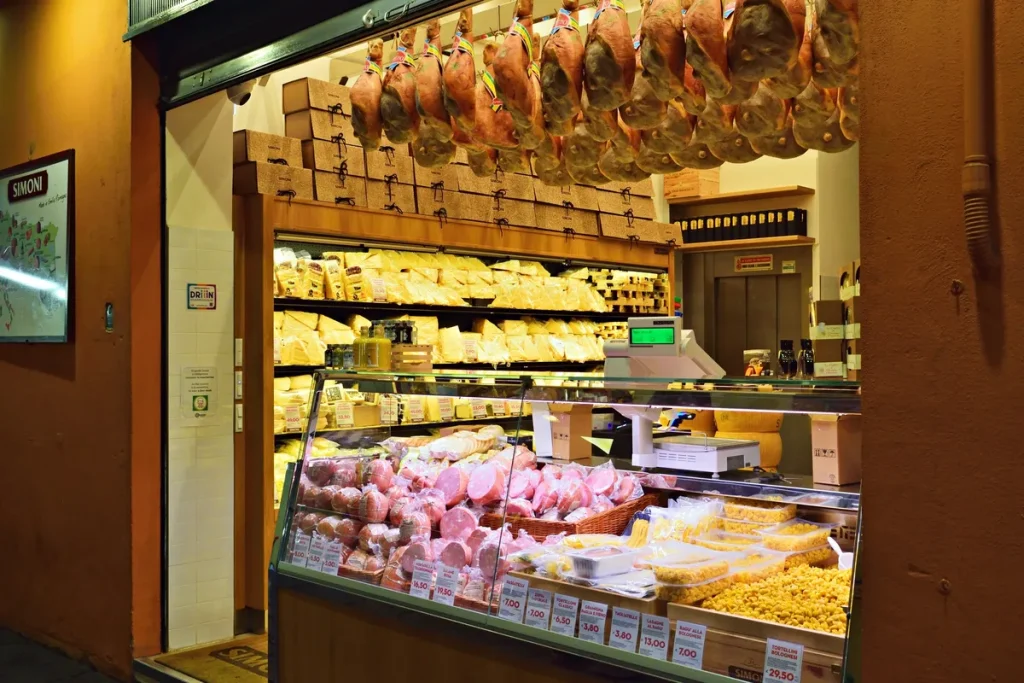
The Quadrilatero: The grid of narrow medieval alleys east of Piazza Maggiore – Via Pescherie Vecchie, Via Drapperie – has been the food market of the city since the Middle Ages. Prosciutto legs, cheese wheels, fresh fish on the cobblestones. Come here to buy ingredients, not to sit down. The outdoor tables in the alleys have become expensive and tourist-facing; the food inside the shops is the point.
Osteria del Sole (Vicolo Ranocchi 1/d): Operating in the same spot since 1465. The specific rule: they sell wine, not food. You buy mortadella, Parmigiano, bread, and olives from the delis in the Quadrilatero, carry them in a paper bag to Osteria del Sole, find a seat at one of the long communal wooden tables, and buy a bottle of local Lambrusco or Pignoletto for around €12. You eat your market food with their wine, sitting next to students, bricklayers, and professors. It is the best value meal in the city.
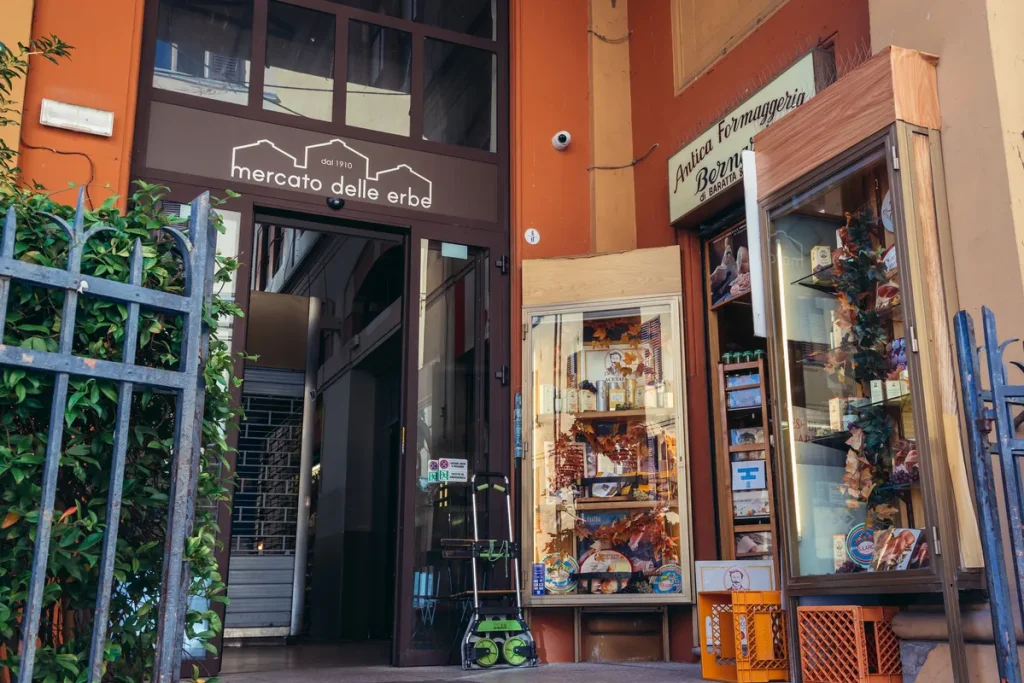
Mercato delle Erbe (Via Ugo Bassi): The largest covered market in the centre, where residents actually shop. In the evenings the side wings become a food court – regional wines, cured meats, no tourist markup.
The Porticoes
Bologna has roughly 40 kilometres of covered arcades at street level – porticoes – that extend over the pavements throughout the historic centre. They were added in the Middle Ages when property owners extended upper floors out over the street to create more living space, supporting them on wooden and stone columns. In 2021 they were named a UNESCO World Heritage Site.
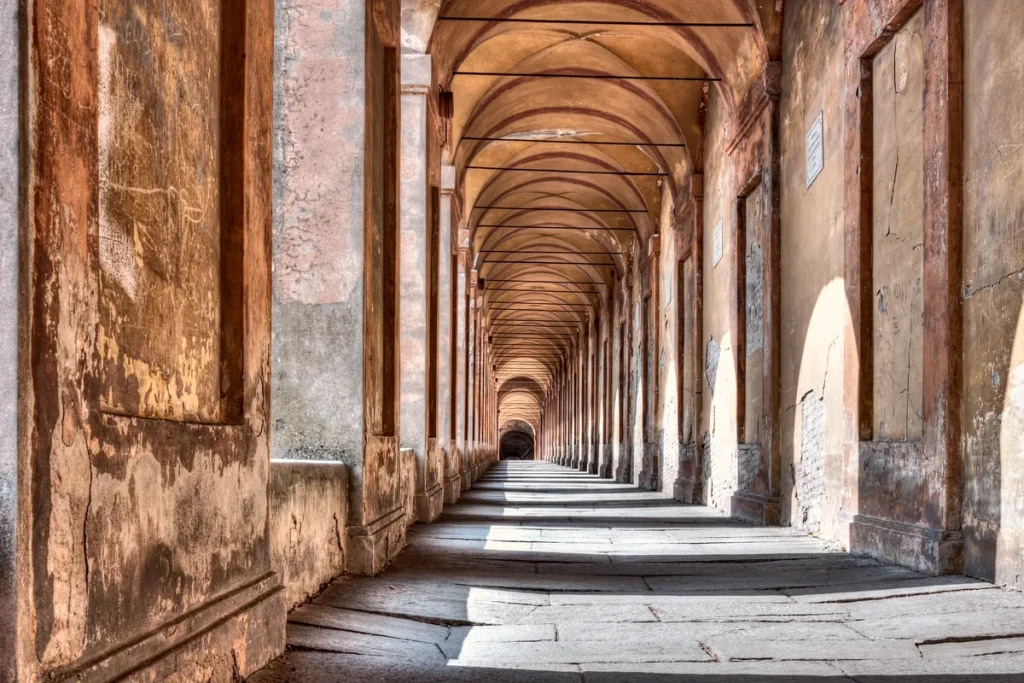
The practical result: Bologna is the most weather-proof city in Europe. In summer you cross the city in shade. In winter you can walk from the train station to Piazza Maggiore in heavy rain without opening an umbrella.
The hike to San Luca: The Portico di San Luca begins at Porta Saragozza and climbs 3.8 kilometres up a steep forested hill to the Sanctuary of the Madonna di San Luca. It runs through exactly 666 stone arches – intentionally designed to represent a serpent, with the church at the top crushing the devil’s head. The climb is steep and takes 45-60 minutes each way. Views of the Apennine hills from the top are clear on a good day, and you are covered from the elements the entire way up.
The Two Towers: 2026 Warning
Every postcard of Bologna shows the Due Torri – the tall Asinelli tower and the severely leaning Garisenda. In the 12th century the skyline had over 100 of these structures, built by wealthy families as displays of power.
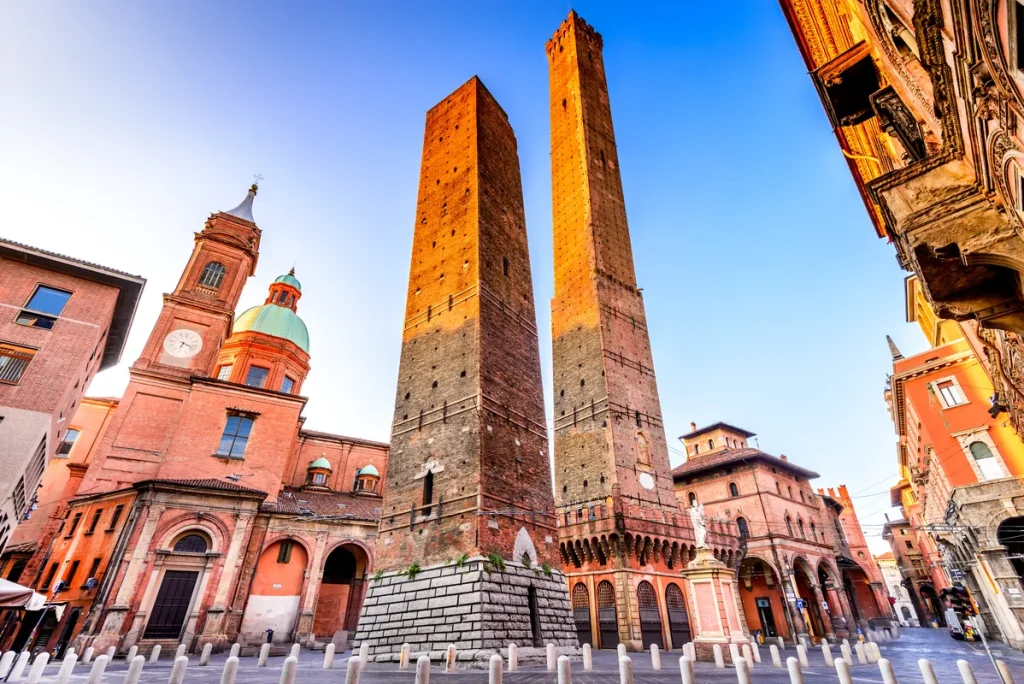
In late 2023, the Garisenda was assessed as structurally at risk of collapse. The city cordoned off the central plaza, erected protective barriers, and began a multi-year stabilisation project. As of 2026, the Asinelli Tower is closed to the public and the surrounding area is an active construction zone. Do not build your itinerary around climbing it.
Alternative viewpoint: Go to the Basilica of San Petronio in Piazza Maggiore. Walk around to the back of the cathedral into Piazza Galvani. For €5, a scaffolding elevator takes you to the roof terrace (La Terrazza di San Petronio) with an unobstructed view across the red rooftops and the hills beyond.
The University Quarter
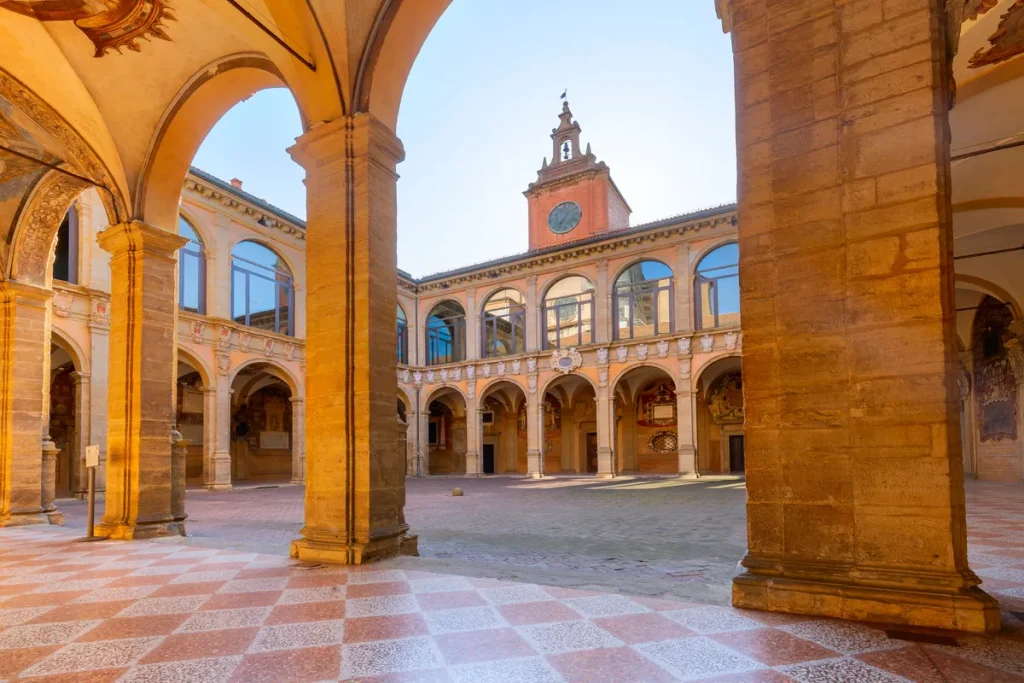
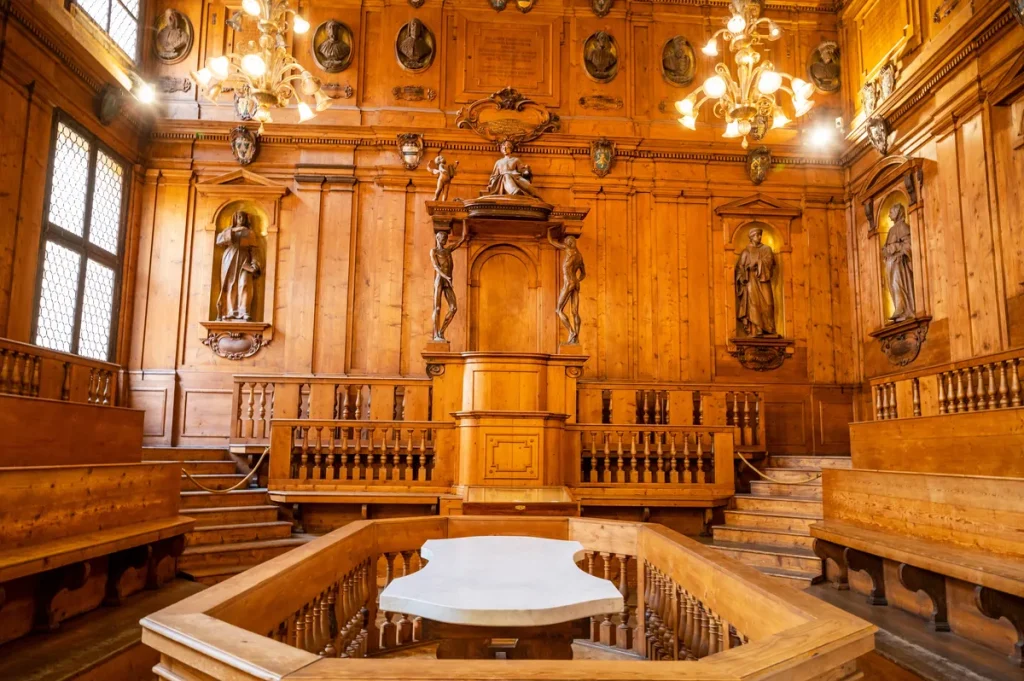
The Archiginnasio: The main university building from 1563 to 1803, just off Piazza Maggiore. Every surface of the interior courtyard is covered in thousands of coats of arms painted by students over the centuries.
The Anatomical Theatre inside costs €3 and is worth it. A wooden amphitheatre where medical students watched cadaver dissections in the 17th century. The carved wooden canopy over the professor’s chair is supported by the Spellati – two life-size statues of men with their skin removed, every muscle and tendon visible. It is extraordinary and deeply strange.
Via Zamboni: The main artery of the student district. Medieval buildings covered in political graffiti, students drinking €2 beers under the porticoes, cheap espresso, loud conversation. The contrast with the polished Archiginnasio two streets away is immediate. It is safe; the graffiti is political, not territorial.
Bologna as a Rail Base
Bologna Centrale sits at the junction of Italy’s high-speed rail network. If you are planning a broader Italy trip, staying here and making day trips is genuinely more efficient than moving hotels every two days.
Journey times from Bologna on high-speed trains:
- Florence – 38 minutes. Long enough to see the David and be back for dinner.
- Modena – 20-30 minutes by regional train. Traditional balsamic vinegar producers and Massimo Bottura’s restaurants.
- Parma – 50 minutes by regional train. Prosciutto di Parma and Parmigiano Reggiano from the source.
- Milan – 60 minutes by high-speed train.
- Venice – 90 minutes by high-speed train.
Download the Trenitalia app before you arrive. Regional trains to Modena and Parma are cheap; high-speed tickets to Florence and Milan should be booked in advance for the best fares.
Getting There and Getting Around
From the airport: Bologna Guglielmo Marconi Airport (BLQ) is connected to Bologna Centrale by the Marconi Express – an automated elevated monorail that takes 7 minutes and costs €12. Tap a contactless card at the turnstile; no paper ticket needed. A taxi runs around €25.
In the city: No metro. The historic centre is compact and flat. You walk. The Limited Traffic Zone (ZTL) covers most of the centre – do not rent a car. Cameras issue automatic fines to non-resident plates and the process for disputing them from abroad is not worth the effort.
Where to Stay
Near the station (Via dell’Indipendenza): Logistically convenient for day trips. Commercially loud, generic, and disconnected from the city’s character. The least interesting option.
Santo Stefano: Southeast of Piazza Maggiore, radiating out from the Piazza Santo Stefano and its cluster of medieval churches. Quiet, well-maintained, lined with good independent restaurants. The best base in the city for most visitors.
Pratello: The western district around Via del Pratello. A long street of cheap wine bars, craft beer spots, and late-night osterias. The right choice if nightlife is a priority.
How many days do I need in Bologna?
Two full days is enough to cover the food markets, the Archiginnasio, the Anatomical Theatre, the San Luca hike, and eat properly. Three days is comfortable if you want to add a day trip to Modena or Parma. One day works as a stop between Florence and Milan, but you will leave wanting more.
Is Bologna worth visiting if I only have a week in Italy?
If your week includes Rome and Florence, Bologna fits naturally as a one or two night stop between them. The 38-minute train from Florence makes it easy to position. It is a better use of a night than a second city you have already seen.
Is Bologna expensive?
Less than Rome, Florence, or Venice. The aperitivo culture and the market eating keep costs low if you use them. The Osteria del Sole approach – buy from delis, drink at the osteria – is genuinely cheap for the quality.
What is the best time to visit?
April, May, September, and October are the most comfortable. July and August are hot and humid – the Po Valley traps heat. Winter (November through February) is cold and foggy, which is actually the right season for the food: tortellini in brodo and ossobuco make more sense when it is 4°C outside.
Is the San Luca hike difficult?
It is steep and continuous for 3.8 kilometres. Fit walkers take around 45 minutes up. The porticoes provide full shade and shelter. There is also a small tourist train (trenino) that runs from the city walls to the sanctuary if the hike is not practical.
First Time in Bologna — What to Know Before You Go
La Dotta (The Learned), La Rossa (The Red), La Grassa (The Fat). A working city with 80,000 students, 40km of porticoed arcades, and the most serious food culture in Italy. Click any pin.