
El Retiro park is not a patch of city grass. It is 350 acres (118 hectares) of 17th-century royal landscape, a UNESCO World Heritage Site, containing over 15,000 trees, two exhibition palaces, an artificial lake, multiple hidden gardens, a rose garden, and a memorial grove. Originally built for King Philip IV’s private use, it was not opened to the public until 1868.
Because it is so large, wandering it without a plan means missing the best of it. This guide covers what is worth your time, what to skip, and how to do it properly.
Retiro sits directly behind the Prado Museum – if you are building a Madrid day, our 3 days in Madrid itinerary and 1 day in Madrid guide both route the park as the natural afternoon recovery after the Prado.
Getting In: Which Gate You Use Matters
El Retiro is walled on all sides. You enter through official gates, and the gate you choose determines what you see first.
Puerta de Alcalá (northwest corner) The grandest entrance, directly behind the Puerta de Alcalá monument. Also the most congested – it drops you straight onto the main tourist arteries. Useful if you are coming from Sol or Gran Vía, but expect company.

Puerta de Felipe IV (western edge, facing the Casón del Buen Retiro) The best gate for most visitors. It deposits you directly into the Parterre Francés – a manicured French-style garden containing the oldest tree in Madrid, a Montezuma cypress planted in 1633. Visually good, significantly quieter than the northern entrance. Use this one if you are coming from the Prado.

Atocha entrance (south) If you are walking from the Prado or Reina Sofía, you approach from the south via the Cuesta de Moyano – a slope lined with permanent wooden stalls selling antique and second-hand books. Worth a slow browse on the way in.

The Heat: A Non-Negotiable Rule
June through September, the sun in Madrid is serious. The park’s open plazas and white dirt paths reflect heat directly upward. Do not try to walk the park between 12:00 PM and 5:00 PM. Either go before 11:00 AM or after 7:00 PM. During midday, retreat into the densely wooded sections or find shade under the horse chestnut trees near the lake. This applies equally to the park and to the city – the full strategy is in our first time in Madrid guide.
The Estanque Grande and the Rowboats
Walk toward the center of the park and the trees open onto the Estanque Grande del Retiro – a large rectangular artificial lake built in the 1630s for King Philip IV, who used it to stage mock naval battles. The eastern edge is dominated by the Monument to Alfonso XII: a sweeping curved colonnade of white marble with a large bronze equestrian statue at its center.
Rowboats

The most photographed activity in the park. Small light-blue wooden rowboats, rented from the southern dock of the lake.
- Cost: roughly €6 weekdays, €8 weekends
- Rental period: 45 minutes
- On Saturday afternoons in spring, the queue exceeds an hour with no shade
- On the water at midday in July, there is zero shade and a direct sunburn guaranteed
If you want to do this, arrive at the dock at 10:00 AM when it opens. No queue, calm water, reasonable temperature.
The solar boat alternative
An enclosed, glass-roofed solar boat operates from the same docks. A few euros, zero effort, a slow 15-minute circuit of the lake. Better option if the temperature is high.
The Two Free Palaces
South of the lake, two 19th-century exhibition buildings stand close together. Both were designed by Ricardo Velázquez Bosco. Both are operated by the Reina Sofía Museum. Both are free.
Palacio de Cristal (Crystal Palace)

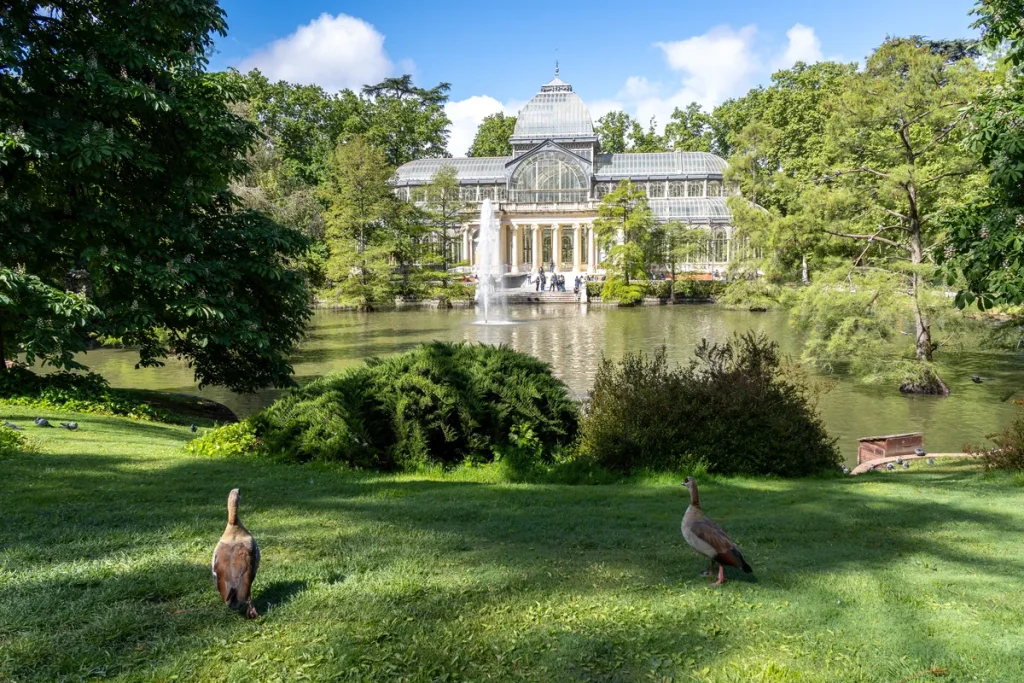
Built in 1887 to house exotic plants from the Philippines for a colonial exhibition. Almost entirely cast iron and large glass panes, sitting on the edge of a small pond with ducks, turtles, and a stand of Bald Cypresses that grow directly from the water – their roots submerged, their foliage turning deep red in autumn.
- Entry: free, with capacity limits – expect a 10-15 minute queue at the door
- No air conditioning. In July and August the interior temperature can reach unsafe levels and guards will close the building. Go in the morning.
- Current exhibitions are site-specific contemporary installations commissioned by the Reina Sofía
Palacio de Velázquez


A short walk from the Crystal Palace. Heavy red and yellow brick construction with iron vaults and glass skylights, decorated with ceramic tiles from the Royal Factory of La Moncloa. Architecturally the opposite of its glass neighbor.
- Entry: free, rarely a queue
- The thick brick walls keep the interior noticeably cooler than outside – the best summer refuge in the park
Both are worth 30-45 minutes each. For the full picture of how these fit into a broader Madrid day, our 25 best things to do in Madrid guide covers them alongside the Prado and the Royal Palace.
The Hidden Sections
Stay on the main avenues – the Paseo de las Estatuas (lined with statues of Spanish monarchs deemed too heavy for the Royal Palace roof) and the paths around the pond – and you will be in the crowds with everyone else. The better parts of the park are in the perimeter zones.
La Rosaleda (The Rose Garden)
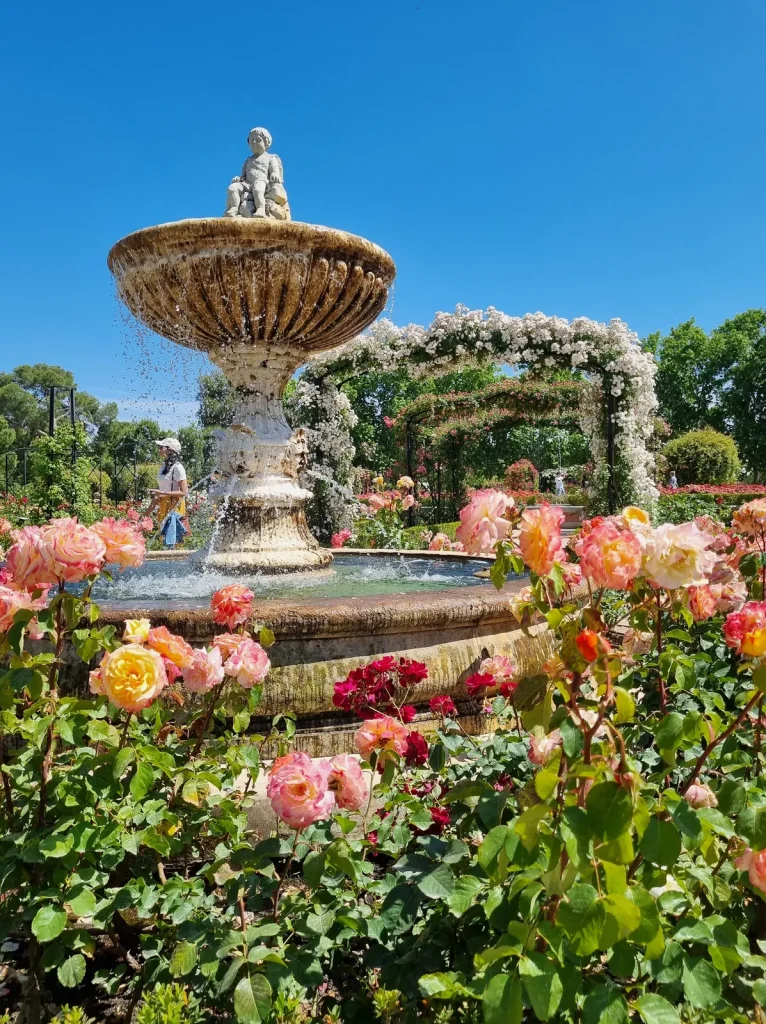
South of the central area. Circular garden designed in 1915 by Madrid’s chief gardener, modeled on the rose gardens of Paris. Over 4,000 rose bushes.
The timing matters completely: in December it is bare thorns. In May and early June it erupts into color and fragrance. The garden is enclosed by trimmed hedges, creating a quiet, scented microclimate that feels entirely separate from the rest of the park.
Jardines de Cecilio Rodríguez (The Peacock Gardens)

Far eastern edge, behind a tall brick wall and wrought-iron gates on the Menéndez Pelayo side. The strictest rules in the park: no bikes, no rollerblades, no dogs, no sitting on the grass. Guards enforce this without negotiation.
The result: the quietest place in Madrid. Geometric boxwood hedges, vine-covered pergolas, checkerboard stone paths – and a large flock of wild peacocks that roam freely through the hedges, occasionally scaling into pine trees. It feels like a private estate that was accidentally left open.
El Bosque del Recuerdo (The Forest of Remembrance)

Near the Atocha entrance. A small raised hill planted with exactly 192 olive and cypress trees – one for each victim of the March 2004 Madrid train bombings. A continuous stream runs around the base. Walk the spiral path to the top quietly. Not a photography spot.
The Fallen Angel

Near the rose garden, the main paths converge at a circular roundabout centered on the Fuente del Ángel Caído (Fountain of the Fallen Angel).
The bronze sculpture, made by Ricardo Bellver in 1877, depicts Lucifer at the exact moment of his expulsion from heaven – falling backward onto rocks, face contorted, a serpent coiled around his legs. The base features demons holding lizards and snakes. The water spouts from their mouths.
It is widely recognized as the only major public monument in the world dedicated to the Devil.
The topographical detail that locals enjoy: the official elevation of the ground directly beneath the statue is 666 meters above sea level. Whether this was deliberate or coincidental has been debated since the 19th century.
The Picnic: How to Do It Right
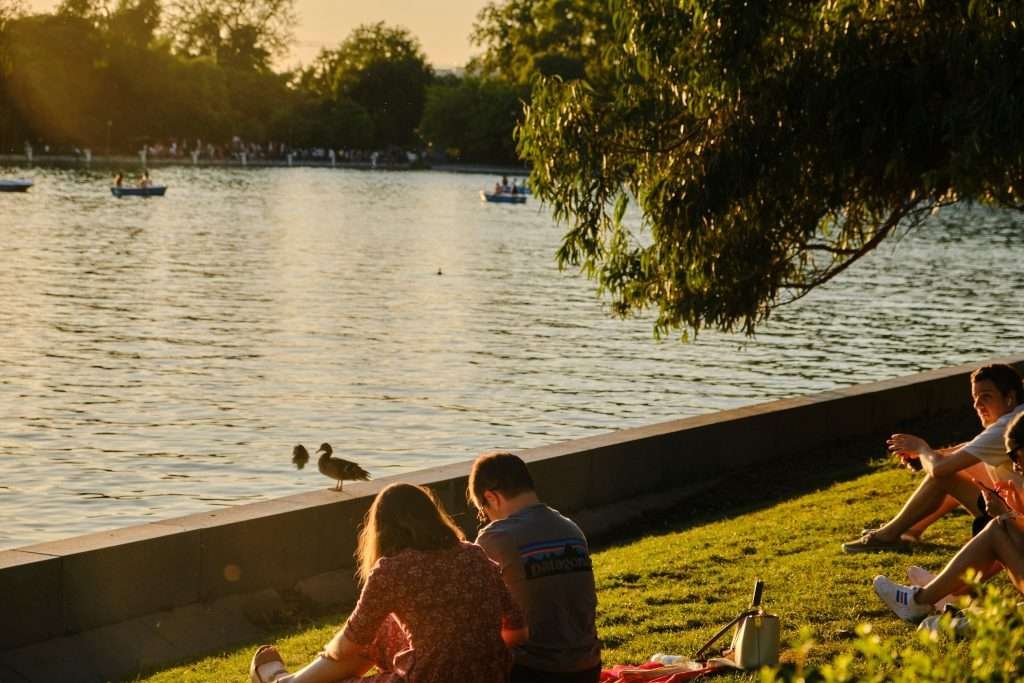
You will spend three to five hours here. Eating inside the park means the trap kiosks around the Grand Pond – overpriced sandwiches that have been in a glass case since morning, bad draft beer, terrible coffee at €5. Avoid all of it.
Source your food before entering. Not a generic supermarket – a proper market stall or charcutería.
If entering from the north (Salamanca/Retiro area): Mercado de la Paz in Salamanca. If entering from the south (Atocha area): Mercado de Antón Martín.
The shopping list for two people:
- 100g Jamón Ibérico de Bellota from a hand-slicing charcutería stall – not vacuum-packed Serrano; the acorn-fed ibérico costs more but is the point
- A wedge of raw sheep’s milk Manchego
- One fresh crusty baguette
- A chilled bottle of Verdejo (white) or Rioja (red) – ask the vendor to open it if it has a cork
Take it inside, bypass the crowded central area, and find the grass near the Palacio de Cristal or the wooded sections south of the lake. Spread out under a Stone Pine. You will be eating alongside local Madrileños doing the same thing.
The full budget approach to eating and drinking in the city is in our Madrid on a budget guide.
The Weekend Transformation
Monday to Thursday: a quiet urban park. Joggers, people reading on benches, occasional tourist groups.
Saturday and Sunday: a different place entirely. The main avenues between the pond and the Puerta de Alcalá fill with tarot readers, caricature artists, full acoustic bands, and roller-skating dancers with Bluetooth speakers. The energy is high and the crowds are dense.
For families: The Teatro de Títeres (Puppet Theater) near the Puerta de Alcalá runs physical comedy puppet shows on weekends for large crowds of local families. Free, no booking required, genuinely entertaining.
Pickpockets: Sunday afternoons in the park are prime hunting ground for professional teams. They work the crowds around street performers and musicians – the moment you stop to watch a magician is the moment your wallet gets lifted. Cross-body bag worn at the front, hand on your pocket in any crowd. This applies to the whole city – see our first time in Madrid guide for the full safety picture.
FAQ
Is El Retiro free to enter?
Yes. The park is free 24 hours a day. The Crystal Palace and Velázquez Palace inside are also free, operated by the Reina Sofía. The rowboats cost €6-8.
How long does it take to walk the whole park?
A full circuit of the park without stopping is about 45-60 minutes of walking. Allow 3-5 hours to see the key sections properly.
Is it safe at night?
The park officially closes at sunset (10-11 PM in summer, earlier in winter). After dark the eastern sections near the Menéndez Pelayo boundary become less advisable. Evening walks around the lit central pond area are fine.
Best time of year to visit?
May and June for the Rosaleda. October and November for the Bald Cypress color at the Crystal Palace pond. Any season other than peak summer midday is good.
Where should I stay to be close to the park?
The Retiro and Salamanca neighborhoods both border the park directly. Our where to stay in Madrid guide covers both with specific hotel picks.