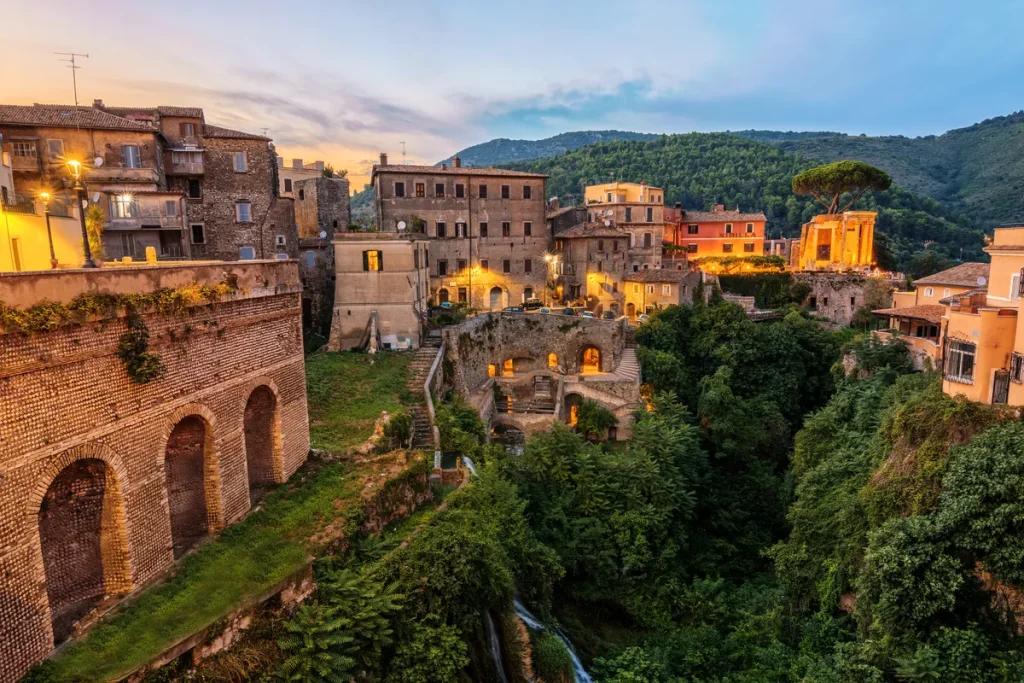
A day trip to Tivoli from Rome covers two UNESCO World Heritage sites – Hadrian’s Villa and Villa d’Este – in a town 30 kilometers east of the city. The journey takes 1 hour by Cotral bus from Ponte Mammolo (Metro Line B) or 1 hour 10 minutes by regional train from Roma Tiburtina, and the combined ticket for both villas (Villae Pass) costs around €20-25 depending on the season. The geographical complication is that Villa Adriana sits at the base of the hill and Villa d’Este sits at the top, 4 kilometers apart – so the order and transport between them determines whether your day runs smoothly or wastes an hour waiting for buses. Do not go on a Monday without checking opening times first. This guide covers the logistics in the order you need them.
Tivoli is one of the most worthwhile day trips from Rome if your itinerary has a free day after the main sights. If you’re still building your Rome schedule, the 3 days in Rome itinerary places Tivoli as a natural extension day four or five.
Getting from Rome to Tivoli: Bus vs. Train
Option 1: Cotral Bus from Ponte Mammolo (recommended for both villas)
If you’re planning to visit both Villa Adriana and Villa d’Este in the same day, start with the Cotral bus – it’s the most flexible option for managing the geography.
Take Metro Line B to Ponte Mammolo station. The Cotral bus terminal is directly outside the metro exit. Take the bus toward Tivoli via Tiburtina – journey time approximately 50-60 minutes depending on traffic. Tell the driver you want the Villa Adriana stop – it’s on the main road before the bus climbs into Tivoli town, and drivers will let you off there if you ask in advance. Fare: approximately €2.20 each way.
From the Villa Adriana stop, the villa entrance is a 10-minute walk down a signed road.
After finishing Villa Adriana, catch the local CAT Bus Line 4 from the same main road back up the hill to Tivoli town center (Piazza Garibaldi). This bus runs regularly but not frequently – check the timetable posted at the stop or the CAT website before you go. Fare: approximately €1.30.
Option 2: Regional Train from Roma Tiburtina or Roma Termini
The train is the better option if you’re going to Villa d’Este only, or if you prefer to start in the town and work your way down to Villa Adriana by local bus.
Trains depart from Roma Tiburtina (Metro Line B, same line as Ponte Mammolo) and occasionally Roma Termini. Journey time: approximately 1 hour 10 minutes. Fare: €3.20 each way. Frequency varies – check the Trenitalia app or the station boards for the day’s schedule.
The Tivoli train station is across the Aniene river from the town center. It’s a flat 15-minute walk into Piazza Garibaldi. From the town center, Villa d’Este is a 5-minute walk. Villa Adriana requires local CAT Bus Line 4 from Piazza Garibaldi (direction: Villa Adriana), which takes about 15 minutes.
Taxi and car notes
Taxis exist in Tivoli but are not abundant. There is usually one or two at the train station on arrival, and the tourist office on Piazza Garibaldi can call one. If you’re driving from Rome, the A24 motorway takes about 40 minutes. Parking near Villa Adriana is easier than in the town center, which has limited space on weekends.
Uber has limited coverage in Tivoli; don’t rely on it as a transport plan.
Villa Adriana (Hadrian’s Villa): What to Know Before You Go
What it is
Hadrian built this complex between 118 and 134 AD on 120 hectares of land at the base of the Tiburtine hills. It was not a villa in the way the word usually implies – a single building with gardens. It was a full imperial settlement: palaces, libraries, theatres, baths, guest quarters, barracks, and experimental architectural structures that Hadrian designed himself or commissioned directly. At its peak it housed thousands of people.
Hadrian was unusual among emperors in that he spent most of his reign traveling the provinces rather than staying in Rome – he visited Britain, North Africa, Greece, Asia Minor. Villa Adriana was built partly as a summary of what he’d seen: specific structures were designed to evoke places he’d visited. The Canopus canal was intended to reference the Egyptian city of Canopus on the Nile delta. The Stoa Poikile (painted porch) was a recreation of a famous portico in Athens.
You’re walking through one man’s attempt to recreate his empire in one place – which is either a remarkable act of architectural imagination or the most expensive scrapbook in history, depending on your perspective.
The key structures
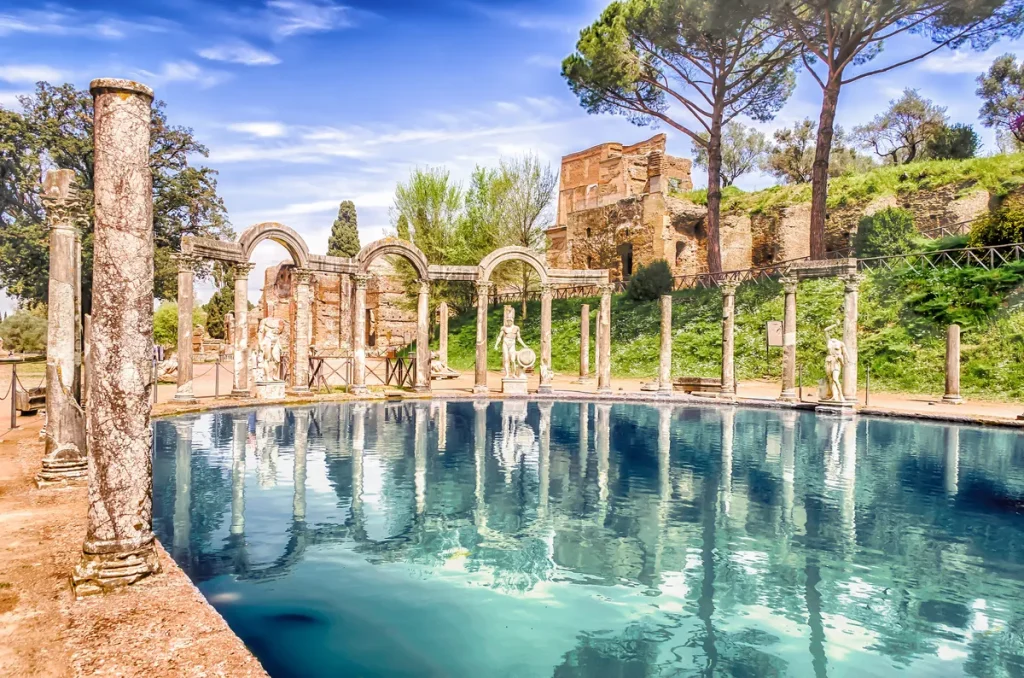
The Canopus is the most photographed section – a long rectangular reflecting pool (119 meters) bordered by colonnades and statues. The statues you see are copies; the originals are in the site museum. At the far end, the Serapeum is a curved dining hall built under a half-dome, designed so water cascaded down the back wall as a decorative feature during banquets.
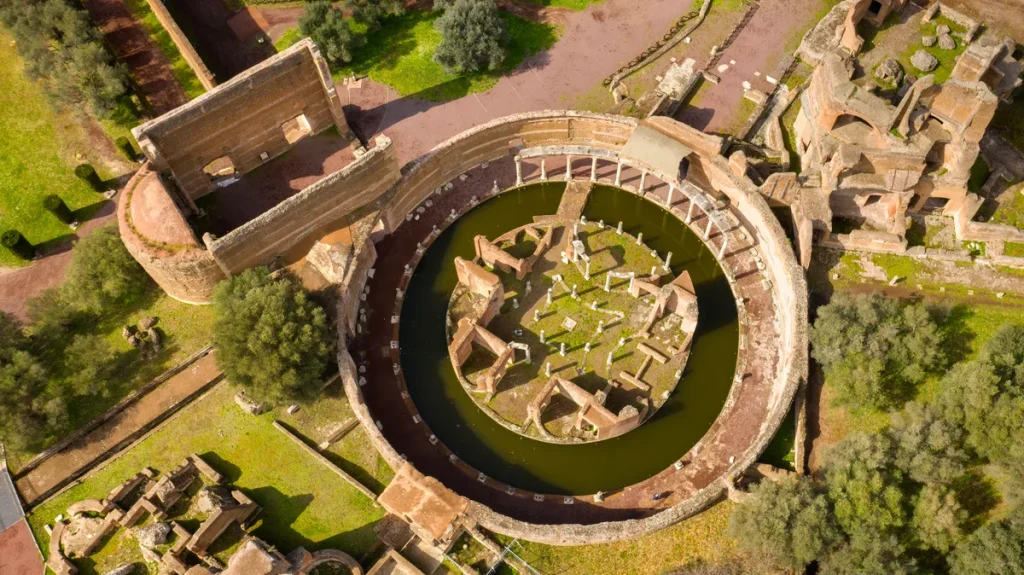
The Teatro Marittimo is Hadrian’s private retreat within the retreat. A circular island surrounded by a moat, accessible only via two wooden drawbridges that Hadrian could raise himself. On the island: a small suite of rooms with a bedroom, bath, and library. The design means it was genuinely inaccessible when the bridges were up. It’s the architectural equivalent of turning your phone off.
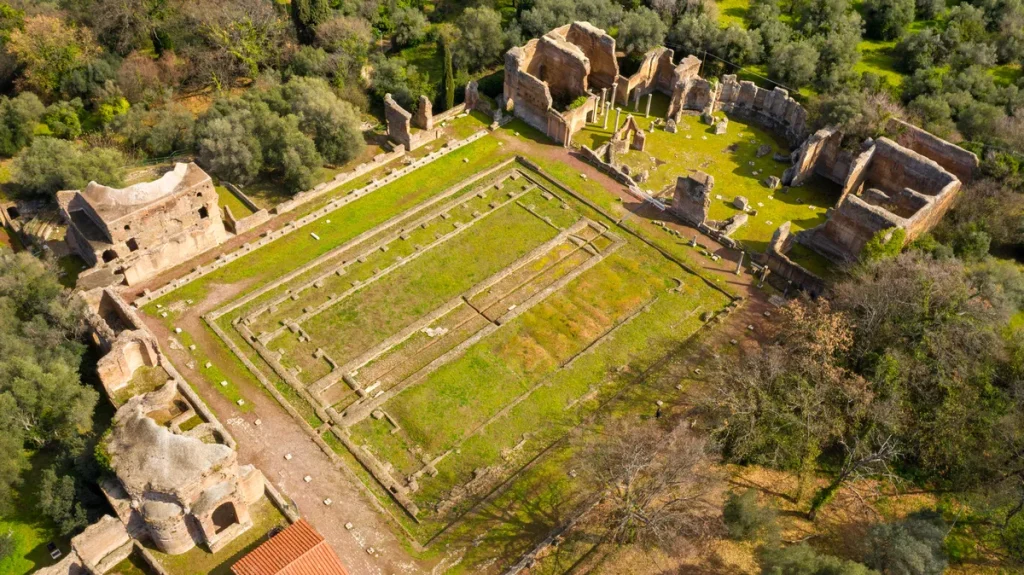
The Piazza d’Oro (Golden Square) is a large peristyle garden whose name comes from the quality of finds excavated here in the Renaissance. The perimeter had alternating convex and concave niches, which creates an unusual rippling effect along the wall line – atypical of Roman architecture and likely Hadrian’s direct influence.
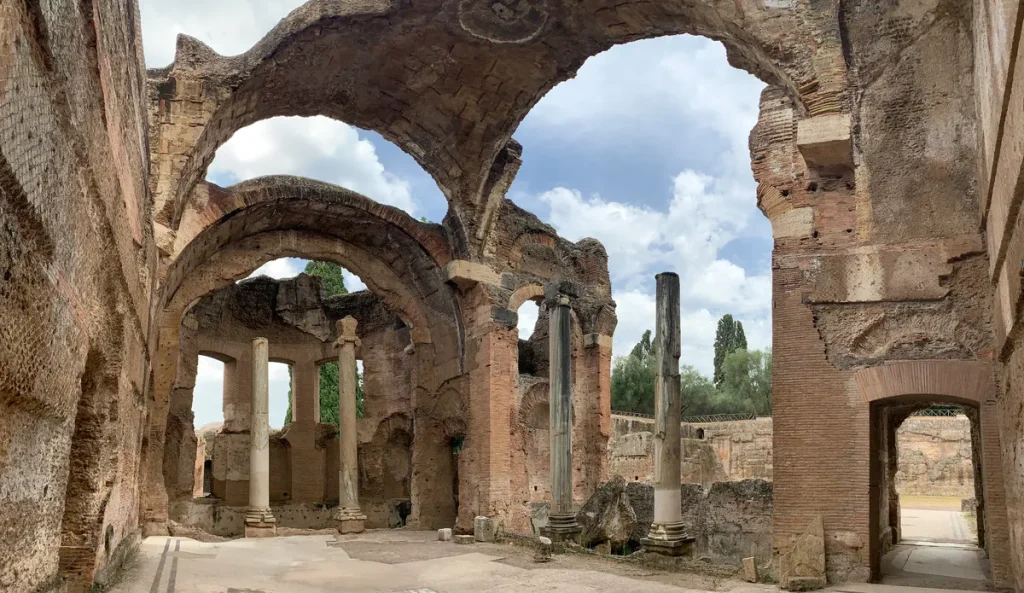
The Large Baths and Small Baths are the best-preserved thermal structures on the site. The scale of the vaulted ceilings in the Large Baths is significant even in ruin – the spaces would have been enormous when intact.
Practical details
Entry: €12 standalone (check for combined Villae Pass at the ticket office). Open Tuesday-Sunday; on Mondays, verify hours on the official MiC website (villae.beniculturali.it) before traveling – hours can be reduced.
The site is large and almost entirely unshaded. In July and August, the limestone reflects heat aggressively by midday. Start as close to 9:00 AM opening as possible and aim to leave by noon. Bring at least a liter of water and a hat. Comfortable shoes with grip – the terrain is uneven ancient stone throughout.
Budget 2-2.5 hours to see the main structures without rushing. A full exploration of the entire 120 hectares takes considerably longer; the map at the entrance shows what’s worth prioritizing.
There is a small cafe near the entrance; it’s adequate but not a reason to plan your lunch around. Eat properly in the town.
Getting from Villa Adriana to Tivoli Town
After finishing at Villa Adriana, walk back to the main road (Via di Villa Adriana) and wait at the bus stop for CAT Line 4 toward Tivoli centro. The bus runs roughly every 20-30 minutes but check the posted timetable – if you’ve just missed one, a taxi from the villa entrance to the town center costs approximately €10-12 and takes 10 minutes.
The town center from the bus is Piazza Garibaldi. Villa d’Este entrance is a short walk uphill from here.
Lunch in Tivoli Town
Don’t eat at the restaurants immediately facing Villa d’Este’s entrance on Piazza Trento – they run on tourist-convenience pricing and the food reflects it.
Walk one street back into the medieval quarter (Rione Campitelli) and look for a trattoria without a laminated tourist menu in the window. The town specializes in trout from the Aniene river and in strozzapreti (short, hand-rolled pasta) with mushroom or truffle sauces from the surrounding hills. Both are worth ordering if they’re on the daily board.
The Pizzutello di Tivoli grape – a long, sweet variety grown in the surrounding countryside – appears in late summer and is sold at the town market if your visit falls in August or September.
A proper trattoria lunch with wine runs €15-20 per person. Budget 1-1.5 hours including the walk to find somewhere decent.
Villa d’Este: What to Know Before You Go
What it is
Cardinal Ippolito II d’Este was appointed governor of Tivoli in 1550 as a political consolation after failing twice in papal elections. He converted a Benedictine monastery on the hillside into a villa and commissioned Pirro Ligorio to design gardens that would make the site famous regardless of who lived there. The hydraulic engineering involved diverting an entire branch of the Aniene river to supply water to approximately 500 fountains, nymphaea, water organs, and water features – all operating on gravity alone, no pumps.
The gardens were essentially complete by 1572, twelve years after Ippolito’s death – he didn’t live to see the finished result. They’ve been functioning, with maintenance and restorations, for roughly 450 years.
The key features
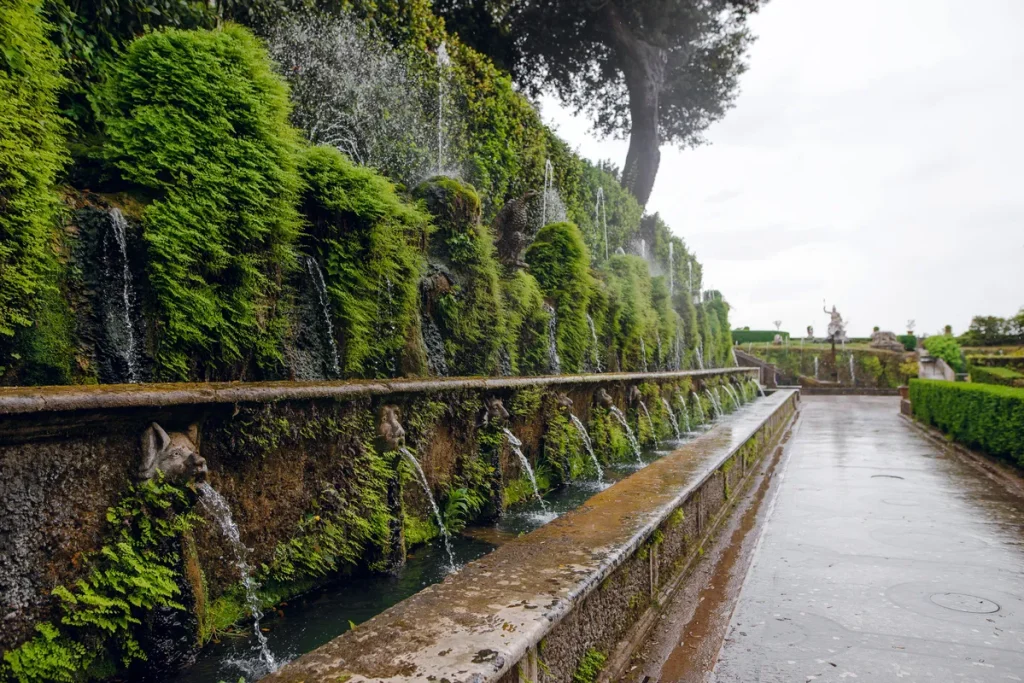
Le Cento Fontane (The Hundred Fountains) is a 130-meter terrace with three tiers of continuous fountain jets running its entire length. The effect is not subtle – it’s a wall of water noise and movement. The three tiers represent the three branches of the Tiburtine rivers. At the eastern end, a carved eagle (the Este family emblem) and an obelisk mark the junction with the main garden axis.
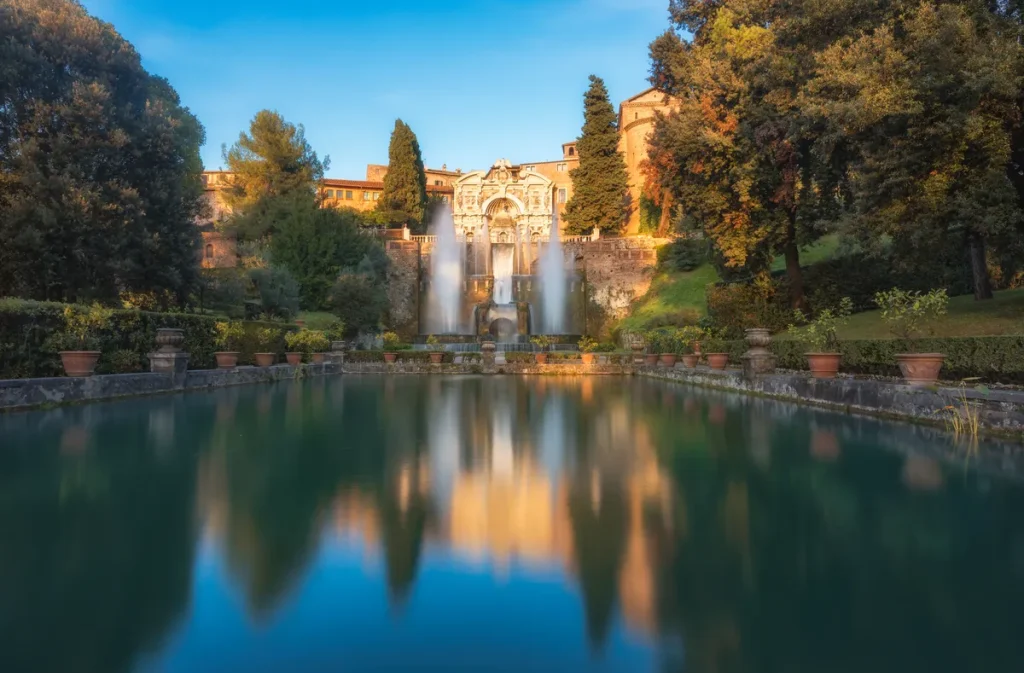
The Fontana dell’Organo (Organ Fountain) is the largest and most complex fountain in the garden – a multi-tiered structure with a mechanical water organ built into it. The water pressure drives bellows that push air through the organ pipes, producing music. The original mechanism dates to the late 16th century and has been restored multiple times; the current system plays on a regular schedule. Check the posted performance times at the entrance and position yourself at the fountain approximately 10 minutes before the next scheduled time. Performances last a few minutes and happen every two hours, with the first typically at 10:30 AM.
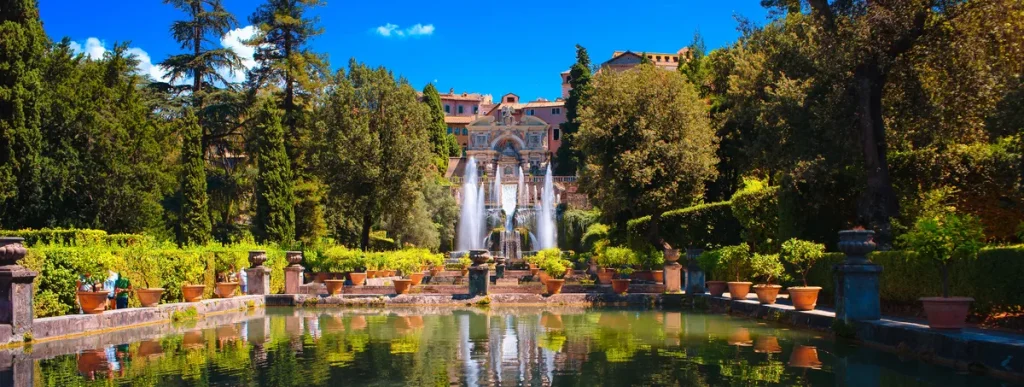
The Fontana di Nettuno (Neptune Fountain) dominates the lower garden with high-pressure jets creating a curtain of water. The current design dates to the 20th century – it replaced a Bernini fountain that was removed in the 18th century. The “wall of water” effect in photographs is from this fountain.
The Fontana di Diana Efesina is one of the stranger features in the garden – a multi-breasted statue of Diana of Ephesus set into a niche, water flowing from each breast. It references the syncretic religious culture of the ancient world and was a deliberate antiquarian statement by Ligorio, who was also an archaeologist.
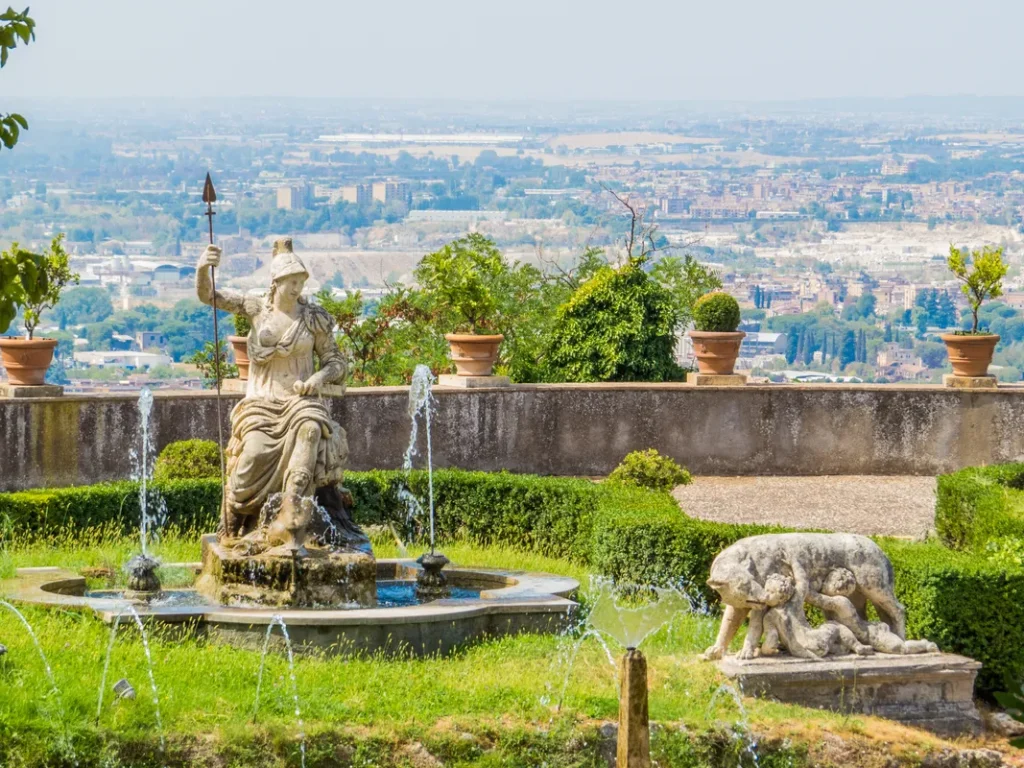
The Villa itself (the building, not just the gardens) contains frescoed rooms depicting the history of the d’Este family and allegories of the Tivoli landscape. The interior is often rushed by visitors focused on the gardens – it takes 20-30 minutes and is worth the time, particularly the Room of the Nobles.
Practical details
Entry: €12 standalone; check for the combined Villae Pass at Villa Adriana’s ticket office, which covers both sites at a reduced combined rate. Open Tuesday-Sunday; reduced hours or closed Mondays – verify on the day you visit.
The gardens are terraced and involve a significant amount of stair climbing – this is not a flat site. If you have mobility issues, the upper terraces (Le Cento Fontane level) are the most accessible; the lower terraces require descending steep paths. Budget 2 hours for a thorough visit including the interior rooms.
The mist from the fountains makes the garden noticeably cooler than the surrounding town, which is part of why visiting in the afternoon makes sense – you’ve already endured the heat at Villa Adriana.
Villa Gregoriana: The Third Site
Most visitors stop after the two main villas. Parco Villa Gregoriana is a 10-minute walk from Villa d’Este and runs along the gorge where the Aniene river drops into the valley.
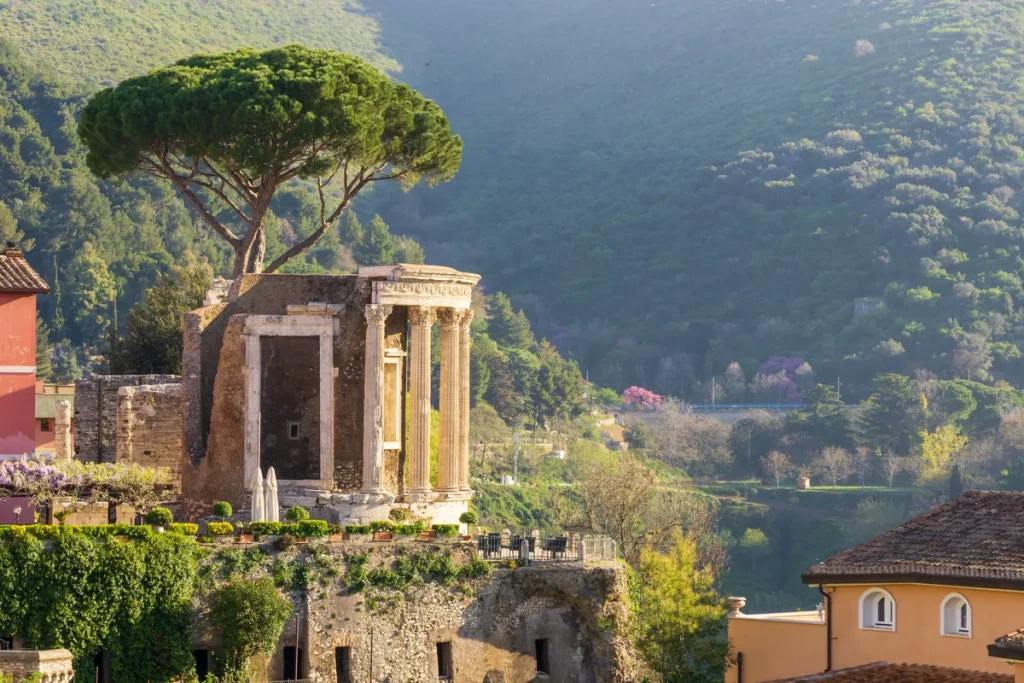
Pope Gregory XVI commissioned the diversion of the Aniene river in 1831 to prevent flooding of the town – the intervention created the Grande Cascata, a 120-meter waterfall that drops into a limestone gorge. The park trails descend into the gorge alongside the falls, passing Roman-era ruins including the Temple of Vesta perched on the cliff edge above the valley. The circular Ionic temple is one of the better-preserved Republican-era structures in Italy outside Rome itself.
The descent into the gorge is steep and takes 30-40 minutes down, 40-50 minutes back up. At the bottom, the spray from the waterfall is physically cooling and the scale of the gorge is significant – not something you can appreciate from the viewpoints above.
Entry: €7. Open daily (unlike the two UNESCO sites, Gregoriana doesn’t close on Mondays). If energy is limited after both villas, the upper viewpoint near the Temple of Vesta is accessible without descending into the gorge and gives the essential view in 20 minutes.
The Tivoli Loop: Full Day Itinerary
08:00 – Depart Rome. Cotral bus from Ponte Mammolo (Metro Line B) toward Tivoli. Tell the driver: Villa Adriana stop.
09:00 – Arrive Villa Adriana. Enter at opening time. Do the Canopus, Teatro Marittimo, Piazza d’Oro, and the baths. Leave by 11:30 at the latest in summer.
11:30 – CAT Bus Line 4 from the main road up to Tivoli centro (Piazza Garibaldi). If the bus timing doesn’t work, taxi €10-12.
12:15 – Lunch in the Rione Campitelli quarter. One street back from the main tourist drag. Trout or strozzapreti. Allow 1-1.5 hours.
13:45 – Walk to Villa d’Este (5 minutes from Piazza Garibaldi). Check the Organ Fountain performance schedule at the entrance and plan your route to be there on time.
14:00 – 16:00 – Villa d’Este. Upper terraces and Le Cento Fontane first; descend to Neptune Fountain; interior rooms of the villa before leaving.
16:15 – Walk to Parco Villa Gregoriana if energy allows. Upper Temple of Vesta viewpoint takes 20 minutes. Descent into the gorge adds another hour.
17:30 – Aperitivo in Piazza Garibaldi or along the town’s main street.
18:30 – Train from Tivoli station to Roma Tiburtina (approximately 1 hour 10 minutes). Last trains run into the late evening – check the return schedule in the Trenitalia app before you leave Rome in the morning.
Tivoli is one of several worthwhile day trips from Rome – that post covers Ostia Antica, Castel Gandolfo, and Pompeii with the same level of transport detail. For your Rome base, where to stay in Rome covers which neighborhood gives you the most efficient access to both Roma Tiburtina and Ponte Mammolo on Metro Line B. For keeping the overall trip cost manageable, Rome on a budget covers the full cost breakdown including day trips.
Can you do both Villa Adriana and Villa d’Este in one day?
Yes, but it’s a full day with significant walking – expect 15,000 to 20,000 steps on uneven terrain. The key is starting at Villa Adriana by 9:00 AM before the heat peaks and using the CAT bus connection efficiently between sites. If you have mobility issues or are traveling with young children, choose one. Between the two, Villa d’Este is the more manageable in terms of terrain if you stay on the upper terraces.
Are the villas open on Mondays?
Villa d’Este typically opens on Mondays but with reduced hours – often from 2:00 PM rather than the standard morning opening. Villa Adriana’s Monday status varies. Always check villae.beniculturali.it before traveling on a Monday. Villa Gregoriana is open daily and does not have this restriction.
Is there a combined ticket for both villas?
Yes – ask for the Villae Pass at the ticket office of whichever villa you enter first. It covers both UNESCO sites at a combined rate and saves a few euros over buying separately. It also lets you skip the second ticket line.
How long should I allow for each villa?
Villa Adriana: 2-2.5 hours for the main structures. A full exploration of the entire site takes 4+ hours. Villa d’Este: 1.5-2 hours including the interior rooms. Villa Gregoriana: 20 minutes for the upper viewpoint, 1.5 hours if you descend into the gorge.
What’s the best time of year to visit Tivoli?
April through June and September through October. July and August are hot and Villa Adriana is particularly brutal in afternoon heat – the limestone amplifies the temperature significantly. Spring visits have the advantage of fuller water flow in Villa d’Este’s fountains. Winter visits are possible but some sections of Villa Adriana may be partially closed for conservation.
Day Trip to Tivoli from Rome — 2026
Two UNESCO sites + a waterfall gorge, 30km east of Rome. Cotral bus from Ponte Mammolo (Metro B): 50-60 min, EUR 2.20. Do NOT go on Monday without checking hours first. Click any pin.