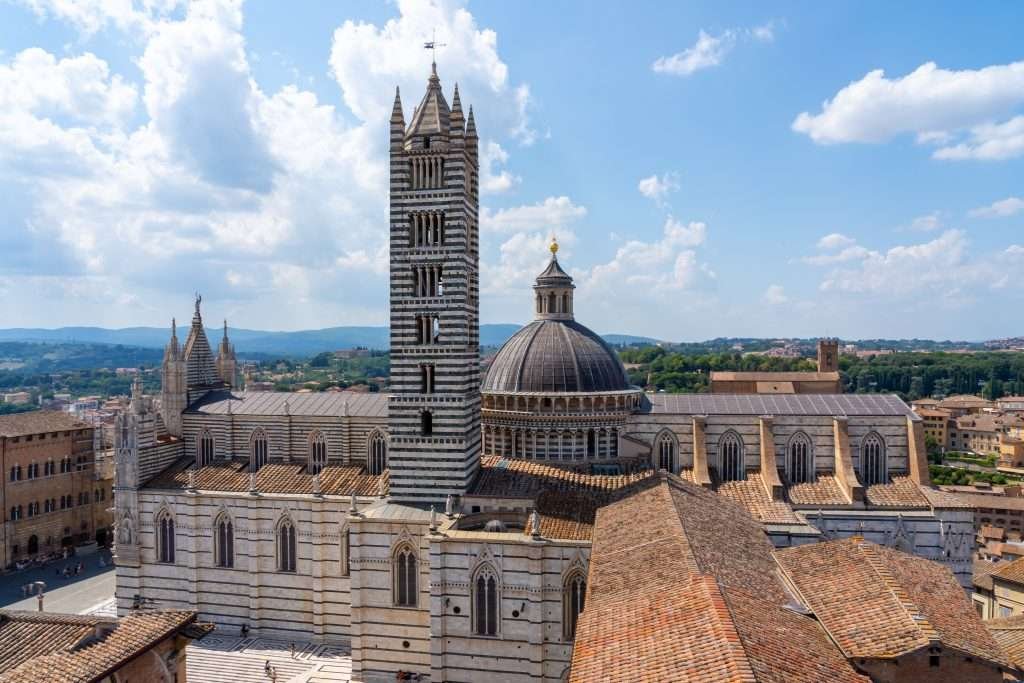
A day trip to Siena from Florence takes 1 hour 15 minutes by express bus and costs €9 each way – making it the most historically significant half-day reachable from the city without a car. Siena is the best-preserved medieval city in Italy: the Piazza del Campo is the civic model that most European medieval squares aspired to, the Cathedral has 56 inlaid marble floor panels and a Pinturicchio fresco room so well-preserved the colors look recent, and the city is divided into 17 competitive neighborhood wards whose rivalry has produced the Palio horse race every summer since 1644. The bus drops you inside the city walls at the same elevation as the main sights. The train drops you at the bottom of a hill requiring escalators through a shopping mall. Take the bus. Don’t go on a Monday – several museums run reduced hours.
Siena sits naturally in a Florence itinerary as a day four or five addition once you’ve covered the main city sights. For building the Florence days themselves, the first time in Florence guide covers the sequencing, and Florence on a budget has the cost breakdown including day trips.
Getting from Florence to Siena
Bus: the right choice (SITA 131R Rapida)
The SITA Busitalia 131R Rapida is the express service between Florence and Siena. Departure from the Busitalia terminal at Via Santa Caterina da Siena 15, which is directly behind Santa Maria Novella train station – exit the station from the main entrance, turn right, and the bus terminal is 2 minutes’ walk.
Journey time: 1 hour 15 minutes. Fare: €9 each way. The bus runs roughly every 30 minutes during the day.
The bus arrives at Piazza Gramsci in Siena, which is inside the city walls and at the same elevation as the historic center. You walk out of the bus directly into the medieval city. This is the specific reason to choose it over the train.
Critical: Take the 131R Rapida not the ordinary 131. The slow service makes stops through the Chianti hill towns and takes over 2 hours. The R is for Rapida – confirm it before boarding or when buying your ticket.
Buy tickets at the Busitalia office in the terminal or from the machine. You can also buy on the bus with cash but the driver doesn’t always have change.
Train: slower and less convenient
Regional trains from Florence Santa Maria Novella to Siena take approximately 1 hour 30 minutes with at least one change, typically at Empoli. Direct services are rare. Fare: approximately €12 each way.
The Siena train station is in a valley at the bottom of the hill, outside the city walls. To reach the historic center from the station, you use a system of escalators (scale mobili) running through a modern shopping complex – it works, takes about 15 minutes, and is about as atmospheric as an airport. From the top of the escalators you’re still 10 minutes’ walk from Piazza del Campo.
The only reason to take the train is if you have a Trenitalia pass and want to use it, or if the bus schedule doesn’t align with your departure time.
Car
Driving takes approximately 75 minutes via the Raccordo Autostradale Firenze-Siena (free) or the Via Cassia (longer but scenic). The problem is arrival: Siena is a ZTL (Zona a Traffico Limitato) city and private cars cannot enter the historic center. You park in one of the lots outside the walls – Parcheggio Il Campo or Parcheggio Santa Caterina are the closest – and walk or take a shuttle bus up. Parking costs €15-20 for a full day. Unless you’re stopping at wineries in the Chianti on the way, the bus is easier.
The Contrade: What They Are and Why They Matter
Before anything else, understand the Contrade system – it’s why Siena feels different from every other Italian city you’ll visit.
Siena is divided into 17 wards (contrade), each representing a historic neighborhood with defined geographic boundaries. Each contrada has its own flag, church, museum, baptismal font, and animal symbol – the Wolf, the Caterpillar, the Dragon, the Unicorn, the Eagle, the Owl, and 11 others. Being born in a contrada means being baptized in its font, getting married in its church, and being buried under its colors. The identity is inherited and lifelong.
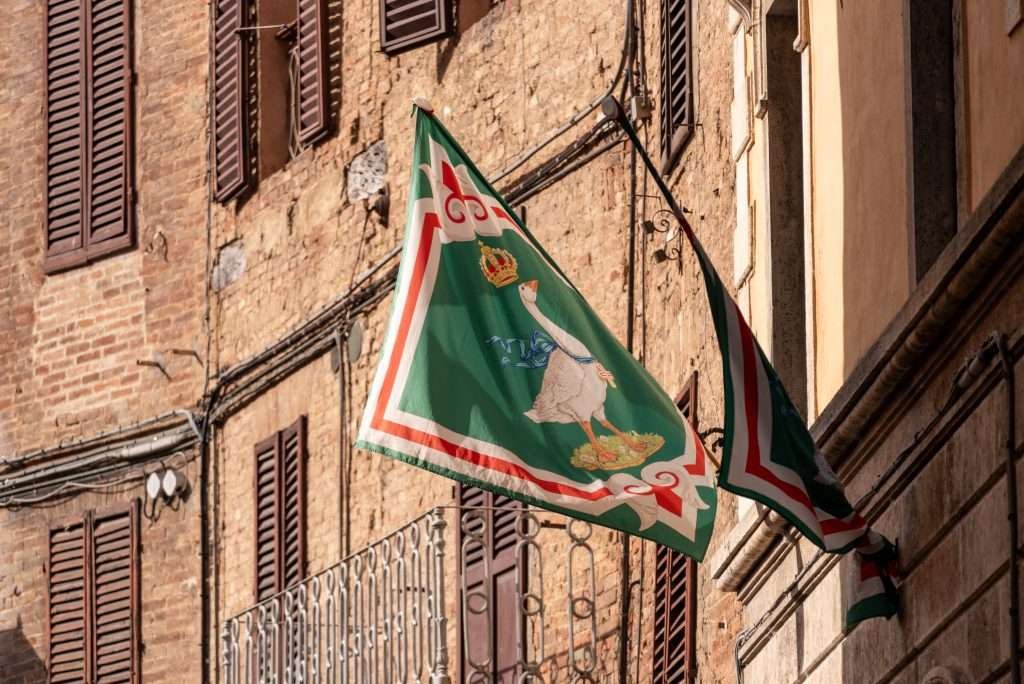
The contrade are in permanent competitive rivalry with each other, and that rivalry finds its most extreme expression in the Palio – a horse race around the perimeter of Piazza del Campo, run twice yearly (July 2 and August 16), in which 10 of the 17 contrade compete. The race lasts 90 seconds. The preparation takes a year. Jockeys ride bareback, bribing and sabotage between contrade are legal strategic tools, and the winning contrada celebrates for months. People cry. The losing contrada’s members are expected to take it hard.
As you walk through the city, look at the iron street lamps and the ceramic plaques mounted at building corners – each shows the contrada’s animal symbol. You’ll be moving through different territories all day without realizing it. The fountain in a contrada’s central square typically has a bronze statue of the ward’s animal. These are not decorative; they’re territorial markers.
Some contrada museums are opening for small group visits in 2026. The tourist office at Piazza del Campo can advise on which are currently accessible.
Piazza del Campo
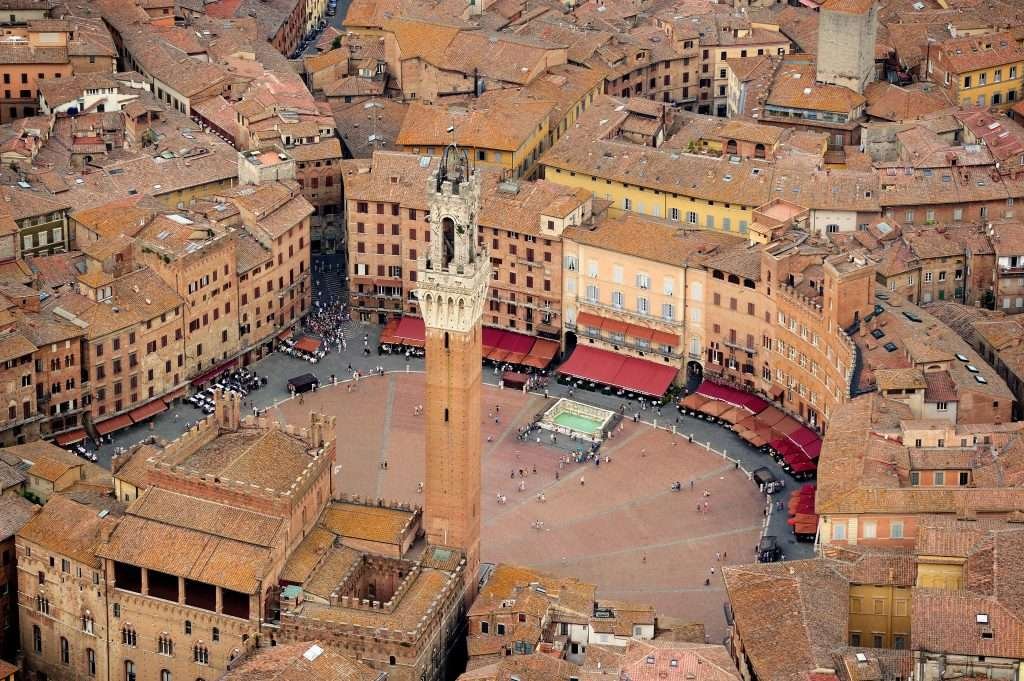
Arrive here first, before the tour groups fill in from around 10:30 AM.
The piazza is shaped like a shallow bowl tilted toward the Palazzo Pubblico – a slight downward slope engineered so rainwater drains to a central drain. The floor is divided into nine segments of red herringbone brick, representing the Governo dei Nove (Council of Nine), the merchant oligarchy that ruled Siena at its peak of power and prosperity from 1287 to 1355. The Nine were responsible for commissioning most of what makes Siena worth visiting.
The cafes and restaurants that ring the outer edge of the piazza charge significantly more than anything one street back. A coffee on the ring: €4-5. A coffee on Via di Città: €1.50. Sit on the brick in the center of the piazza itself – it’s the most-used public furniture in the city and everyone does it – rather than paying the view tax at a cafe table.
Palazzo Pubblico and Museo Civico
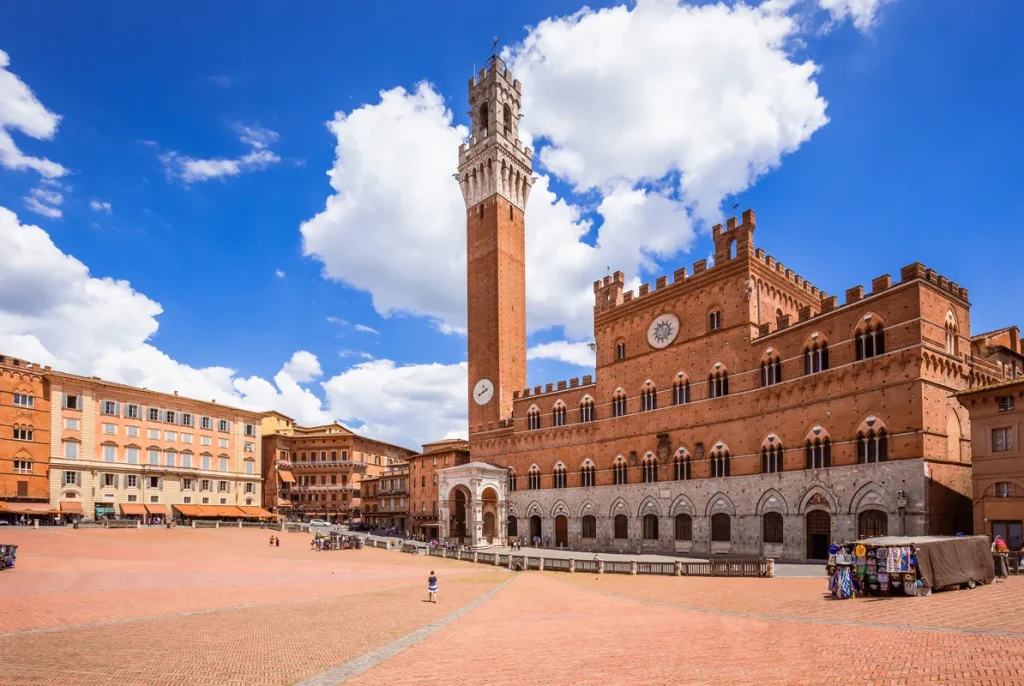
The Gothic town hall on the south side of the piazza (the curved side) was built between 1297 and 1310. It contains the Museo Civico with what is arguably the most important secular fresco cycle of the medieval period: Ambrogio Lorenzetti’s Allegoria ed Effetti del Buono e Cattivo Governo (Allegory of Good and Bad Government), painted 1338-1339.
The cycle covers three walls of the Sala dei Nove. One wall shows the effects of good government on a city: commerce operating, buildings under construction, people dancing in the streets, farmers working productive land. The opposite wall shows the effects of bad government: the city crumbling, the countryside abandoned, armed men in the streets. The personification of Tyranny sits enthroned on one wall; Justice and the Common Good on the other. It was painted as a direct political statement for the council chamber where the Nine met to govern – a reminder of what was at stake.
The Lorenzetti frescoes are the specific reason to pay the museum entry fee. Entry: €9.

Torre del Mangia
The tower on the left side of the Palazzo Pubblico stands 88 meters and has 400 steps. The staircase is narrow and genuinely vertical in the upper sections. At the top: the view across the Tuscan hills, the rooftops of Siena’s three hills laid out below, and a direct look down into the piazza from above.
Entry: €10. The combination ticket with the Museo Civico is €14 and worth it if you’re doing both. Arrive early – the tower has timed entry and sells out by mid-morning in high season.
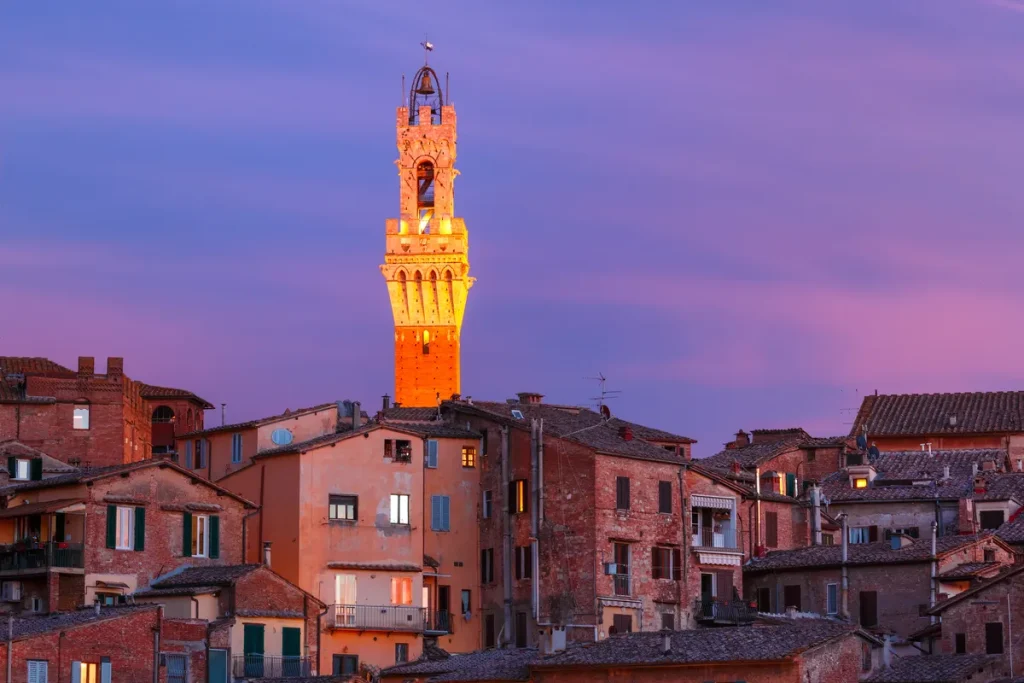
The Duomo Complex
The Cathedral of Siena is a 30-minute walk uphill from Piazza del Campo, or a 10-minute walk via Via di Città and Via del Capitano. Head there after the Palazzo Pubblico, before lunch.
The Cathedral Itself
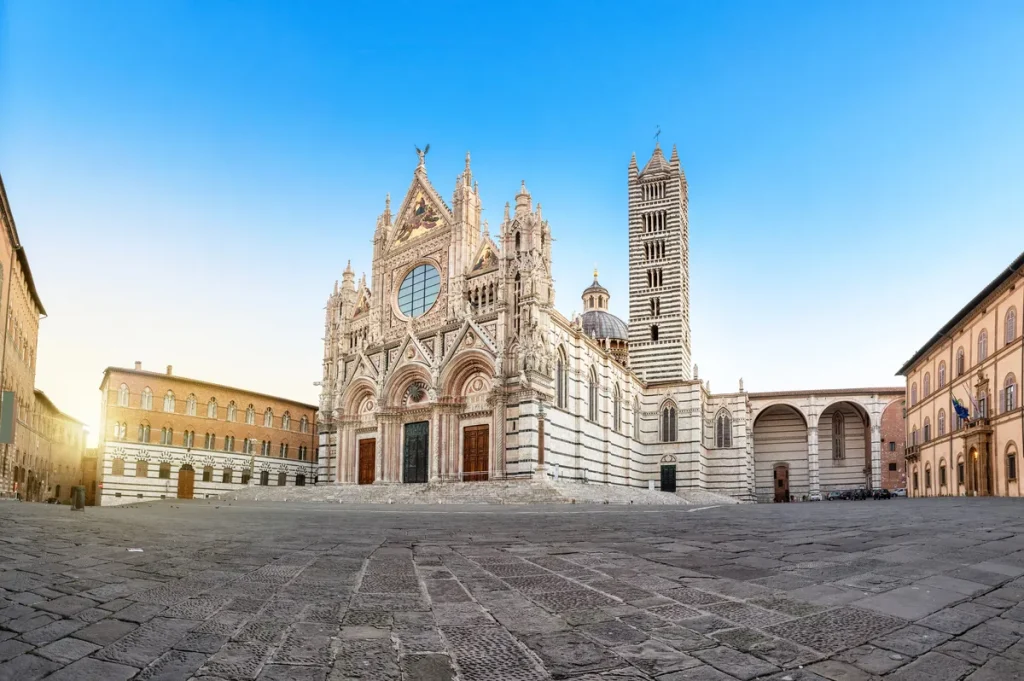
The Duomo’s facade is alternating bands of black and white marble – the same striped pattern used throughout the building’s exterior and interior columns, based on the colors of the Balzana (Siena’s civic symbol) and the colors of the two horses that, according to legend, the founders of the city rode. Construction started in the 12th century; the current building took shape through the 13th and 14th centuries.
Entry: €5 (cathedral alone). The Opera della Metropolitana combined ticket (€15) includes the cathedral, Piccolomini Library, Baptistery, and the Facciatone – this is the right ticket to buy.
The Marble Floor
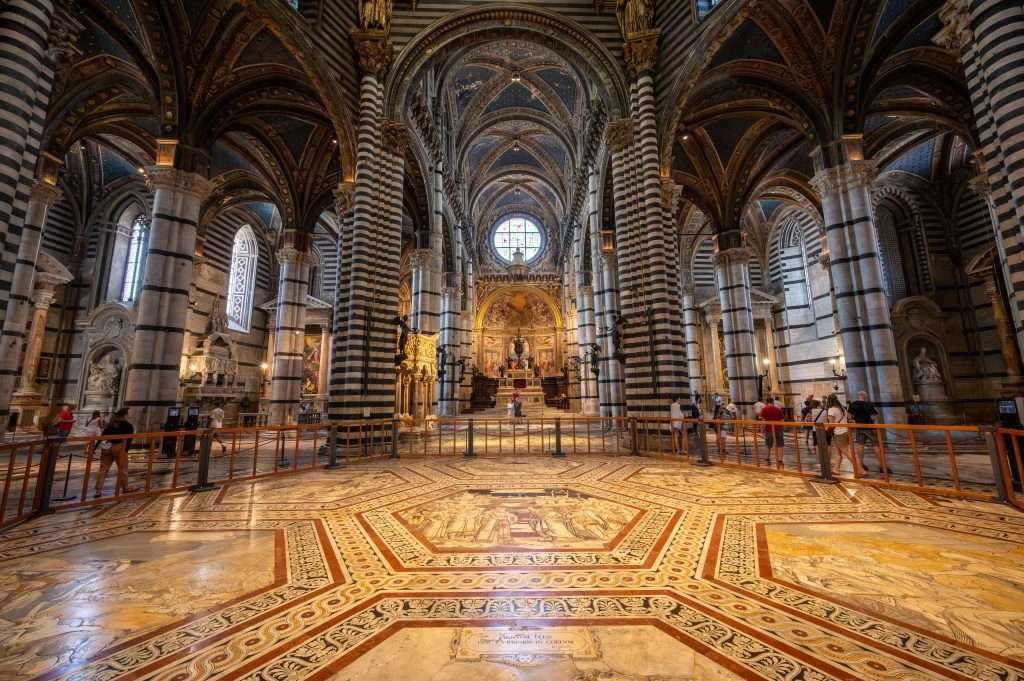
The Duomo’s floor consists of 56 panels of inlaid and etched marble, created by different artists between the 14th and 16th centuries. They depict sibyls, allegorical scenes, and narrative episodes from the Old Testament – essentially a Bible in stone, designed for an era when most worshippers couldn’t read.
The problem is that most of the floor is covered with wooden boards for protection for most of the year. It is uncovered for a specific period each year, typically late August through late October (the exact dates shift). If your visit falls in that window, the floor is the single most remarkable thing you’ll see in Siena. If it’s covered, the panels visible near the entrance are still worth examining.
Piccolomini Library
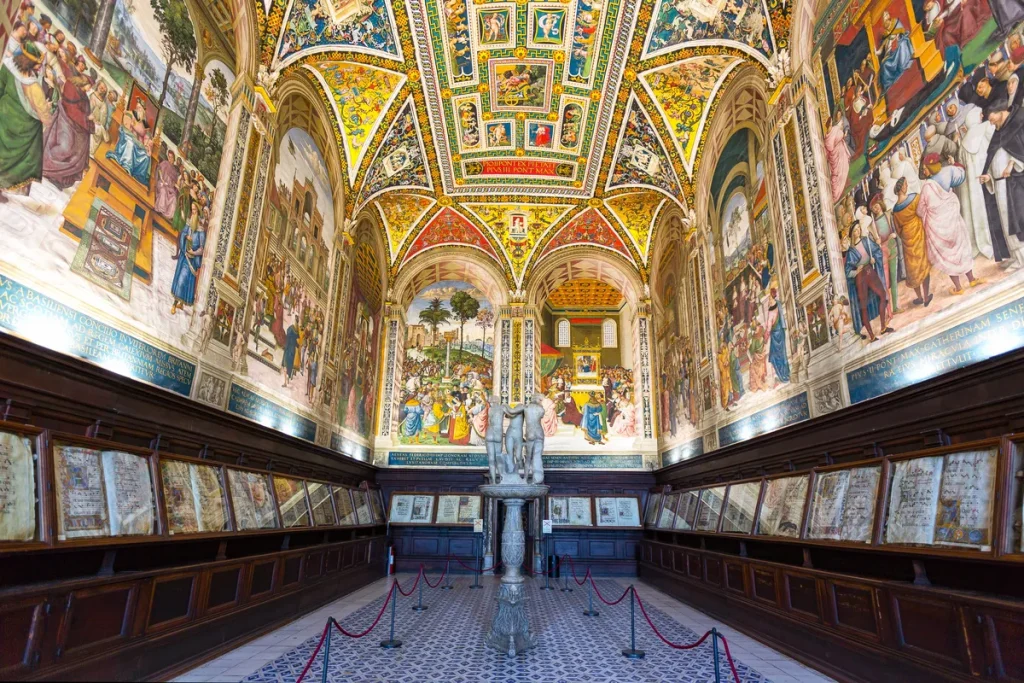
Through a door on the left side of the nave. Built by Cardinal Francesco Piccolomini in 1502 to house the library of his uncle, Pope Pius II, the room is covered floor-to-ceiling in frescoes by Pinturicchio completed between 1503 and 1508. Ten large panels depict scenes from the life of Pius II. The colors are the specific point: because the room has no windows facing direct sunlight, the pigments have not faded. A scene painted in 1503 looks like it could have been done recently. Lapis lazuli blue, verdigris green, ochre, vermilion – saturated and intact.
Budget 20 minutes specifically for this room. It’s easy to rush past on the way to the nave.
The Facciatone
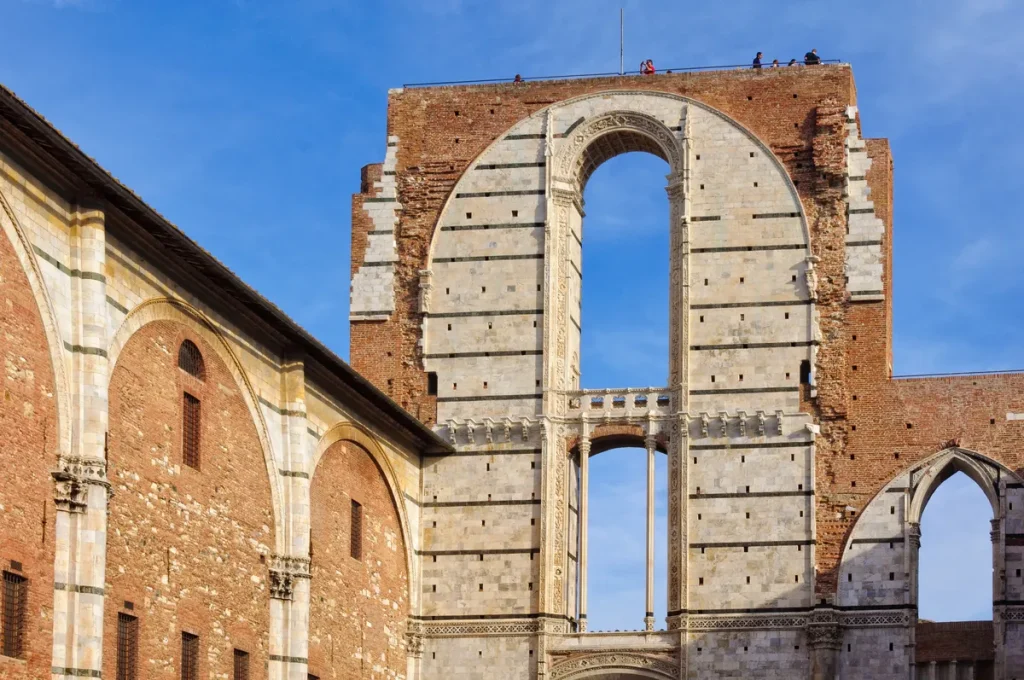
In 1339, Siena began an expansion project intended to make their cathedral the largest in Christendom – the existing building would become just the transept of the new structure. Work stopped in 1348 when plague killed between half and two-thirds of the city’s population. The planned nave was never built. What remains is the Facciatone – the facade wall of the expansion that was abandoned mid-construction.
You can climb to the top of the Facciatone. The view from up there looks directly down onto the finished cathedral’s roof and across the city – a perspective that makes the scale of the abandoned project comprehensible. It’s included in the combined ticket.
The Baptistery
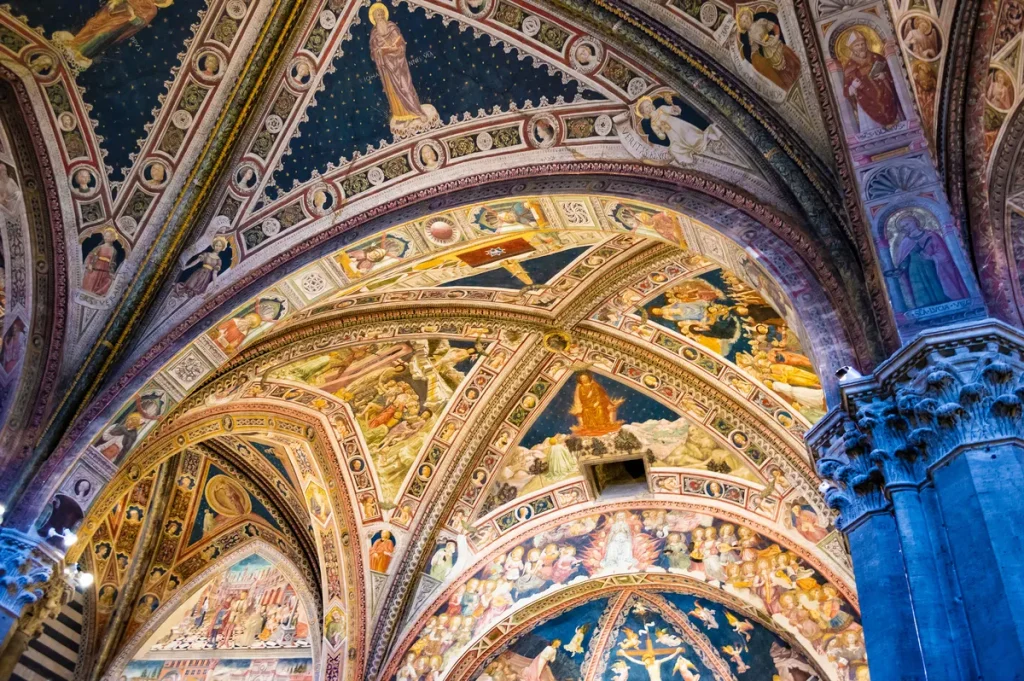
Below the cathedral, accessed separately. Contains a baptismal font with bronze gilded panels by Donatello, Jacopo della Quercia, and Lorenzo Ghiberti – three of the most significant sculptors of the early 15th century, competing on adjacent panels of the same object. Donatello’s Feast of Herod panel is the one to look for: figures in violent motion, a severed head on a platter, spatial recession into a background that anticipates perspective painting. Included in the combined ticket.
Food in Siena
What to order
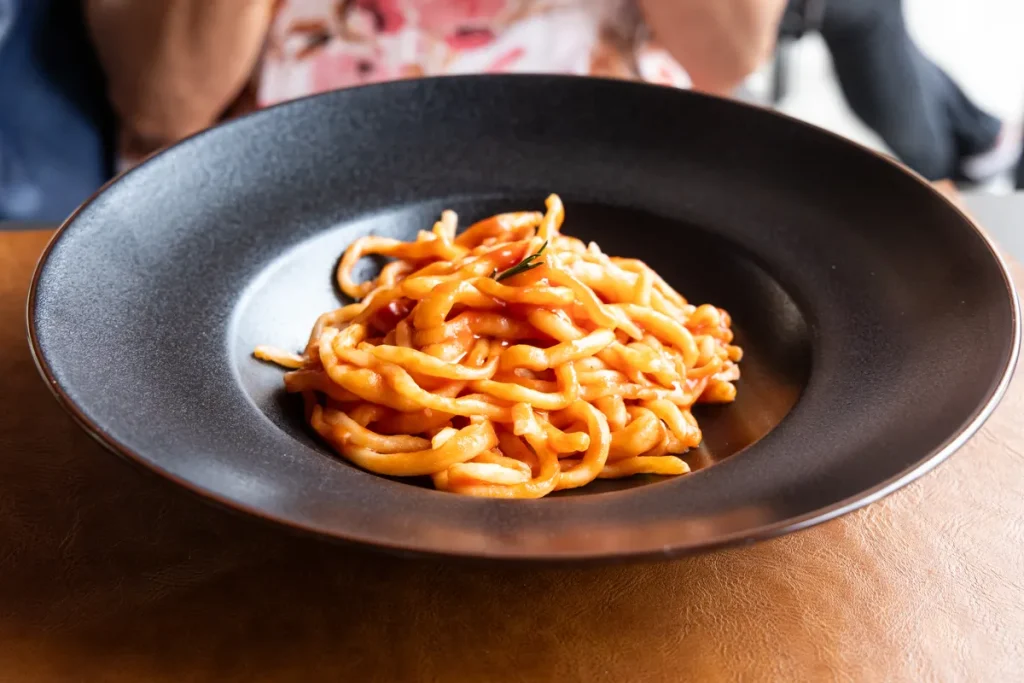
Pici is the Sienese pasta – thick, hand-rolled, like a fat spaghetti with uneven texture that grips sauce. It’s made without eggs, just flour and water, rolled by hand on a wooden board. The sauce that belongs with it here is aglione – a slow-cooked sauce of aglione garlic, a large, mild variety grown in the Val di Chiana that loses its sharpness when cooked down and becomes sweet and dense. Pici all’aglione is the Sienese equivalent of carbonara in Rome: the thing to order, not optional.
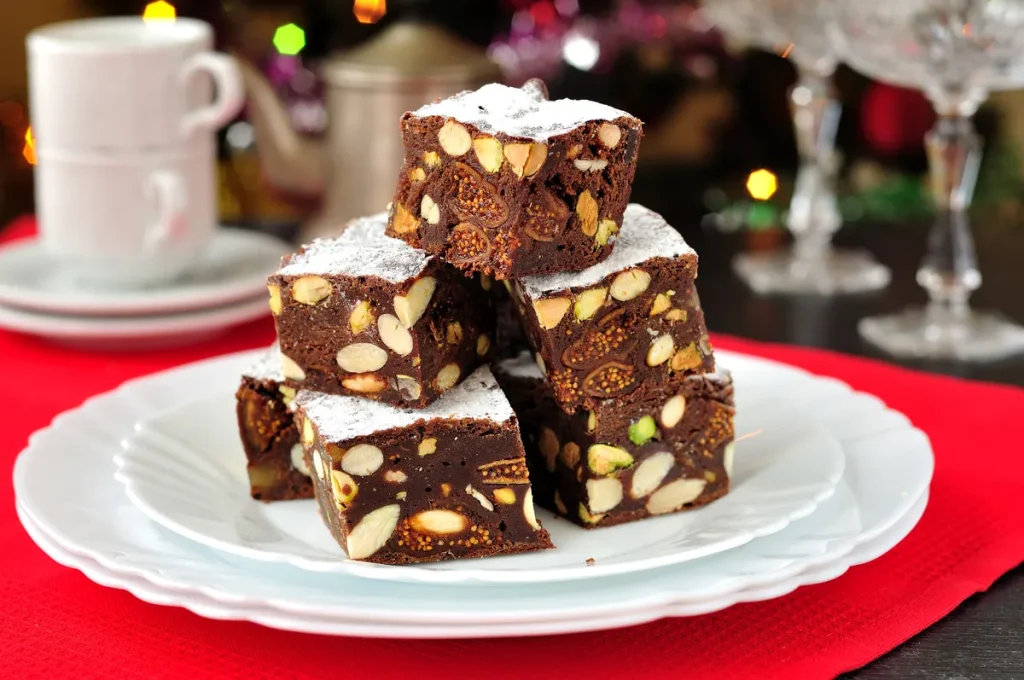
Panforte is a dense flat cake of dried fruit, nuts (almonds, hazelnuts), spices (cinnamon, coriander, white pepper), and honey, pressed and baked until firm. It dates to the 13th century in some form – a preserved food originally practical for long journeys and now a product made and sold in Siena specifically. Buy it at Pasticceria Bini on Via dei Fusari (off Piazza del Campo) or at Nannini on Via Banchi di Sopra. A piece costs €3-5.
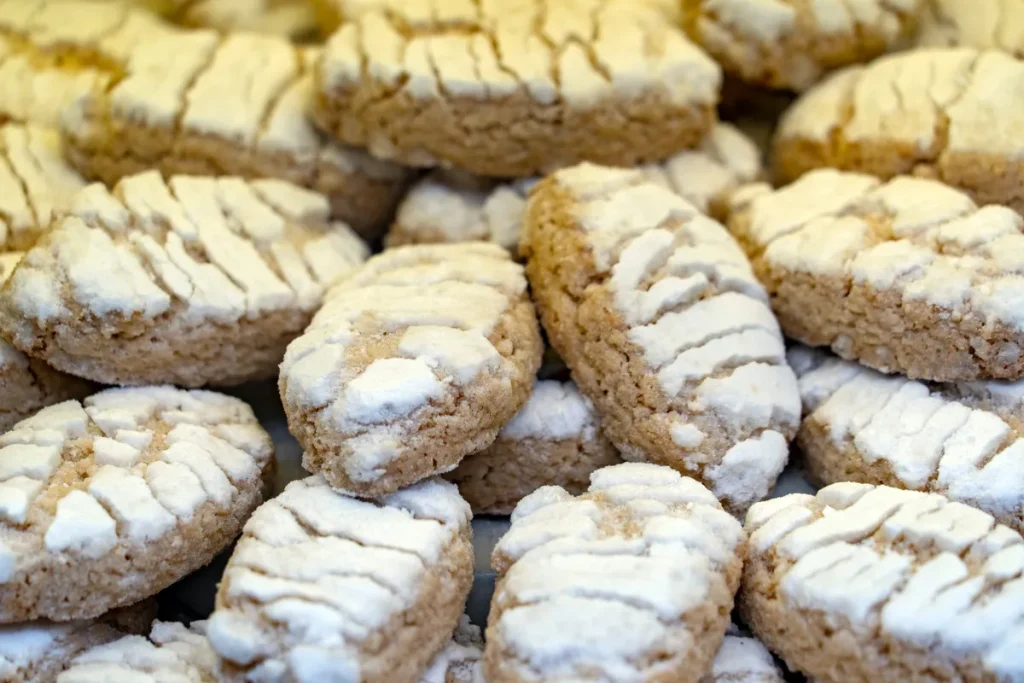
Ricciarelli are soft, flat almond cookies dusted with powdered sugar, related to marzipan but less sweet and with a slightly chewy center. Also from Nannini or Bini. Eat them with a glass of Vin Santo, the amber dessert wine made from dried Trebbiano and Malvasia grapes.
Where to eat lunch
The restaurants facing Piazza del Campo from the curved northern arc charge a view premium of approximately 40-50% over equivalent food one street back. The food is usually fine; you’re paying for the seat, not the kitchen.
Better value: the streets immediately behind the Duomo (Via del Capitano, Via di Stalloreggi) have trattorias that serve a working lunch to locals without the tourist markup. A full pici lunch with wine here runs €15-18 per person. Sit down between 12:30 and 1:30 PM – the midday lunch window is taken seriously and most places stop serving by 2:30.
San Domenico and the Skyline View
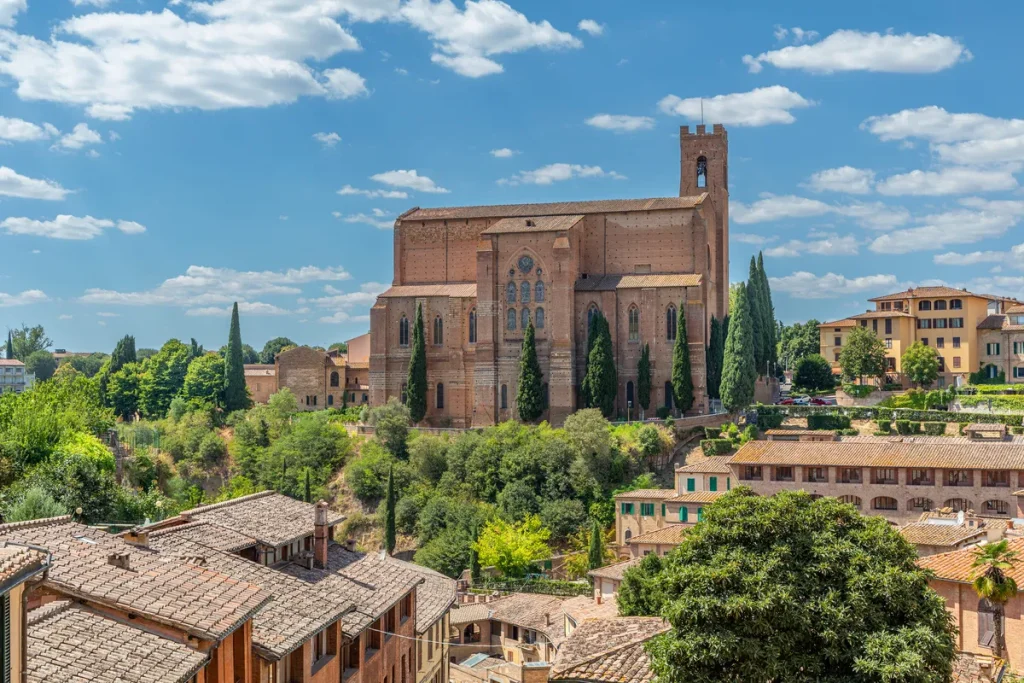
When the main sights start feeling crowded, walk northwest from Piazza del Campo (about 15 minutes on foot) to the Basilica di San Domenico. The church itself is unusual – a fortress-like Gothic structure with no facade decoration, which reads as blunt and powerful rather than unfinished. Inside, the Cappella di Santa Caterina contains a reliquary holding the mummified head of Catherine of Siena (1347-1380), the mystic and theologian who became the patron saint of Italy. It’s displayed in a tabernacle on the altar. Sienese pilgrims come to this chapel specifically; it’s an active site of veneration, not just a curiosity.
The square in front of San Domenico offers the canonical view of Siena: the Duomo’s striped facade and bell tower on one side, the Torre del Mangia rising above the Piazza del Campo on the other, the Tuscan hills behind everything. This is the vantage point for the photograph most people associate with Siena. It’s also significantly less crowded than the piazza itself.
Full Day Itinerary
08:30 – Busitalia 131R Rapida from Florence, behind Santa Maria Novella station.
09:45 – Arrive Piazza Gramsci. Walk to Piazza del Campo (8 minutes).
10:00 – Piazza del Campo. Torre del Mangia if you’ve pre-booked (do this first, timed entry fills up). Otherwise, Museo Civico and the Lorenzetti frescoes.
11:30 – Walk to the Duomo complex via Via di Città and Via del Capitano. Piccolomini Library first (before the tour groups fill the room), then the nave and floor, then the Facciatone, then down to the Baptistery.
13:30 – Lunch in the streets behind the Duomo. Pici all’aglione. Allow 1-1.5 hours.
15:00 – Walk to San Domenico and the skyline viewpoint. Allow 30-40 minutes.
16:00 – Back through the contrade streets. Look for the animal plaques at building corners. Wander Via di Città and Via Banchi di Sopra.
17:00 – Aperitivo on Piazza del Campo (one drink, not a meal).
18:00 – Bus back to Florence from Piazza Gramsci. Last buses run into the evening; check the return schedule in the morning.
Plan Your Trip
- First Time in Florence
- 1 Day in Florence
- 3 Days in Florence
- 25 Things to Do in Florence
- Where to Stay in Florence
- What to Eat in Florence
- Day Trips from Florence
- Florence on a Budget
- Venice vs Florence
- Rome vs Florence
- 7 Days in Tuscany
Is one day enough for Siena?
Yes, for the Cathedral complex, Piazza del Campo, and San Domenico. Siena is compact – the historic center fits within a 20-minute walk in any direction. If you stay overnight, the city after 7:00 PM when the day-trippers leave has a genuinely different atmosphere – quieter, more local, worth experiencing if your schedule allows.
Can you visit Siena and San Gimignano in the same day?
Not comfortably by public transport. San Gimignano requires a bus from Poggibonsi, which itself requires a change from Siena – the total journey is 1.5-2 hours each way and buses are infrequent. Trying to do both produces a day of logistics rather than sightseeing. Choose one. If you have a car, the combination is feasible but still rushed.
When is the Palio and should I plan around it?
The Palio runs on July 2 and August 16. The race itself lasts 90 seconds but the day begins with a historical procession at around 5:00 PM and the piazza fills from noon. Accommodation in Siena on Palio days books out a year in advance at double the normal rate. If you want to witness it, plan very far ahead. If you’re day-tripping, the crowds make movement around the center difficult on Palio day – it’s better to avoid these specific dates unless the Palio is the point.
Are the Duomo floor panels visible year-round?
No. Most of the floor panels are covered with protective wooden boards for the majority of the year. The uncovering period is typically late August through late October, though the exact dates vary. Check the Opera della Metropolitana website (operaduomo.siena.it) for the current year’s schedule before your visit.
What shoes should I wear?
Siena is built on three hills with significant elevation changes between them. The route from Piazza del Campo to the Duomo involves an uphill walk on paving stones. The Piazza del Campo itself has a sloped brick surface that becomes slippery when wet. Wear shoes with grip and proper ankle support – this is more walking-intensive than it appears on a flat map.
Day Trip to Siena from Florence — 2026
SITA 131R Rapida bus from behind Santa Maria Novella: 1h15, EUR 9 each way. Do NOT go Monday without checking hours. Avoid July 2 and August 16 (Palio days). Click any pin.