
Book Alhambra Tickets Granada before you book your flight. That is not a metaphor. The Alhambra is the most visited monument in Spain, and the entry system is built to deny you if you are not prepared.
This is not a palace you stroll into on a Tuesday afternoon. It is a fortified palatine city spread across the Sabika Hill – the seat of the Nasrid Dynasty, the last Islamic sultanate in Western Europe. The authorities fight a daily battle against over-tourism, and their weapon is a rigid, zero-tolerance ticketing system. Miss your 30-minute entry window by 60 seconds, and the guards will turn you away. No refunds, no appeals.
This guide covers everything you need to get in, move through the complex efficiently, and understand what you are actually looking at. If you are still planning the broader trip, start with the first time in Granada guide before diving into the logistics here.
The Ticketing System: How to Not Get Burned
The Official Source
Buy only from tickets.alhambra-patronato.es. Secondary sites charge up to 40% markup for the same ticket. Tickets go on sale 90 days in advance. During peak periods – May, September, October, and Easter week – general admission slots sell out within hours of release. Set a calendar reminder.
The Passport Rule (Read This Twice)
Every ticket is strictly nominal. When you book, you enter the exact first name, last name, and passport number for each person in your group. At the Nasrid Palace checkpoint, guards physically scan your passport and match it against the barcode on your ticket.
What does not work: a phone photo of your passport, a paper photocopy, your driver’s license if you booked with a passport number. Bring the physical document.
The 30-Minute Entry Window
When you select a time slot – say, 10:30 AM – that is not when you enter the Alhambra grounds. That is your one-time window to enter the Nasrid Palaces specifically. Be at the palace queue by 10:15 AM. Arrive at 11:00 AM and you are locked out permanently. You can still visit the gardens and the fortress, but you have missed the reason you came.
Sold Out? Try the Granada Card
The Bono Turístico (Granada Card) includes public transport, the Cathedral, the Royal Chapel, and several other sites – plus its own separate allocation of Alhambra tickets. When the main site shows zero availability, the Granada Card often has slots. It costs more, but it saves your trip. If budget is a factor in your planning, the Granada on a budget guide breaks down whether the card is actually worth it against buying individual tickets.
The Layout: Four Zones, One Hill
Understanding the geography before you arrive prevents the most common mistake: showing up at the wrong entrance.
The Alcazaba – The oldest section, a heavy military garrison at the western tip of the hill. Built for defense, not aesthetics.

The Nasrid Palaces – The core of the complex and the reason tickets are so hard to get. Three connected palace sections housing the famous reflecting pools, stucco carvings, and muqarnas ceilings.
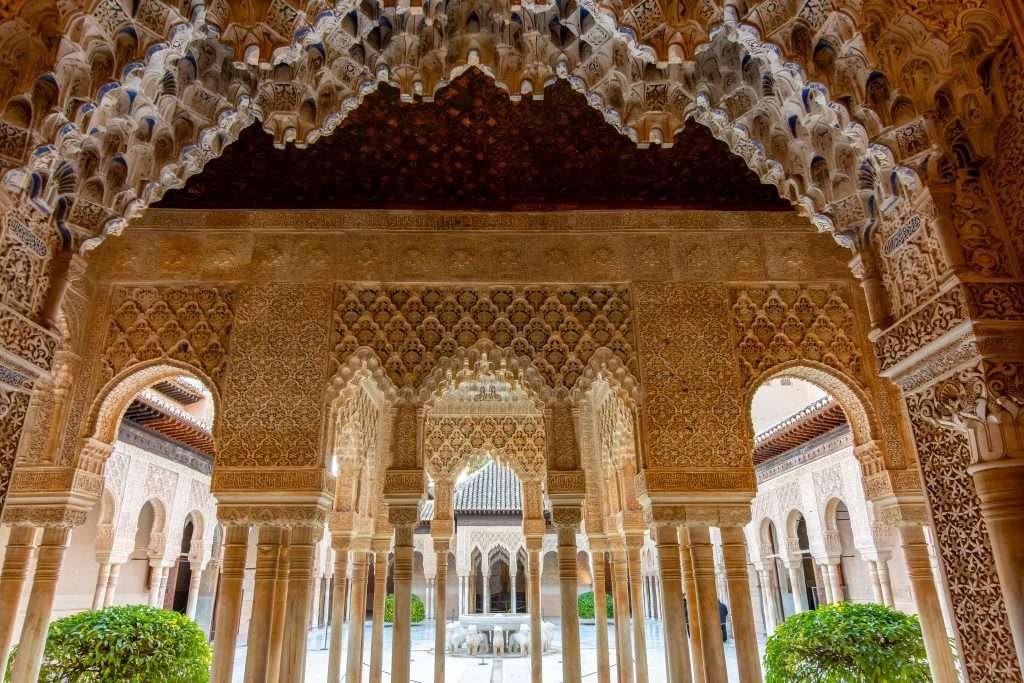
The Generalife – The Sultan’s summer retreat on an adjacent hill, connected by a bridge over a ravine. Known for its tiered gardens and irrigation channels.
The Partal – Terraced gardens and porches connecting the palaces to the upper complex. The Torre de las Damas reflecting pool is here and is largely ignored by the crowds rushing between the main attractions.
Free zones – The Palace of Charles V, the Alhambra Museum, and the main thoroughfare (Calle Real) require no ticket. If you failed to get a ticket entirely, you can still walk through the Gate of Justice and explore the exterior footprint of the fortress.

Getting Up the Hill: Three Options
The Cuesta de Gomérez (Walking) – Start at Plaza Nueva and walk straight up. Through the Gate of the Pomegranates, the path enters a dense elm forest with ancient irrigation channels running along the sides. It is a steep 15-20 minute climb with one major advantage: it deposits you at the Puerta de la Justicia, the back entrance, which is three minutes from the Nasrid Palace queue. If you are running late, this is your only option.
The Main Entrance (Taxi or Bus) – Taxis and the C30 minibus drop you at the main pavilion at the eastern end of the hill – a 15-20 minute walk from the Nasrid Palaces. If your palace time slot is at 10:00 AM and you arrive here at 9:50 AM, you will not make it. Only use this entrance if your slot is at least an hour away and you are starting with the Generalife.
The C30 or C32 Red Minibuses – Depart from Isabel la Católica square in the city center. €1.40 per ride, runs frequently. Useful if you want to preserve energy for the 10,000+ steps inside the complex.
The Nasrid Palaces: What You Are Looking At


Once the guards scan your passport and you cross into the Nasrid Palaces, the character of the place shifts entirely. The military stonework disappears. Everything here was designed to represent the Islamic concept of paradise on earth.
The Mexuar
The administrative wing, where the Sultan dispensed justice. After 1492, the Catholic Monarchs converted sections of it into a chapel, inserting their own heraldry directly over Arabic calligraphy. You can see exactly where one civilization ended and another asserted itself.
The Palace of Comares
Stand in the Patio de los Arrayanes (Court of the Myrtles) and notice the large rectangular reflecting pool. The Moors used water as an architectural mirror – the Comares Tower appears to float.
Inside the tower, in the Hall of the Ambassadors, look straight up. The domed ceiling is made of 8,017 individually cut pieces of cedar wood, joined without a single nail, representing the seven heavens of the Islamic cosmos. The craftsmanship is from the 14th century.
The Palace of the Lions

The most photographed section. A courtyard of 124 slender marble columns surrounds the central Fountain of the Lions – an alabaster basin resting on twelve stone lions that spout water. The columns appear fragile but have stood for 650 years.
Look at the ceilings in the Hall of the Two Sisters and the Hall of the Abencerrajes (the room where legend says an entire noble family was slaughtered – the rust-colored stain on the marble fountain basin is still visible). These ceilings are muqarnas: thousands of hanging plaster prisms cut to fracture light and create a sense of geometric infinite depth.
The walls throughout the palaces are covered in Arabic script. These are not decorative patterns – they are poems written specifically for each room by the Sultan’s viziers, praising the architecture and the ruler. Ibn Zamrak’s verses are still legible if you know where to look.
The Generalife: Water as Engineering
After the palaces, cross the bridge to the Generalife. This was the Sultan’s working agricultural estate and leisure retreat – built for seclusion, not diplomacy.
The Patio de la Acequia
A long, narrow pool flanked by crossing water jets. The continuous sound of the water was functional, not decorative: it masked private conversations from guards and servants walking nearby. Acoustic privacy in the 13th century.
The Water Staircase (Escalera del Agua)
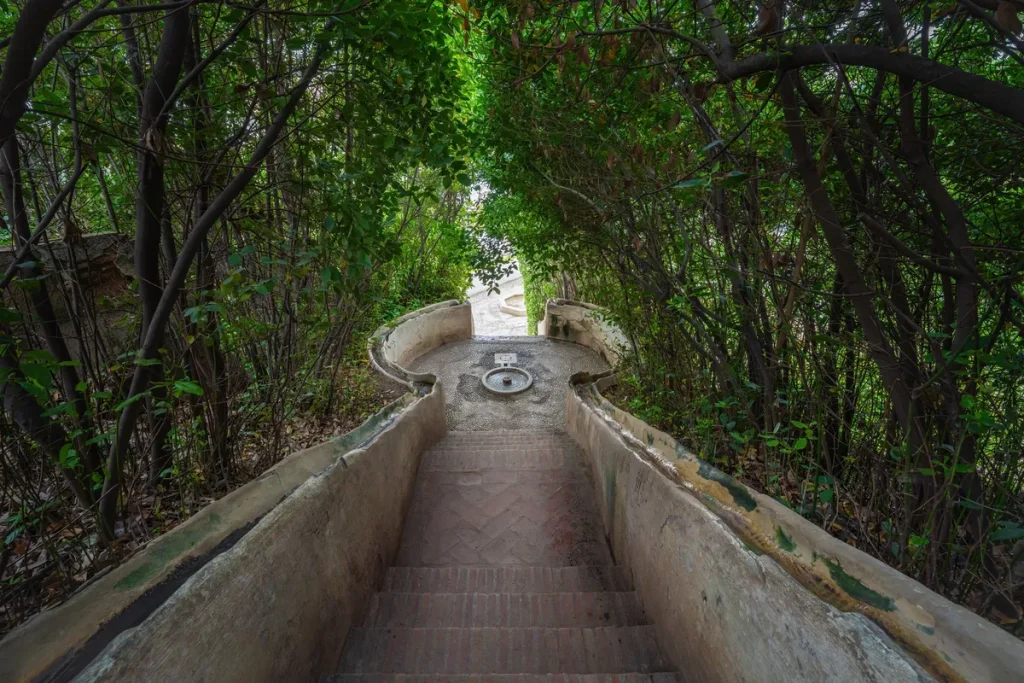
Climb to the highest shaded point of the gardens. The handrails of the staircase are not stone – they are open terracotta tiles channeling cold mountain water from the Sierra Nevada downhill. You can dip your hands in as you climb.
The Acequia Real
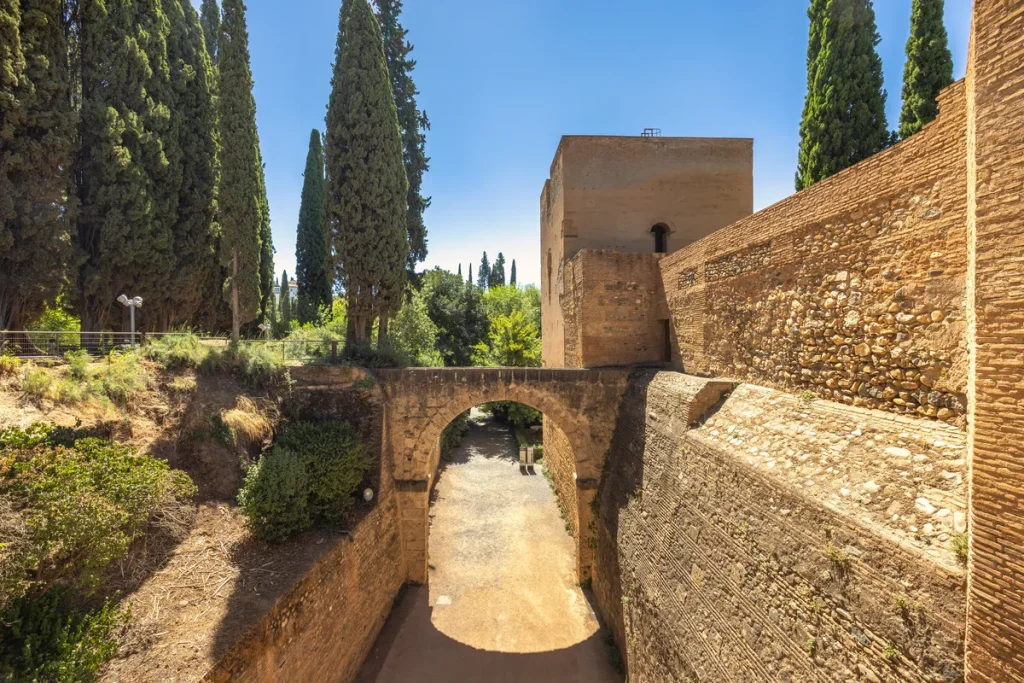
The most impressive engineering feat on the entire hill is invisible to most visitors. The Alhambra sits on an elevated, dry, rocky ridge. Every drop of water you see in the fountains and channels was diverted from the Darro River via an 8-kilometer canal built in the 13th century. The Moors used siphons, dams, and water wheels to push the water uphill against gravity. Without it, nothing here would exist.
The Alcazaba and the Palace of Charles V
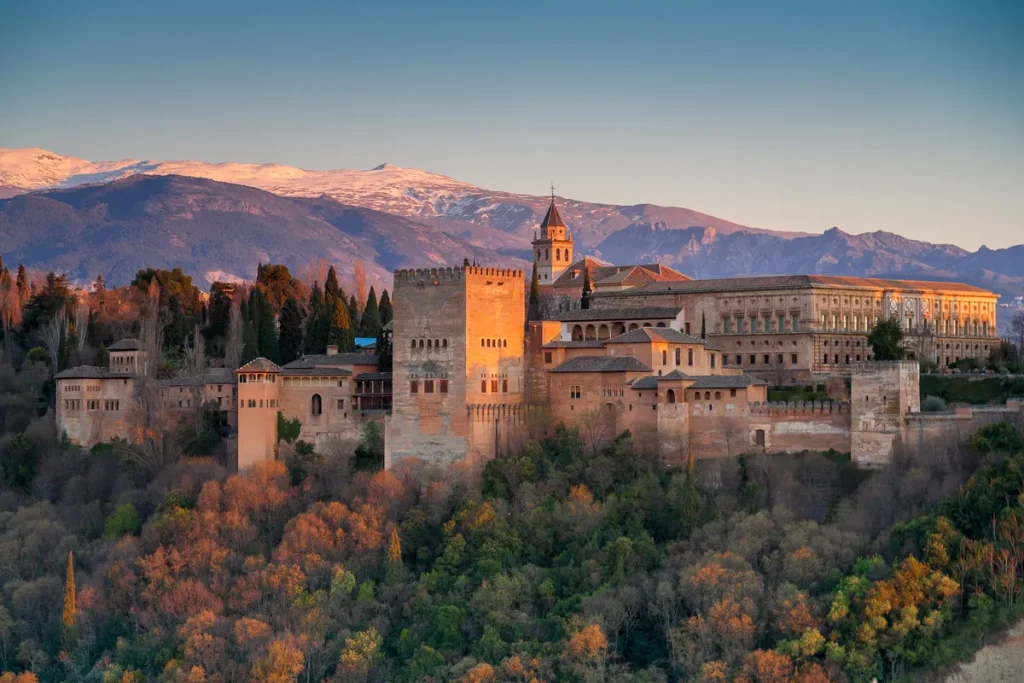
The Alcazaba
A working military garrison turned monument. Walk through the Plaza de Armas and look at the excavated barracks foundations. Then climb the Torre de la Vela (Watchtower) at the western tip – 360-degree views of the city, the Albaicín below, and the Sierra Nevada peaks behind. The massive bell in the tower was historically rung to signal irrigation shifts for farmers in the valley.
The Palace of Charles V
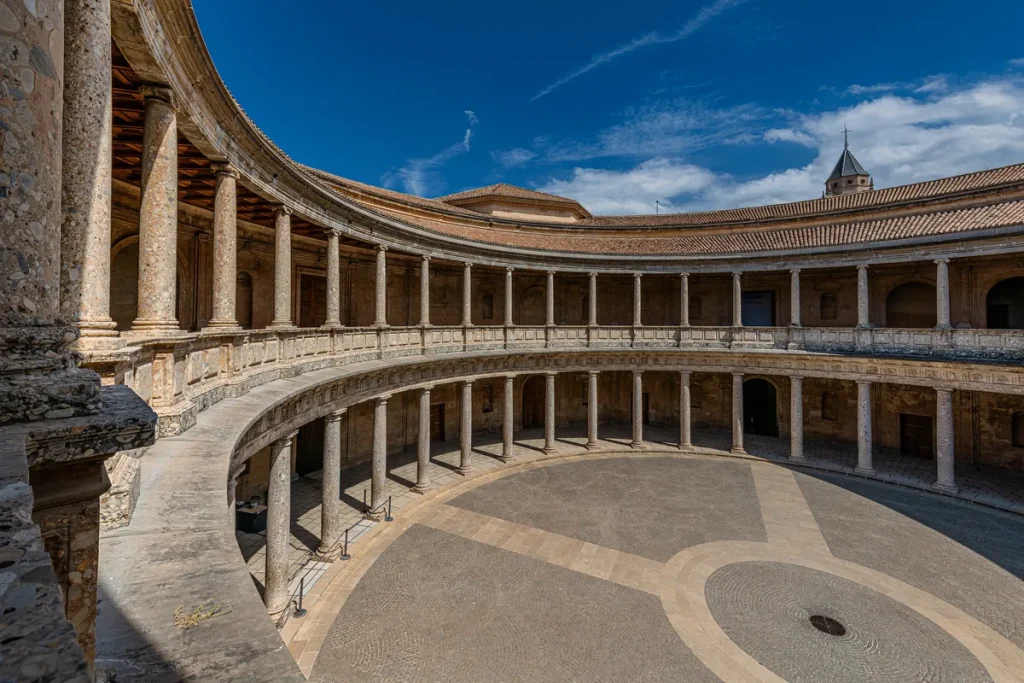
After the Reconquista, Charles V demolished part of the Moorish palace and built a square Renaissance structure here to mark the conquest. It is jarring – a heavy Roman stone block dropped into a world of delicate plasterwork and water.
The interior is a different story. The circular courtyard is near-perfect acoustically; stand in the exact center and speak normally. The Alhambra Museum inside holds the original ceramic Alhambra Vases and the carved wooden doors removed from the palaces for preservation.
The Night Visit
Night tickets (Visita Nocturna) are sold separately from daytime admission and have their own availability pool. You book either the Nasrid Palaces or the Generalife – not both on the same night.
The lighting inside the palaces at night uses warm, low-level sources hidden at the base of the walls, which emphasizes the three-dimensional depth of the plaster carvings in a way daylight does not. The Court of the Myrtles at night – the Comares Tower reflected in black water, the crowd reduced to a fraction of daytime capacity – is worth the separate booking.
Note: the night visit does not include the Alcazaba or the outer gardens, which close at dusk. You still need a daytime ticket for those.
Practical Rules
Food: No eating or drinking inside the Nasrid Palaces, the Generalife, or the Alcazaba. A guard will appear. Eating areas are located near the Palace of Charles V and the main entrance pavilion.
Water: Granada is high-altitude, the air is dry, and you will walk 10,000-15,000 steps. Stone drinking fountains throughout the exterior grounds dispense cold, safe mountain water. Bring a reusable bottle.
Shoes: 700-year-old river stones, slick marble, uneven dirt paths. High-quality walking shoes only. Flip-flops will become a problem within two hours.
Sun: The Alcazaba and upper Generalife have almost no shade. In July and August, the afternoon sun is extreme. Use the thick-walled, water-cooled Nasrid Palaces as a thermal break during peak heat (usually 1:00-4:00 PM).
Photography: Permitted almost everywhere. Tripods, monopods, and selfie sticks are banned. Large backpacks must be worn front-facing inside the Nasrid Palaces to avoid backing into 14th-century stucco. Do not touch the plasterwork or tiles – skin oils cause permanent damage.
Strollers: Security will direct you to check it at the free locker near the Puerta del Vino (Wine Gate) before entering the Nasrid Palaces. Use a wearable carrier instead.
FAQs
How much time do I actually need?
A minimum of three to four hours covers the Nasrid Palaces, the Generalife, the Alcazaba, and the Palace of Charles V without feeling rushed. History and architecture enthusiasts should block five to six hours. Check the 3 days in Granada itinerary to see how to build the Alhambra into a full trip without cramming.
Should I book a guided tour or use the audio guide?
If you have a strong interest in history, a guided tour is worth it. The Alhambra is complex and the on-site placards are minimal – a good guide explains the geometry and translates the Arabic poetry carved into the walls. On a tighter budget, the official Alhambra app’s audio guide is comprehensive and lets you move at your own pace.
What happens if I miss my Nasrid Palace time slot?
You are denied entry to the palaces permanently. You can still see the Generalife and the Alcazaba on your ticket, but you have missed the main attraction. No refunds, no standby. Be at the palace gate 15 minutes before your slot.
Is there a dress code?
No religious modesty requirement. Shorts and tank tops are fine. Prioritize sun protection and comfortable shoes over everything else.
Can I bring a baby stroller?
You will be directed to check it at the locker near the Wine Gate before entering the palaces. The Alhambra is a medieval maze of steep stairs, narrow doorways, and uneven cobblestones. A wearable carrier is the practical solution.