
Valencia on a budget is entirely achievable if you avoid the specific corridor of cruise-ship-priced restaurants surrounding the Cathedral. While the historic center operates on a tourist economy, three streets away the city functions on a local one. This guide breaks down how to navigate Valencia on a budget, from timing your paella orders to using the “sunken” highway that cuts through the city for free.
The tourist pressure is concentrated in a specific corridor – the Plaza de la Reina, the Cathedral, and the blocks immediately surrounding the Mercado Central. Cruise ship passengers flow through this area daily and the restaurants price accordingly. Three streets away, the city operates on a completely different economy.
This guide covers both realities: where the money goes unnecessarily, and how to avoid it. For the full picture of what Valencia offers and how to sequence your days, our first time in Valencia guide and 25 best things to do in Valencia cover the logistics alongside this.
The Paella Rules: How Not to Get Scammed
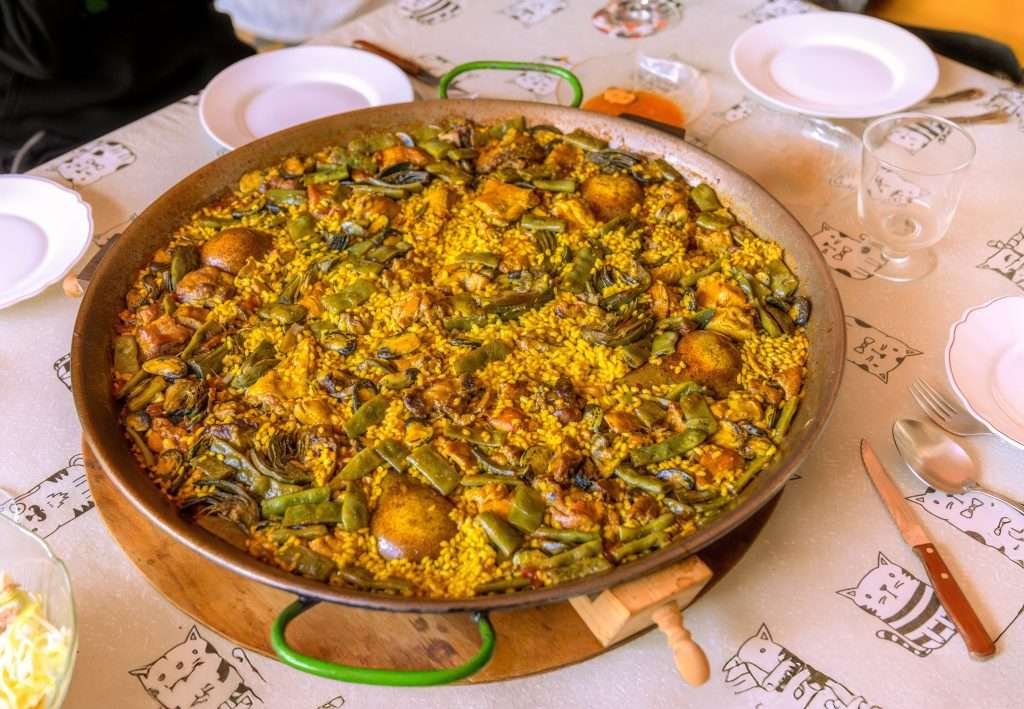
You are in the city that invented paella. You must eat it here. You must also understand that the tourist restaurants in the historic center know foreigners do not know the rules, and they price accordingly.
Three things that determine whether you are eating the real thing:
1. The ingredients
Authentic Paella Valenciana contains chicken, rabbit, flat green beans (bajoqueta), butter beans (garrofón), saffron, and sometimes snails. It does not contain seafood. It does not contain peas. It absolutely does not contain chorizo – adding chorizo to a Valencian paella is treated locally as a culinary offense of the highest order. If you want seafood rice, you order Paella de Marisco or Arroz del Senyoret, but you do not call it Paella Valenciana.
2. The time
Locals eat paella for lunch only, between 2:00 PM and 4:00 PM. It is considered too heavy to eat before bed. Any restaurant actively advertising paella for dinner at 8 PM is targeting tourists.
3. The cooking time
A real paella takes a minimum of 40 minutes from order to table. The rice has to absorb the broth slowly to form the socarrat – the caramelized crust at the bottom of the pan that is the most prized element. If your paella arrives in 10 minutes, you have paid €20 for reheated frozen rice.
The budget options:
- Menú del Día on Thursdays: Thursday is traditional paella day across Valencia. Go to a working neighborhood – Benimaclet, Ruzafa, or the streets around the train station – at 2:00 PM and look for chalkboards advertising the Menu of the Day. For €12-15 you get a proper plate of paella, a starter, dessert, and a drink.
- El Palmar: Take EMT Bus Line 24 out to El Palmar, the small village on the Albufera lake where paella was actually developed. The rice is grown in the surrounding fields. Competition between the chiringuitos here is fierce and the prices are noticeably lower than in the city center.
The Turia Park: Your Free Highway
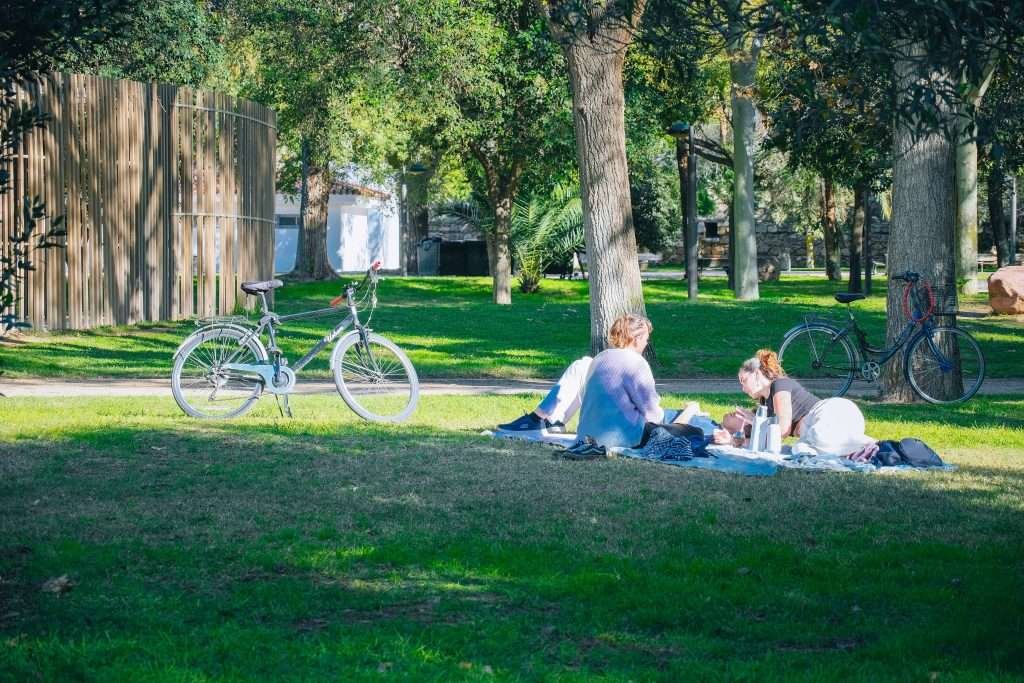


In 1957 a major flood hit Valencia. Rather than rebuild on the old riverbed, the city diverted the Turia River around the perimeter and transformed the 9-kilometer dried channel into a sunken linear park – the Jardín del Turia – that curves around the entire historic center.
This park is your primary transport corridor and it is completely free.
The bike strategy
Valencia is flat. It also has one of the best protected cycling networks in Europe. Rent a standard city bike from any rental shop (Valencia Bikes, Do You Bike, or similar) for roughly €10-15 for the full day. Drop into the Turia, ride under ancient stone bridges, through pine tree shade, and cross the entire city from the Bioparc in the west to the City of Arts and Sciences in the east – completely car-free and faster than surface traffic.
This also eliminates any need for taxis or ride-sharing apps within the city.
The City of Arts and Sciences: Free vs. Paid
At the eastern end of the Turia park stands the Ciudad de las Artes y las Ciencias – Santiago Calatrava’s white, skeletal, sci-fi complex of museums and performance spaces. It looks like nothing else in Europe.

What costs money: The Oceanogràfic (aquarium), Hemisfèric (IMAX cinema), and Science Museum. Combined tickets exceed €40 per person.
What costs nothing: Everything outside the buildings.
- The massive turquoise reflecting pools that surround the complex – walk directly up to the water’s edge
- L’Umbracle – the open-air ribbed structure on the southern edge, a free botanical garden of Valencian flora and palm trees with contemporary sculptures throughout
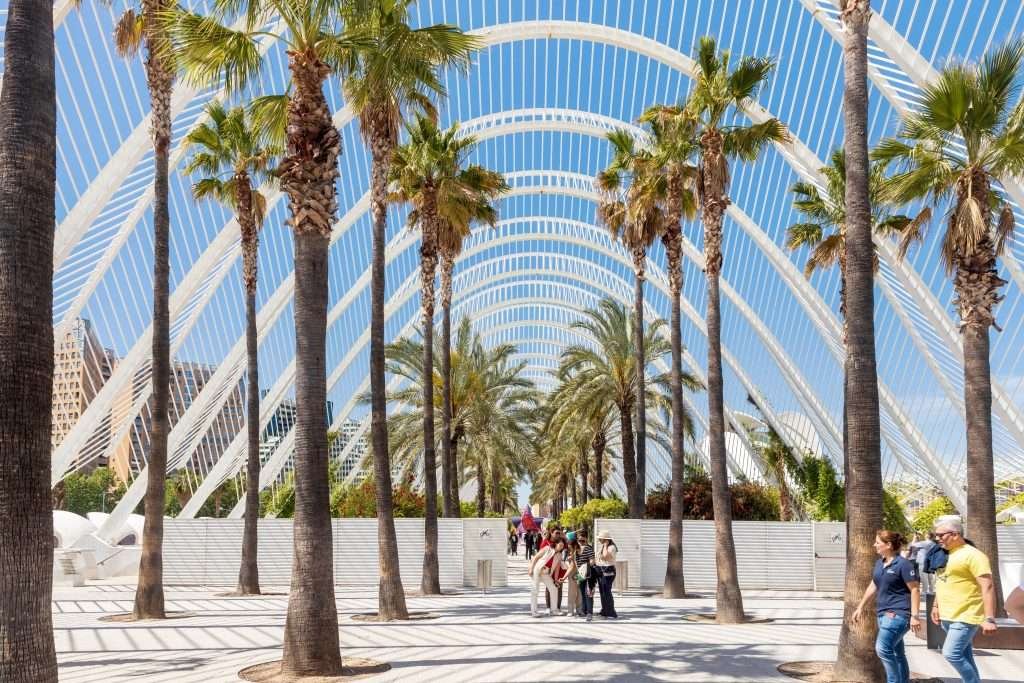
- The full exterior architecture, which is the actual draw for most visitors
Timing: Do not come at 2 PM in summer – the white concrete reflects the heat intensely. Bike here at 7 PM. The golden hour light on the buildings is the best photography the city offers, and it costs nothing.
The Mercado Central: Market Picnic Strategy
Skip the hotel breakfast. The Mercado Central is one of the largest active food markets in Europe, housed in a 1920s Valencian Art Nouveau building. Entry is free. It is open Monday to Saturday, 7:30 AM to 3:00 PM.
The picnic build (feeds two, costs roughly €12):
Go to a bakery stall: fresh crusty bread, €1. Go to a charcutería stall: 100g of sharp Manchego and 100g of Jamón Serrano or chorizo, €5-7. Go to the fruit section: two large Valencian oranges or a punnet of strawberries, €2. Go to an olive stall: a container of garlic-stuffed green olives, €2.
Walk 10 minutes to the Turia park, sit under a palm tree, and eat better than most cafes in the tourist zone will feed you for three times the price.
Note: The market closes completely at 3 PM. Arrive in the morning.
Sunday Museum Loopholes
The Valencian regional government mandates free entry windows at major cultural institutions. Four worth knowing:
Museo Fallero (The Fallas Museum)

Every March, Valencia spends millions building enormous satirical statues (ninots) for Las Fallas, only to burn them all in a single night. The Museo Fallero houses the one statue saved from the flames each year since 1934 – the “pardoned” ninot. Essential for understanding why this city is the way it is.
- Free: All day Sundays and public holidays
La Almoina (Underground Roman City)

Directly behind the Cathedral. You walk on suspended glass floors above the excavated ruins of the original Roman settlement from 138 BC – baths, thermal complexes, layered foundations showing every civilization that built over the last one.
- Free: Sundays and public holidays, 10:00 AM to 2:00 PM
IVAM (Valencian Institute of Modern Art)

Large industrial galleries with contemporary and modern art exhibitions. High-quality programming that changes regularly.
- Free: Saturdays 3:00 PM to 7:00 PM, and all day Sundays
Palacio del Marqués de Dos Aguas

The most photographed building in Valencia. The exterior is a violently ornate Rococo alabaster facade – faces, figures, and decoration layered to the point of visual overload. Inside: the National Museum of Ceramics.
- Free: Saturdays 4:00 PM to 8:00 PM, Sundays 10:00 AM to 2:00 PM
Airport Transit
Land at Valencia Airport (VLC, Manises) and ignore the taxi rank. A cab to the historic center costs a flat rate of around €25.
The Metro:
The airport has its own dedicated Metro station beneath the terminal. Walk downstairs to the red kiosks. Buy a SUMA Card (the unified transit card, €1 for the card itself), then load a single Zone AB ticket – total cost around €4.80. Take Line 3 (Red) or Line 5 (Green) directly into the historic center – Xàtiva or Colón stations in 20 minutes. You save €20 before you reach your hotel.
Once in the city, the historic center is pedestrianized and you will primarily walk or cycle. A 3-day unlimited transit pass is only worthwhile if you are staying in the suburbs or making multiple daily beach trips.
Where to Sleep
The premium for staying next to the Mercado Central or Plaza del Ayuntamiento is real. Three cheaper alternatives:
Ruzafa
South of the train station. Gentrified but still significantly cheaper than Ciutat Vella. Craft bars, good restaurants, wide streets. Walking distance to the center, bike distance to everything else. The best balance of location and price for most visitors.
Benimaclet
North of the Turia, a former independent village absorbed by the city and now heavily student-populated. Dirt cheap tapas bars, €1.20 coffees, authentic neighborhood feel. 15 minutes by tram or bike to the center. The best option for strict budgets.
El Cabanyal
The historic fishermen’s quarter directly behind Malvarrosa beach. Streets of small houses covered in colorful ceramic tiles, a neighborhood in active revival, cheap guesthouses and seafood tapas immediately outside your door. Base yourself here if beach access matters more than museum proximity.
The Beach: What Actually Costs Money

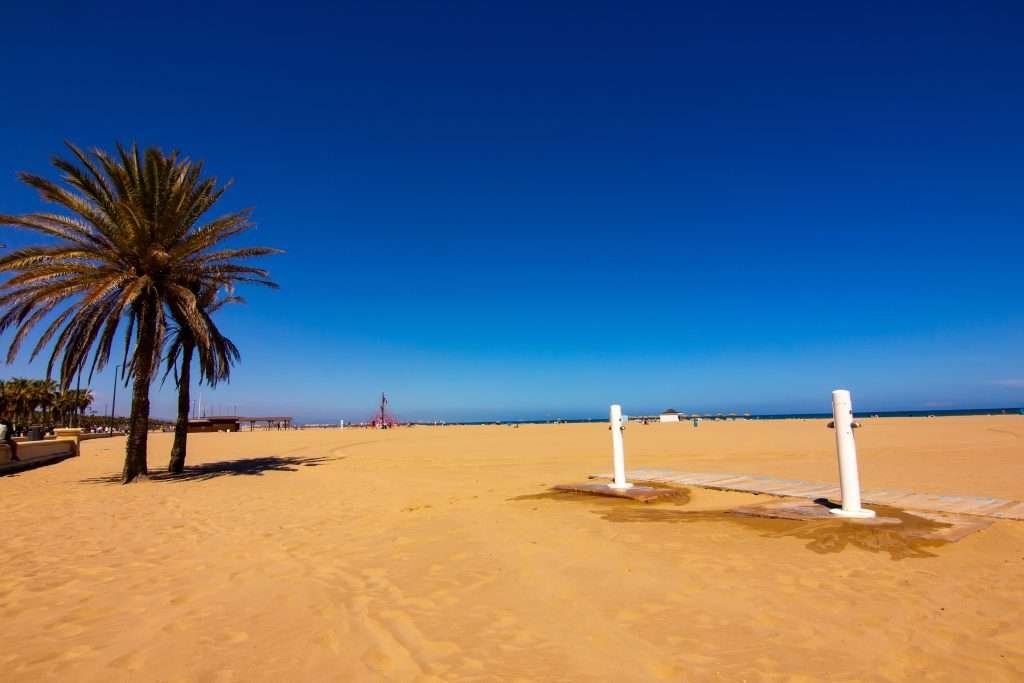
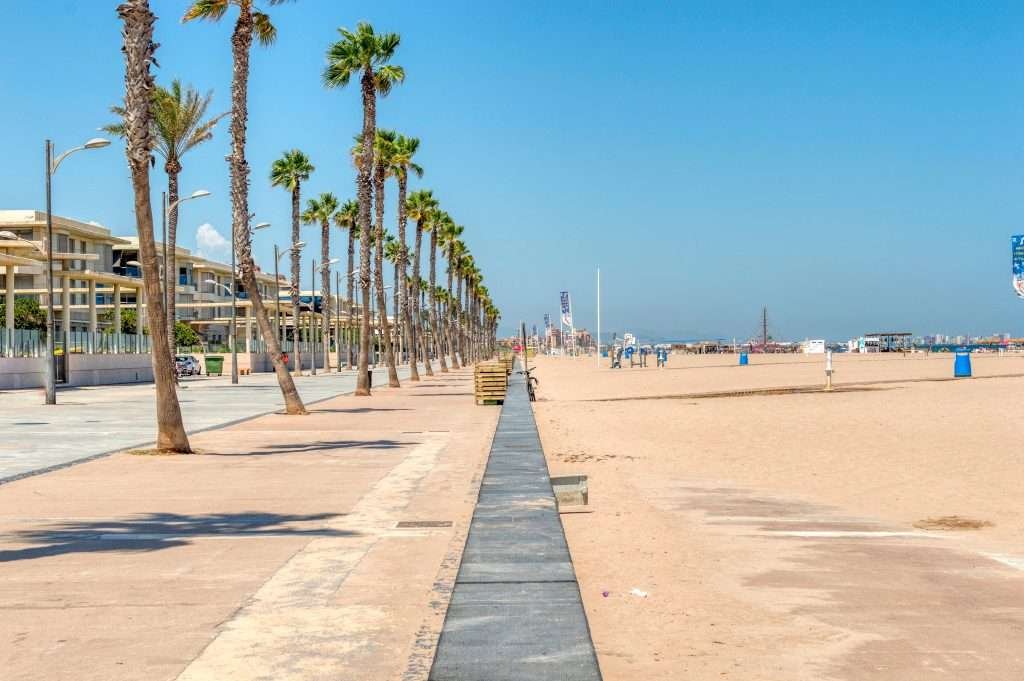
Valencia’s beaches – Playa de la Malvarrosa and Playa de las Arenas – are inside the city limits and free to access. The sand and the Mediterranean Sea cost nothing.
The sun lounger trap: The boardwalk is lined with hamacas – rented sun loungers at €6-15 per day. All Spanish beaches are public property by law. Walk past the lounger section and put your towel directly on the sand.
The beach drinks trap: Cocktails from beach club waiters on Malvarrosa run at premium prices. The move: stop at a Consum or Mercadona supermarket before taking EMT Lines 19 or 32 to the beach. Buy cold beers and snacks. A full beach day including food and drink stays under €6.
For a slightly quieter, less tourist-facing beach, walk 15 minutes north up the sand to Playa de la Patacona.
FAQ
What is Agua de Valencia and should I drink it?
The city’s local cocktail: fresh orange juice, cava, vodka, and gin. It tastes like juice and has the alcohol content of a strong mixed drink. Order a pitcher to split. Respect it.
Is the tap water drinkable?
Yes, though Valencia has very hard water – high mineral content. It is safe but does not taste great. Asking for agua del grifo at restaurants is fine and saves money.
Do I need to tip?
No. Leave small change after a good sit-down meal if you want to – never more than rounding up the bill.
When is the worst time to visit on a budget?
March 15-19 during Las Fallas. Hotel prices quadruple, the city fills completely, and streets are blocked for bonfires and fireworks. An extraordinary festival if you budget for it; impossible on a tight budget.
How far is Valencia from Madrid and Barcelona?
High-speed AVE or OUIGO from Madrid to Valencia (Joaquín Sorolla station): 1 hour 50 minutes. From Barcelona: around 3 hours via the Euromed coastal route. Book both on Renfe well in advance – prices surge significantly in the week before travel.